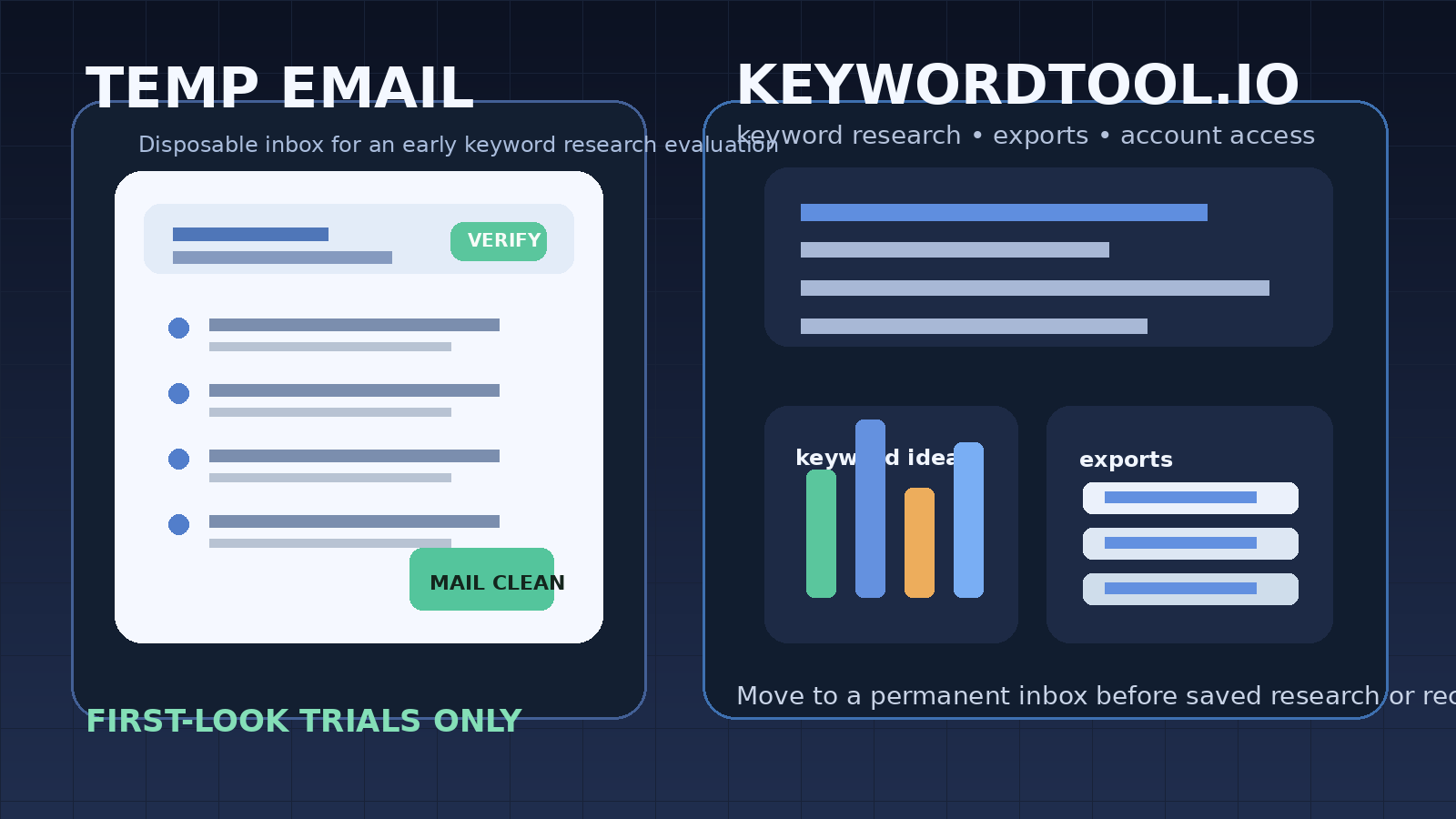
A temp email for KeywordTool.io can be useful for a quick trial when you only need signup verification and a first look at keyword research workflows, but it becomes risky once you want to keep saved research, exports, recovery options, or long-term account access.
Use a temporary inbox for early evaluation, then switch to a permanent address before the account becomes part of real SEO work.
Why people look for a temp email for KeywordTool.io
Keyword research tools often ask for an email address before they unlock onboarding, reports, export options, or product walkthroughs. That is normal, but it also means one quick test can turn into a stream of welcome emails, reminders, upsell messages, webinar invites, and follow-up outreach. If you compare several SEO tools in the same week, your regular inbox can fill up with noise before you decide which product is actually worth keeping.
That is why a disposable inbox can feel appealing. A temporary address from Anonibox or another similar service gives you a way to verify signup, get through the first login, and review the product without instantly handing over your long-term email address. In the early stage, that can be practical. The important part is knowing where the temporary email helps and where it starts to create more risk than convenience.
When a temporary inbox makes sense for KeywordTool.io
A temporary address is most useful when the account is still experimental. At that point, you are not trying to build a durable workflow yet. You are simply testing whether the product deserves more attention.
- checking whether the signup flow is simple or sales-gated,
- reviewing the first keyword research workflow,
- comparing KeywordTool.io with adjacent tools such as Keywords Everywhere, AnswerThePublic, AlsoAsked, Keyword Insights, LowFruits, Exploding Topics, or WriterZen,
- keeping one-off vendor messages out of your regular inbox,
- deciding whether the tool is useful enough to deserve deeper evaluation.
In those cases, the account is still low stakes. You need access, not commitment. You want a clean first look rather than a long-term relationship with every product you test.
When a temp email for KeywordTool.io becomes risky
The risk appears as soon as the account starts holding anything you would not want to lose or recreate. Keyword research platforms stop being disposable once they become part of real planning work.
A temporary inbox is a poor long-term choice if the account starts to matter for:
- saved research you plan to revisit later,
- exports you may need for briefs, content plans, or client work,
- repeat access across multiple work sessions,
- password resets, recovery emails, or account ownership checks,
- billing, procurement, or any longer evaluation that could turn into paid use.
Once the account becomes useful enough that losing inbox access would be frustrating, the disposable address has already outlived its safe purpose.
A practical way to use a temp email for KeywordTool.io
1. Generate the inbox before you start the signup
Create the temporary address first so every verification and onboarding email lands in one place. That makes the trial cleaner and easier to compare with other tools.
2. Use it for verification and the first product checkpoint
The best use case is narrow: confirm the account, inspect the dashboard, look at the first few keyword suggestions, and decide whether the workflow is promising. This stage is where a disposable inbox adds the most value.
3. Save important details outside the inbox
If you receive a verification link, onboarding note, or setup instruction you might need later, copy it into your own notes right away. A temporary inbox is not a dependable archive. It is a short-term access tool.
4. Judge the product by research value, not by the email sequence
Some vendors send polished onboarding campaigns. Others barely send anything. That matters far less than whether the product helps you find usable search terms and organize your research in a way that saves time.
5. Switch to a permanent address before the account becomes real work
The best time to move off a temporary inbox is early, before you build real dependency on the account. If you already know you want to keep returning to the research, exporting ideas, or using the tool in planning, do not wait until recovery becomes a problem.
What to evaluate during a KeywordTool.io trial
If you are going to spend time inside the product, focus on the parts that affect actual usefulness rather than just the novelty of getting access.
How quickly you can move from idea to shortlist
A strong keyword research tool should help you move from a broad topic to a workable shortlist without drowning you in clutter. During the trial, pay attention to whether the workflow feels direct or bloated.
Whether the suggestions are actually usable
Volume alone is not enough. The real test is whether the results feel relevant to the audience you serve and specific enough to support content decisions. If the output is full of weak or repetitive terms, the tool may not deserve a place in your stack.
How well the workflow supports prioritization
Good keyword research is not just discovery. It is also sorting. You should be able to tell which ideas are interesting, which ones are practical, and which ones are probably not worth writing about. If the tool does not make prioritization easier, that is a useful signal.
Whether you start caring about keeping the work
This is the turning point for the email decision. The moment you start thinking, “I do not want to lose this research,” the account is no longer disposable in practice. That is when long-term access matters more than short-term inbox convenience.
How likely you are to come back and export results
Many keyword tools feel most useful after the first session, when you return to refine, compare, or export ideas. If you can already see yourself doing that, it is smarter to migrate to a stable address sooner rather than later.
Why a disposable inbox is weak for ongoing keyword research
Keyword research is often iterative. You do not always solve everything in one session. You come back later, compare topics, check priorities, revisit earlier ideas, and decide which terms deserve briefs or production. That kind of repeated use works better when account access is stable.
A temporary inbox works against that once the account begins to matter. If the inbox expires or goes unattended, you may lose recovery access, miss important account messages, or create friction around reconnecting to the same work later. The tool itself may still be useful, but the account setup becomes weaker than it needs to be.
This matters even more if your research starts feeding client work, team planning, or a broader editorial process. The whole point of using a disposable inbox is to keep the evaluation stage clean. It stops being helpful once it threatens continuity.
Common mistakes people make
- Leaving the temporary address attached too long: they mean to switch later, then forget until the account already contains useful work.
- Using one throwaway inbox for every tool: that cancels a lot of the organizational benefit and makes follow-up harder to track.
- Confusing trial access with long-term ownership: early access is one thing; stable account management is another.
- Saving important research before fixing the email setup: if the work matters, the recovery path matters too.
- Evaluating the vendor based on the emails instead of the product: the real question is whether the tool improves your research workflow.
A better rule: temporary first, permanent later
The cleanest strategy is simple. Use a temporary inbox for low-commitment testing, then promote the account to a real email address once the product proves useful. That gives you the privacy and inbox-control benefit of a disposable address without pretending the whole account should stay disposable forever.
That is where Anonibox fits naturally. It is useful for protecting your main inbox during the first-pass trial stage, especially if you are comparing several SEO tools at once. But once KeywordTool.io becomes tied to saved research, exports, repeated use, or account recovery, a stable email address is the smarter foundation.
Quick checklist before you sign up
- Is this only a first-look evaluation?
- Would it be acceptable if you lost easy access to the inbox later?
- Do you mainly need signup verification and a short testing window?
- Are you still comparing options rather than committing to one tool?
- Has the account stayed free of important saved work, billing, or repeated workflow dependency?
If most of your answers point to a short exploratory test, a temporary inbox is reasonable. If the account is already drifting toward real use, switch to a permanent address early.
Final answer
Yes, a temp email for KeywordTool.io can be a smart move for an early keyword research trial when you only want to verify the account, inspect the workflow, and avoid long-term vendor email clutter.
No, it is not the best long-term setup once the account starts holding saved research, exports, recovery value, or repeated access needs. Use the disposable inbox for the first look, then move to a stable address before the work becomes important.