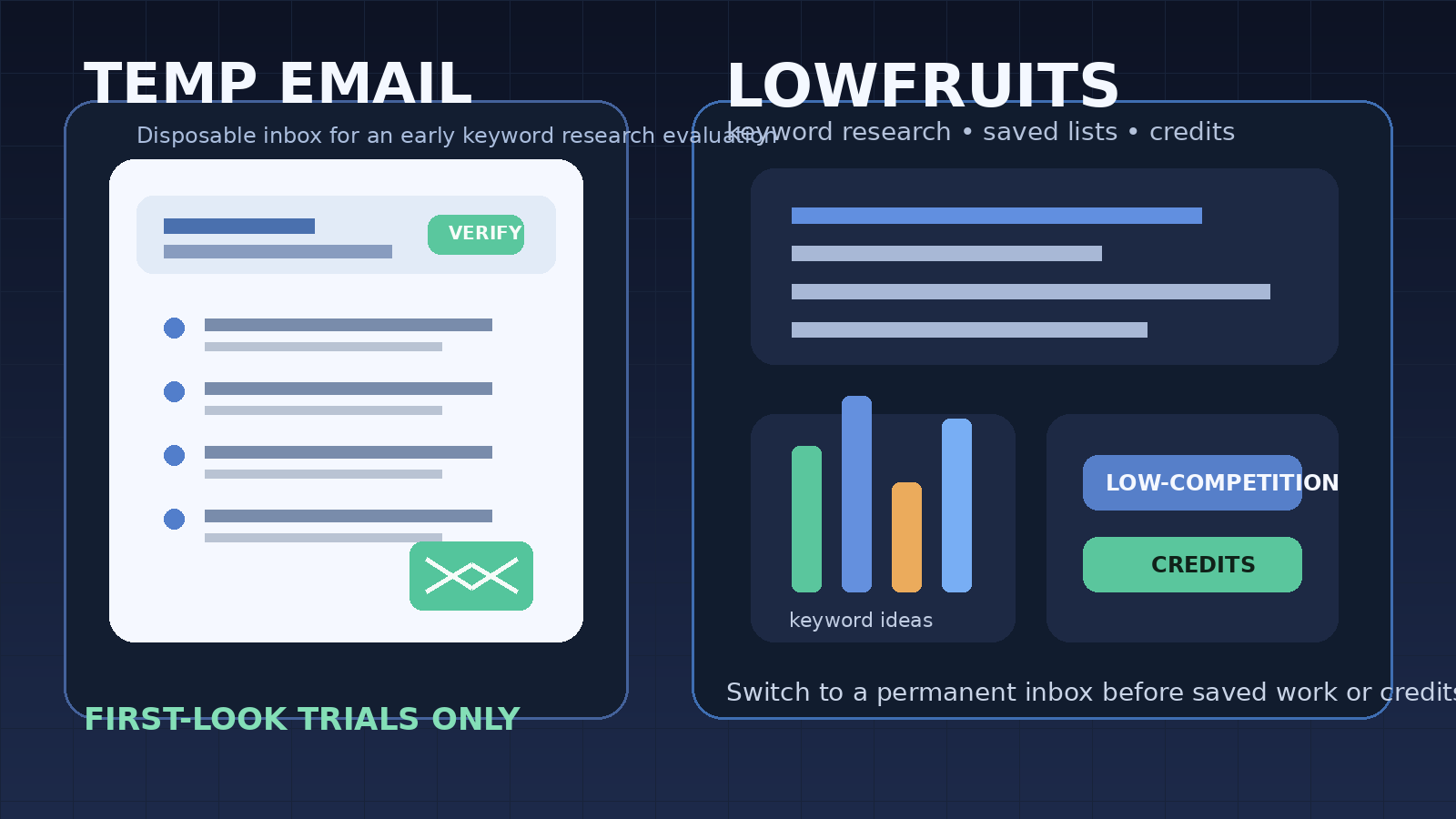
A temp email for LowFruits can work for a first-pass evaluation when you only need signup verification and a quick look at the keyword research workflow, but it becomes risky once saved lists, credits, exports, or shared access start to matter.
Use a temporary inbox for the early checkpoint, then move to a permanent address before the account becomes part of real research work.
Why people look for a temp email for LowFruits
Keyword research tools usually ask for an email before they unlock the dashboard, trial access, onboarding, or follow-up guidance. That is normal, but it also means one quick product check can start a longer stream of welcome emails, product nudges, sales follow-up, and promotional reminders. If you compare several SEO tools in the same week, your regular inbox can get noisy fast.
That is why some people look for a disposable inbox. Anonibox or another temporary address gives you a clean way to verify the account, review the first product flow, and keep an early test separate from your long-term inbox until you know whether the tool is worth keeping.
For LowFruits specifically, the appeal is easy to understand. You may want to see whether the workflow fits your process for finding lower-competition topics, reviewing SERP data, grouping keyword opportunities, and deciding whether the tool deserves a place in your research stack. At that stage, privacy and inbox control matter more than long-term account ownership.
When a temporary inbox makes sense for LowFruits
A temporary email is most useful during the earliest evaluation phase, when the account is still disposable in practice. That can include:
- checking whether the signup flow is smooth,
- seeing how the dashboard presents keyword opportunities,
- comparing LowFruits with adjacent tools such as Keyword Insights, Keywords Everywhere, AnswerThePublic, AlsoAsked, Exploding Topics, or WriterZen,
- keeping an exploratory test out of your main work inbox,
- deciding whether the product is even relevant before giving a vendor your permanent address.
In short, a temp inbox is reasonable when you are still asking, “Is this worth deeper attention?” It helps you access the product without instantly turning a one-off test into a long-term communication channel.
When a temp email for LowFruits becomes risky
The downside appears as soon as the account starts holding anything you would actually care about losing. Keyword research tools stop being disposable the moment they become operationally useful.
A temporary inbox is the wrong long-term choice if the account begins to matter for:
- saved keyword lists or organized research projects,
- credits or account-based usage you may want to preserve,
- exports, notes, or recurring research workflows,
- team collaboration or shared access,
- password resets, account recovery, billing, or admin notices.
If the account is now storing work you would not want to rebuild, the temporary inbox has already outlived its safe purpose. At that point, convenience turns into fragility.
A practical way to use a temp email for LowFruits
1. Generate the temporary inbox before you open the signup form
Do this first so every verification message and onboarding email lands in a clean, isolated place. That keeps the trial organized and makes it easier to compare multiple tools without mixing their messages together.
2. Use it only for verification and the first product checkpoint
The best use case for a disposable inbox is the first-look stage: account confirmation, the welcome email, maybe a quick-start guide, and your first session inside the product. You are not committing yet. You are just deciding whether the workflow is promising enough to keep evaluating.
3. Save the important messages immediately
If you need a verification link, first-login instructions, or any setup note that could matter later, copy it into your own notes right away. A temporary inbox should not be treated like a permanent archive. It is a short-term access tool, not a reliable knowledge base.
4. Judge the product by research value, not by the email sequence
Some vendors send polished onboarding. Others send almost nothing. That detail matters far less than whether the tool actually helps you find usable opportunities. Focus on the workflow, the relevance of the keyword ideas, and whether the output is practical enough to influence real content decisions.
5. Switch to a permanent address before the account becomes real work
The best time to move off a temporary inbox is early, before the account owns something valuable. If you already know you want to keep saved lists, preserve credits, or revisit the same projects later, make the switch sooner rather than later.
What to evaluate during a LowFruits trial
If you are going to spend time inside the tool, evaluate the parts that will affect actual day-to-day usefulness rather than getting distracted by the novelty of the signup flow.
How fast you can get from idea to useful keyword shortlist
A good keyword research tool should reduce friction. You should be able to move from a seed topic to a shortlist of genuinely interesting opportunities without feeling buried in clutter. If every search creates more noise than insight, the trial is already telling you something important.
Whether the suggestions feel actionable
Useful keyword research is not just about volume. It is about whether the suggestions are specific enough to support content decisions. Look for queries that are understandable, relevant to your audience, and realistic for your site instead of just technically “low competition” on paper.
How well the workflow supports prioritization
The best tools help you separate “interesting” from “worth publishing.” During the trial, notice whether it is easy to save, compare, and prioritize keyword ideas. If the workflow makes you lose track of what matters, that becomes more painful over time.
How much you would care about saved work disappearing
This is the turning point for the temp-email decision. If you start building lists you want to revisit, grouping ideas for future briefs, or spending enough time that redoing the work would be annoying, you should no longer treat the account as disposable.
Whether credits, limits, or exports become part of the value equation
Many research tools become more important once usage limits, exports, or account-based access enter the picture. If credits matter, the inbox tied to the account matters too. You do not want a useful paid or semi-persistent workflow hanging off an address you never meant to keep.
Why a disposable inbox is weak for ongoing keyword research
Keyword research is often iterative. You do not always solve everything in one session. You might return to the same topics later, compare ideas against performance data, revisit saved lists, or hand opportunities to a teammate. That kind of ongoing work benefits from continuity.
A temporary inbox works against that once the trial becomes a real workflow. If the inbox expires or goes unattended, you may lose recovery access, miss account notices, or create unnecessary friction around shared ownership. The product may still be useful, but the account setup becomes unstable for no good reason.
This matters even more if you are running several SEO experiments at once. The whole point of using a temporary address is to reduce clutter during early evaluation. It stops being helpful when it introduces account-management risk into a process that should be repeatable and organized.
A better rule: temporary first, permanent later
The cleanest strategy is simple: use a temporary inbox for low-commitment testing, then promote the account to a real address once the product proves useful. That gives you the privacy and inbox-control benefits of a disposable email without pretending the whole account should stay disposable forever.
That is where Anonibox fits naturally. It is helpful for the first stage, when you want to verify access, inspect the dashboard, and compare multiple tools without flooding your normal inbox. But once LowFruits becomes part of actual keyword research, a stable email address is the better foundation.
Quick checklist before you sign up
- Are you only doing a first-look evaluation?
- Will the account hold saved keyword lists you care about next week?
- Could credits, exports, or billing matter later?
- Will teammates need access or shared visibility?
- Are you just trying to keep several vendor trials out of your main inbox while you compare options?
If most of your answers point to a short exploratory test, a temporary inbox is reasonable. If the account is already drifting toward real usage, switch to a permanent address early.
Final answer
Yes, a temp email for LowFruits can be a smart move for a first-pass trial when you only want verification, a quick product check, and less inbox clutter.
No, it is not the best long-term setup once the account starts holding saved lists, credits, exports, recovery paths, or team access. Use the disposable inbox for the first look, then move to a stable address before the work becomes important.