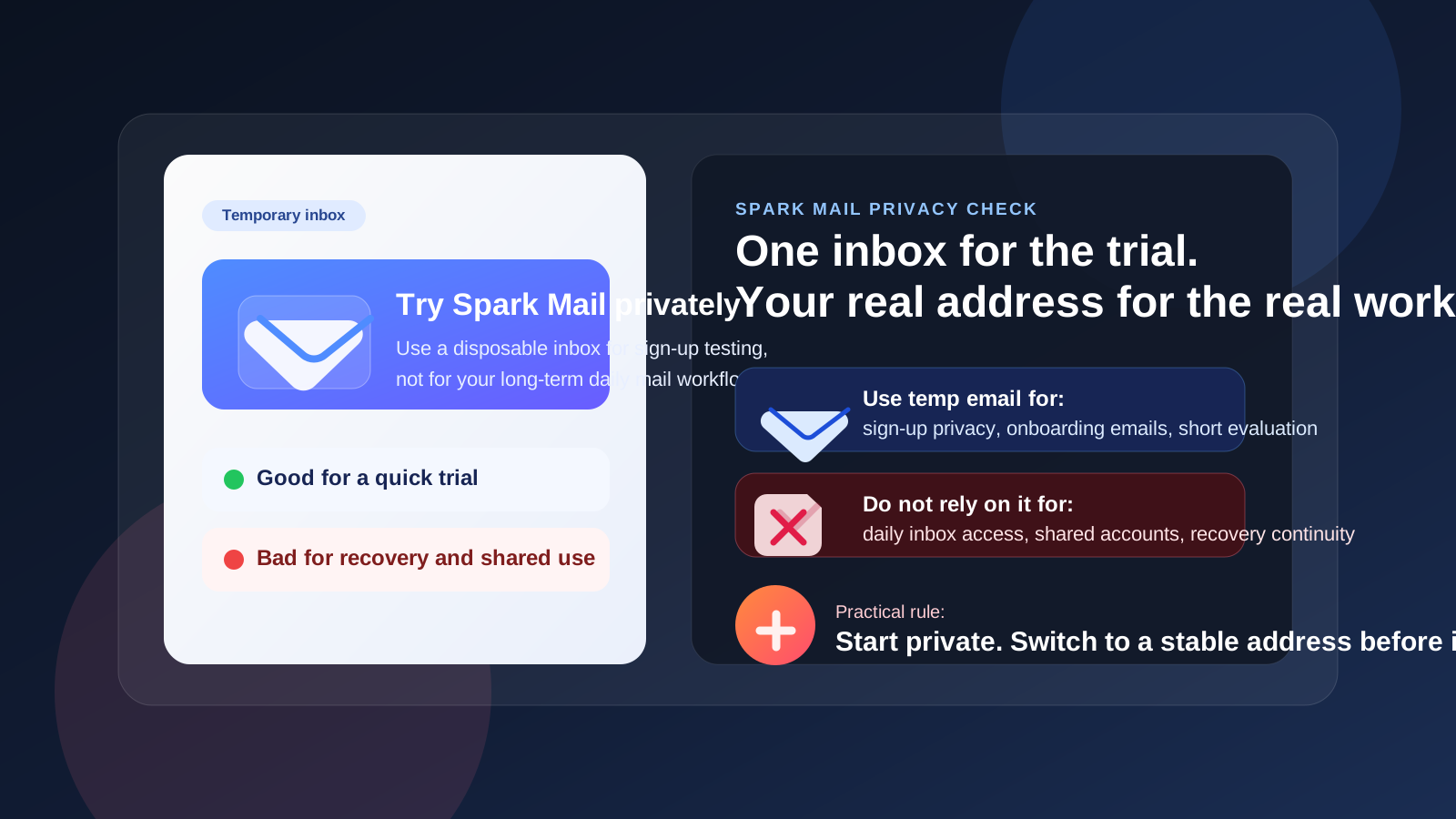
A temp email for Spark Mail is fine for private sign-up testing or a short product trial. It is a bad long-term choice once your daily inbox, shared accounts, or account recovery depend on that address.
If you only want to evaluate Spark Mail without handing your main address to another onboarding flow, a disposable inbox can help. If you plan to use Spark Mail as part of your real email setup, switch to a stable address before the account starts to matter.
Why people consider a temp email for Spark Mail
Spark Mail sits in a category where privacy choices can get messy fast. It is not just another newsletter signup or one-off SaaS dashboard. People often try Spark Mail because they want a cleaner inbox, better organization, easier account handling across devices, or a more focused daily email workflow. That makes the initial signup feel low-stakes, but the product can quickly become tied to real communication habits.
That is exactly why some people look for a temp email first. They want to:
- test the onboarding flow without adding one more company to their main inbox
- see whether the app fits their workflow before sharing a long-term address
- avoid sales or feature-update emails if they are only doing a quick trial
- compare Spark Mail against other email tools without creating lasting inbox clutter
That reasoning is completely fair. A temporary inbox can be a practical privacy layer during the evaluation stage. The mistake is assuming it stays practical after the evaluation stage ends.
Short answer: good for testing, bad for dependence
If your goal is just to create an account, receive the verification message, click around, and decide whether Spark Mail is worth your time, a temp email can work well.
If your goal is to make Spark Mail part of your real daily email life, a temp email is usually the wrong foundation. Once you care about account continuity, device access, collaboration, billing messages, security notices, and recovery options, disposable inboxes stop being a convenience and start becoming a liability.
When using a temp email for Spark Mail makes sense
There are a few situations where using a temporary inbox is a sensible move.
1. You are only testing the product
If you want to see how the interface feels, whether the setup is smooth, or whether the workflow clicks for you, a temporary address can help you get through signup without exposing your everyday address right away.
2. You are comparing several email tools at once
People often test tools like Spark Mail alongside other inbox apps and clients. In that phase, a disposable address can reduce clutter and keep all those trial messages away from your personal or work inbox.
3. You do not want long-tail marketing email from a trial
Even perfectly legitimate products often send onboarding messages, feature announcements, upgrade reminders, and return-to-product nudges. If you are not sure you will stick with the app, it is reasonable to avoid putting your real address into that stream on day one.
4. You are doing a quick privacy-first first look
Sometimes you simply want to answer one question: “Is this worth a deeper setup?” In that case, a disposable inbox can act as a buffer between casual curiosity and long-term account attachment.
When a temp email for Spark Mail becomes a bad idea
This is the part that matters more. Spark Mail becomes less like a casual signup and more like infrastructure once you keep using it. That is where a disposable inbox starts to break down.
You rely on the account across devices
If you install Spark Mail on your phone, laptop, and maybe a second machine, the account stops being temporary in practice. You need dependable access to sign-in messages, change notices, and account support communication. A throwaway inbox is shaky footing for something you may want to use every day.
You connect important real inboxes
Even if the Spark Mail account itself begins as an experiment, the product becomes more meaningful once you connect real email accounts to it. At that point, recovery and account continuity matter more than signup privacy.
You use team or shared features
If coworkers, collaborators, or shared workflows enter the picture, the cost of losing account access goes up. Disposable addresses are poor tools for anything that might need future invites, follow-ups, or account maintenance.
You expect to need recovery later
Many people underestimate this. They think, “I only need the temp inbox once.” Then a few weeks later they want to reset something, confirm a login, review an account notice, or prove ownership. That is where temporary inboxes fail most often: not on day one, but on the day you suddenly need them again.
What can go wrong if you keep the temp email too long?
The risks are not dramatic movie-plot risks. They are boring, practical, frustrating risks. Those are usually the ones that actually hurt.
- Lost recovery options: if you cannot access the original inbox anymore, account recovery becomes harder.
- Missed account notices: security alerts, device confirmations, or billing emails may go somewhere you no longer control.
- Broken continuity: what felt like a private trial becomes a messy migration later.
- Collaboration friction: if another person ever needs to coordinate around the account, a disposable address creates avoidable confusion.
- Poor recordkeeping: you may lose the paper trail for when the account was created, what settings changed, or which address owns it.
None of this means a temp email is “unsafe” in every case. It just means the tool is only good for one part of the lifecycle: the low-stakes beginning.
A smarter way to use a temp email with Spark Mail
If you want privacy and long-term sanity, the best move is to treat the temporary address as a first-step filter rather than a permanent identity.
Step 1: Use the temp email only for the initial evaluation
Create the account, receive the verification email, and spend some time understanding the product. Focus on whether Spark Mail actually suits your needs. Does it feel better than your current setup? Does it solve a problem you really have, or are you just collecting another app?
Step 2: Decide quickly whether the trial is serious
If Spark Mail is clearly not for you, stop there. That is the ideal temp-email use case: you learned what you needed to learn and you protected your main inbox from extra noise.
If it is for you, do not keep pretending the setup is temporary. Move the account to a stable address while the stakes are still low.
Step 3: Switch to a stable email before the account matters
Your stable address does not have to be your oldest or most personal inbox. It just has to be one you actually control and plan to keep. If you want a cleaner privacy boundary, use a dedicated long-term address rather than your main everything-address.
This is where Anonibox fits naturally: it is useful for reducing exposure during evaluation. It is not a magic substitute for stable account ownership when the tool becomes part of your real workflow.
Step 4: Save any important setup details
If Spark Mail ends up staying in your stack, keep a clear record of the account email you want tied to it. That way you do not end up months later asking yourself which address owns what.
Should you use a burner email, a permanent alias, or your main address?
For Spark Mail, those three options are not equally good.
Burner email
Best for: quick trials, curiosity, short product comparisons.
Worst for: anything you may need to recover, maintain, or use across devices over time.
Permanent alias or dedicated secondary email
Best for: users who want privacy separation without sacrificing continuity.
This is often the sweet spot. You still avoid handing over your most exposed primary address, but you keep control over recovery and long-term access.
Main address
Best for: people who already know Spark Mail will be part of a serious long-term workflow and do not mind the product living alongside other important account activity.
If you know you are all in, your main address is fine. If you are privacy-conscious or just want cleaner boundaries, a stable secondary address is often better.
Practical checklist before you decide
Ask yourself these questions before using a temp email for Spark Mail:
- Am I just testing Spark Mail, or do I already expect to keep using it?
- Will this account matter across multiple devices?
- Could I need the original inbox later for recovery or confirmation?
- Will I connect important personal or work email accounts?
- Would a stable privacy-focused address be smarter than a disposable one?
If most of your answers point toward ongoing use, skip the disposable inbox and use a stable address from the start. If your answers point toward a quick evaluation only, a temp email is reasonable.
Common mistake: confusing inbox privacy with account stability
A lot of people treat these as the same thing, but they are not. Inbox privacy is about reducing spam, marketing clutter, and unnecessary exposure. Account stability is about making sure you can still access and manage something later.
Temporary email is strong for privacy at the start. It is weak for stability over time. Once you separate those two goals, the decision gets easier.
Final answer
Using a temp email for Spark Mail makes sense if you only want a private, low-commitment trial. It does not make much sense if Spark Mail is going to become part of your everyday email setup.
The practical rule is simple: use a disposable inbox for the first look, then move to a stable address before account recovery, device access, collaboration, or daily workflow depend on it. That gives you the privacy benefit without creating a completely avoidable long-term mess.