Yes — using a temp email for Sprinto is a sensible way to verify a short compliance trial, inspect the platform, and keep early follow-up out of your main inbox.
It works best for evaluation, demos, and internal testing. Once the workspace starts holding real compliance work, shared ownership, or auditor-facing details, move the account to a permanent address you control.
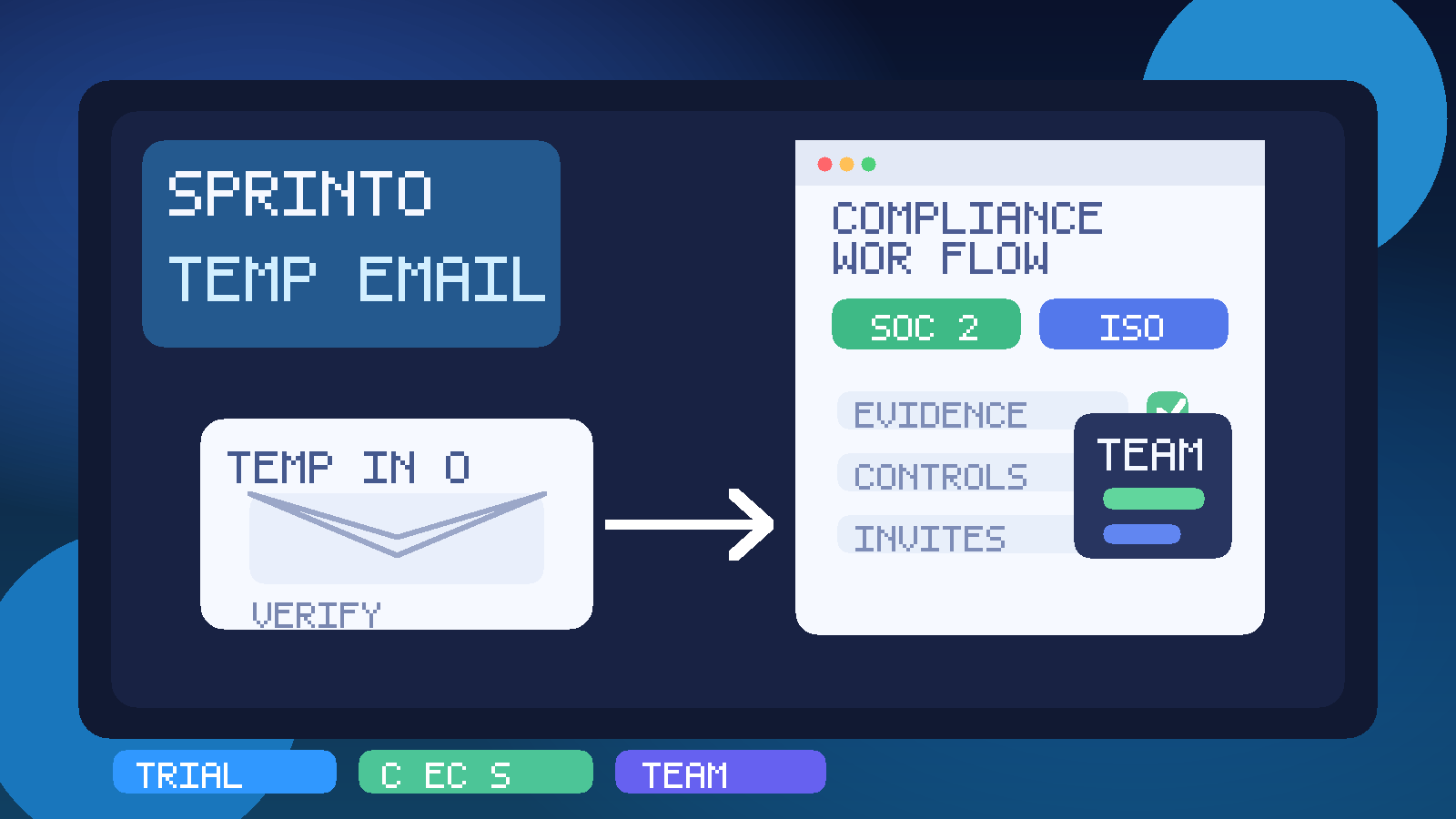
Why people use a temp email with Sprinto
Compliance tools create a very specific kind of inbox traffic. The first signup can trigger verification emails, onboarding sequences, integration prompts, evidence reminders, meeting nudges, team invite messages, and sales follow-up. None of that is inherently bad, but it can become noisy fast when you are only trying to answer a simple question: is this platform worth a deeper look?
That is why a temporary inbox can make sense during the earliest stage of evaluation. You still receive the confirmation link and the first-run instructions, but you keep that activity away from the mailbox you use for everyday work. If you like to separate exploratory signups from long-term accounts, a tool like Anonibox fits that workflow naturally.
When a temp email for Sprinto is a smart choice
A temp email is most useful when the account is genuinely temporary. Common examples include:
- reviewing the signup and initial workspace setup before involving the wider team,
- comparing Sprinto against other compliance automation platforms,
- checking how framework mapping, evidence collection, or task workflows look in practice,
- testing the invite flow for a small internal demo,
- keeping vendor follow-up out of your permanent security or operations inbox until you know the platform is a serious candidate.
In those situations, the temporary address is not about secrecy. It is about keeping early research organized and reversible.
When a temp email is the wrong choice
A temp inbox becomes a bad fit the moment the account stops being disposable. If the workspace starts to matter, the email attached to it needs to be stable too.
Avoid relying on a temp email for Sprinto if the account will be used for:
- ongoing compliance operations,
- real evidence collection tied to audits or reviews,
- shared ownership across security, engineering, finance, or leadership,
- billing, contracts, or renewal notices,
- security alerts and account recovery,
- anything that would become painful if the inbox later disappeared.
The rule is simple: temporary inbox for temporary evaluation, permanent inbox for durable ownership. Compliance platforms are especially important to get right because they often sit close to sensitive process documentation and cross-functional workflows.
How to use a temp email with Sprinto without creating problems later
1. Decide whether this is a trial or the beginning of a real rollout
Before signing up, be honest about your intent. If you already expect to connect internal systems, invite several stakeholders, and use the workspace as a real operating tool, start with a permanent address. If you are only evaluating the interface, workflow, and fit, a temporary inbox is reasonable.
2. Generate the inbox before you begin signup
Create the temporary address first so every verification and onboarding message lands in one place. That usually includes the initial confirmation email, a welcome sequence, and whatever setup prompts the platform sends during the first session.
3. Use the temp email for verification and early product access only
The strongest use case is short-term access: confirm the account, review the dashboard, inspect framework coverage, and see how the product handles onboarding. That is very different from using a throwaway inbox as the long-term anchor for an actual compliance program.
4. Save the few messages that matter
If a message contains a useful setup link, invite context, or a note you may want later, save it somewhere you control. Temporary inboxes are convenient, but they are not your archive.
5. Switch to a stable address as soon as the workspace becomes real
The fastest way to create future headaches is to leave a serious account attached to a disposable mailbox because “we will fix it later.” If the platform makes the shortlist, promote the account early. That small cleanup is much easier before the workspace collects more people, tasks, and dependencies.
What to evaluate while testing Sprinto
If you use a temp email for Sprinto, the inbox itself is only a supporting detail. The real value comes from using the trial to answer practical product questions.
Framework coverage and clarity
Look at how the platform explains the frameworks and requirements relevant to your team. Even on a short trial, you should be able to tell whether the interface makes compliance work easier to understand or just wraps complex tasks in prettier language.
Evidence collection workflow
One of the biggest promises in this category is reducing manual evidence chasing. During a test, pay attention to how clearly the platform shows what evidence is needed, where it comes from, how often it is refreshed, and what still requires human action. If the workflow feels vague at trial stage, that is worth noticing.
Integrations and operational realism
Compliance software can look polished in a demo while becoming clumsy once it meets real systems. You do not need to complete a full rollout during a trial, but you should still inspect whether the integration path feels grounded in the tools your team actually uses.
User roles and invite flow
Because these tools often involve multiple departments, team access matters. A temp email is fine for testing invites, but you should still judge whether user management feels understandable, whether responsibilities are obvious, and whether the platform seems built for cross-functional work rather than a single isolated owner.
Signal versus inbox noise
Trials are also a chance to see how much the product depends on email prompts. Helpful reminders are fine. Endless follow-up is less impressive. Using a temporary inbox lets you observe that behavior without dumping every evaluation message into the account you actually rely on.
Benefits of using a temp email here
- Less inbox clutter: trial mail stays out of your daily work inbox.
- Cleaner vendor comparisons: each product evaluation can stay separate.
- Better privacy hygiene: not every early-stage signup needs your permanent address on day one.
- Lower commitment pressure: you can inspect the platform before turning a quick test into an ongoing relationship.
That last point matters more than people admit. Product research is easier when every test does not instantly become a long-tail stream of messages.
The trade-offs you should not ignore
Temporary email is useful, but it is not magically risk-free.
- Recovery can get messy: if the inbox disappears while the account still matters, you may regret the shortcut.
- Shared ownership becomes awkward: real compliance work needs a dependable communication anchor.
- Important notices can be missed: account, billing, or security messages do not belong in a mailbox you may never revisit.
- Migration later is annoying: moving ownership is easier early than after a workspace becomes busy.
These are not reasons to avoid temporary email altogether. They are reasons to use it in the right phase of the account lifecycle and to stop using it once the account becomes operationally important.
Common mistakes people make
Turning a trial into a real system without updating the inbox
This is the classic problem. Someone signs up “just to look around,” then keeps the workspace, invites teammates, and starts using it more seriously. Weeks later, the original temporary mailbox is still attached to an account that now matters. That is avoidable.
Using a permanent inbox for every tiny vendor experiment
The opposite mistake is also common. If you test five or six products in the same month and give each one your main address immediately, you create inbox clutter that lasts long after the evaluation is over. For truly early-stage trials, that is unnecessary friction.
Judging the product by email volume instead of workflow quality
A trial should help you assess the platform itself: the dashboard, the tasks, the evidence flow, the integrations, and the operational model. The inbox should support that process, not become the center of it.
Waiting too long to promote the account
If you already know the platform is worth keeping, switch the email early. “We can change it later” is how disposable choices quietly turn into administrative chores.
Temp inbox vs alias vs permanent mailbox
If you are not sure whether the account will stay temporary, an alias or secondary mailbox may be the better middle ground. It gives you separation without the fragility of a short-lived inbox.
A simple decision framework looks like this:
- Temp inbox: quick evaluation, one-off demo, or short product comparison.
- Alias or secondary mailbox: longer evaluation cycles, repeat testing, or vendor accounts you may revisit.
- Main work or team inbox: durable ownership, ongoing compliance work, billing, account recovery, and anything tied to production operations.
That framework keeps the privacy habit practical. Not every signup deserves your permanent inbox, but not every account should depend on a disposable address either.
A quick checklist before you use temp email for Sprinto
- Is this account clearly a trial rather than a long-term compliance workspace?
- Do you only need the inbox for verification and first-run access?
- Would it be acceptable to stop caring about this mailbox later?
- Are you willing to switch to a permanent address if the platform becomes a serious candidate?
- Are you evaluating the actual compliance workflow instead of just the signup experience?
If the answers are mostly yes, a temp inbox is probably a clean fit. If several answers make you hesitate, start with a more stable address instead.
Conclusion
A temp email for Sprinto is a practical choice when you want to explore compliance automation, review evidence collection workflows, and test the invite experience without sending every early-stage message into your main inbox.
Just do not confuse a useful trial tactic with a good long-term ownership plan. Once the account starts to matter, switch it to a stable email address you control. That gives you the privacy and inbox benefits of temporary email during evaluation without creating unnecessary cleanup later.