Yes, you can use a temp email for Stack Overflow if you only want short-term sign-up privacy or a low-stakes test account.
But it is usually a bad long-term choice if you want reliable account recovery, comment notifications, reputation-building continuity, or a stable developer identity you may need later.
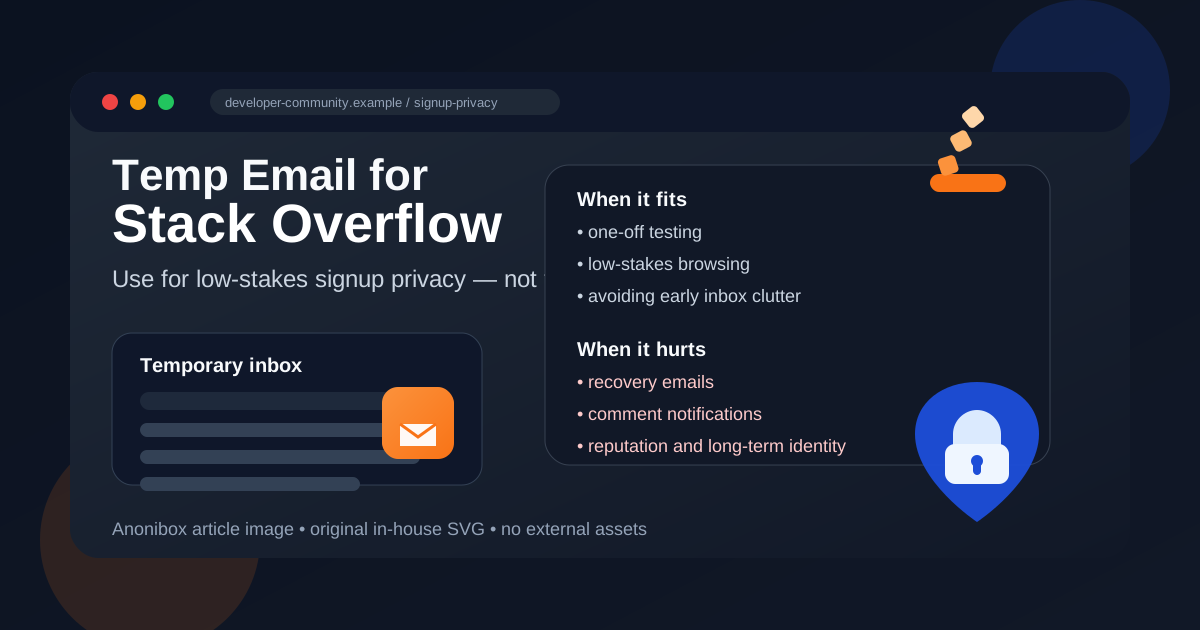
That distinction matters because Stack Overflow is not just another throwaway signup. For some people it is a quick Q&A account they barely touch. For others it becomes part of their public technical footprint: answers, bookmarks, saved posts, profile links, Teams access, and years of notifications tied to one identity. A disposable inbox can help with privacy in the first case, but it can create real friction in the second.
Short answer: okay for low-stakes testing, weak for serious long-term use
If your goal is simply to create a test account, check the product flow, read a few gated areas, or avoid putting your main inbox into another account system right away, a temp address can be reasonable. A tool like Anonibox can help keep that first step separate from your personal or work mailbox.
If you plan to participate seriously, ask or answer questions, collect reputation, receive comment replies, join private Teams, or keep the account for years, a stable email address is the safer choice. Stack Overflow activity can turn into a long-lived professional asset, and disposable email is a poor foundation for that kind of account.
Why someone would use a temp email for Stack Overflow
There are a few legitimate reasons someone may want temporary-email privacy here:
- Reducing inbox exposure: you do not want another platform sending updates to your primary address immediately.
- Testing account setup: you want to see how the site, preferences, or notifications work before committing a permanent address.
- Separating experiments from your real identity: maybe you are testing tags, profile settings, or account behavior without mixing that with your main developer identity.
- Avoiding account sprawl in a main mailbox: developers often collect logins across forums, docs sites, SaaS tools, newsletters, and code platforms. Temporary inboxes help contain that mess.
Those are sensible goals. The problem is that the value of a Stack Overflow account often increases over time, while the usefulness of a temp inbox usually drops after the first verification email.
Where temporary email works reasonably well
1. One-off account testing
If you only want to see how registration works, browse logged-in settings, or experiment with an account you do not expect to keep, a temp inbox is usually fine.
2. Low-stakes reading and bookmarking
If you are mostly using the account casually and would not care much if you lost access later, the risk is lower. The account is acting more like a convenience profile than a long-term professional identity.
3. Short-lived workflow experiments
You may want to test notification settings, tag follows, or whether a Stack Overflow login is necessary for some feature before you connect a permanent address. That is a fair use case for a temporary inbox.
Where it starts getting risky fast
Account recovery
This is the biggest issue. If you lose the email address, lose access to the inbox, or cannot receive future recovery messages, getting back into the account can become difficult. A platform may be easy to join with a disposable address, but that does not mean it is easy to recover later without one.
Reputation and answer history
Stack Overflow is one of those sites where a profile can quietly become important. Maybe you answer a few useful questions, collect reputation, or end up linking your profile from a résumé, portfolio, or developer bio. If that happens, the account stops being disposable even if the inbox was disposable at the start.
Comment and reply notifications
If someone comments on your answer, requests clarification, or posts a useful follow-up, email notifications can matter. Missing them consistently can make the account harder to manage and make you look absent from your own contributions.
Teams, workspaces, or related sign-ins
If your use extends into Stack Overflow for Teams or any work-related workflow, a temp email is usually the wrong tool. Team invites, account continuity, and professional ownership work much better with a stable address you control long term.
Sign-in method confusion
Some users sign in through Google, GitHub, or another identity provider instead of relying only on direct email/password access. If that is your setup, the privacy picture changes. A disposable inbox may not be doing much for you if the real identity anchor is your GitHub or Google account anyway.
What many people underestimate
The main trap is assuming a Q&A account will stay low-value forever. That is often wrong. A quick account can turn into:
- a profile with useful saved posts and activity history,
- a public record of technical contributions,
- a link you want to keep on a portfolio or application,
- an account connected to team access or technical communities.
Once that happens, the original privacy win from a temp inbox can be outweighed by the long-term inconvenience of weak recovery and fragmented identity management.
A safer way to use temp email here
If you still want the privacy benefit, the smartest approach is to treat temp email as a screening tool, not a forever solution.
Step 1: decide whether this is a throwaway or keeper account
Before you sign up, be honest about the goal. Are you just testing? Or do you realistically expect to use the account for months or years?
Step 2: use a temp inbox only for low-stakes sign-up privacy
If it is a true experiment, a temporary address is fine for the first verification message and early exploration.
Step 3: switch to a stable address if the account becomes useful
If you start posting answers, joining discussions, or relying on the profile professionally, move to an email address you control long term. That can be a dedicated developer inbox, an alias you keep, or another separate but durable address.
Step 4: save important settings immediately
If the platform allows email changes, do it before the temp inbox disappears from your workflow and before you forget which address was used.
Better alternatives than a pure temp inbox
For many Stack Overflow users, a durable alias or separate inbox is better than a fully disposable address.
Use a dedicated developer email
A separate inbox just for coding communities, docs platforms, and developer tools keeps your main mailbox cleaner without creating recovery problems.
Use an email alias you control long term
An alias gives you separation and some privacy while preserving ownership. If the alias starts getting noisy, you can filter it or retire it later.
Use temp email only for first-pass evaluation
If you are unsure whether you will keep the account, temp email can still play a role. Just do not confuse “good for sign-up” with “good for lifecycle management.” Those are different things.
Practical signs you should not keep using temp email on Stack Overflow
- You have started answering questions regularly.
- You care about reputation points, badges, or profile continuity.
- You want to receive comment or reply notifications reliably.
- You linked the account anywhere public.
- You may need the account later for hiring, networking, or professional credibility.
- You joined any work-related or team-related Stack Overflow workflow.
If any of those are true, you have already outgrown a disposable inbox.
Best practices if you want privacy without future regret
- Decide up front whether the account is temporary or long-term.
- Do not build a public contribution history on an inbox you cannot keep.
- Prefer a separate stable inbox over a fully disposable one for developer communities you may revisit.
- Remember that SSO can expose a different identity anchor than the email itself.
- Change the email early if the account starts to matter.
Final answer
A temp email for Stack Overflow is fine for one-off sign-up privacy, basic testing, or a low-stakes account you truly do not care about later. It helps keep your main inbox out of yet another platform while you decide whether the account is worth keeping.
But if you expect to build reputation, save useful history, receive notifications, recover the account later, or use Stack Overflow as part of your professional identity, a temporary inbox is usually the wrong long-term choice. In that case, a separate permanent inbox or controlled alias gives you better privacy without sacrificing stability.
That is the practical middle ground: use temp email to reduce exposure at the start, then switch to something durable the moment the account stops being disposable.