Yes — a temp email for Strapi is useful when you want to test the admin panel, content modeling flow, or a demo project without turning one quick experiment into months of follow-up email.
No — it is a poor long-term choice once the account matters for production admins, teammate invites, password recovery, or any project your team may need to access later.
That is the practical answer. Strapi often gets evaluated in the messy middle between curiosity and commitment. A developer wants to compare it with Directus or Contentful. A founder wants to spin up a proof of concept quickly. A small product team wants to see whether the content types, API structure, and editorial workflow feel better than their current setup. In that stage, people usually want fast access, not another permanent stream of welcome emails, webinar invites, feature announcements, and sales follow-ups in their main inbox.
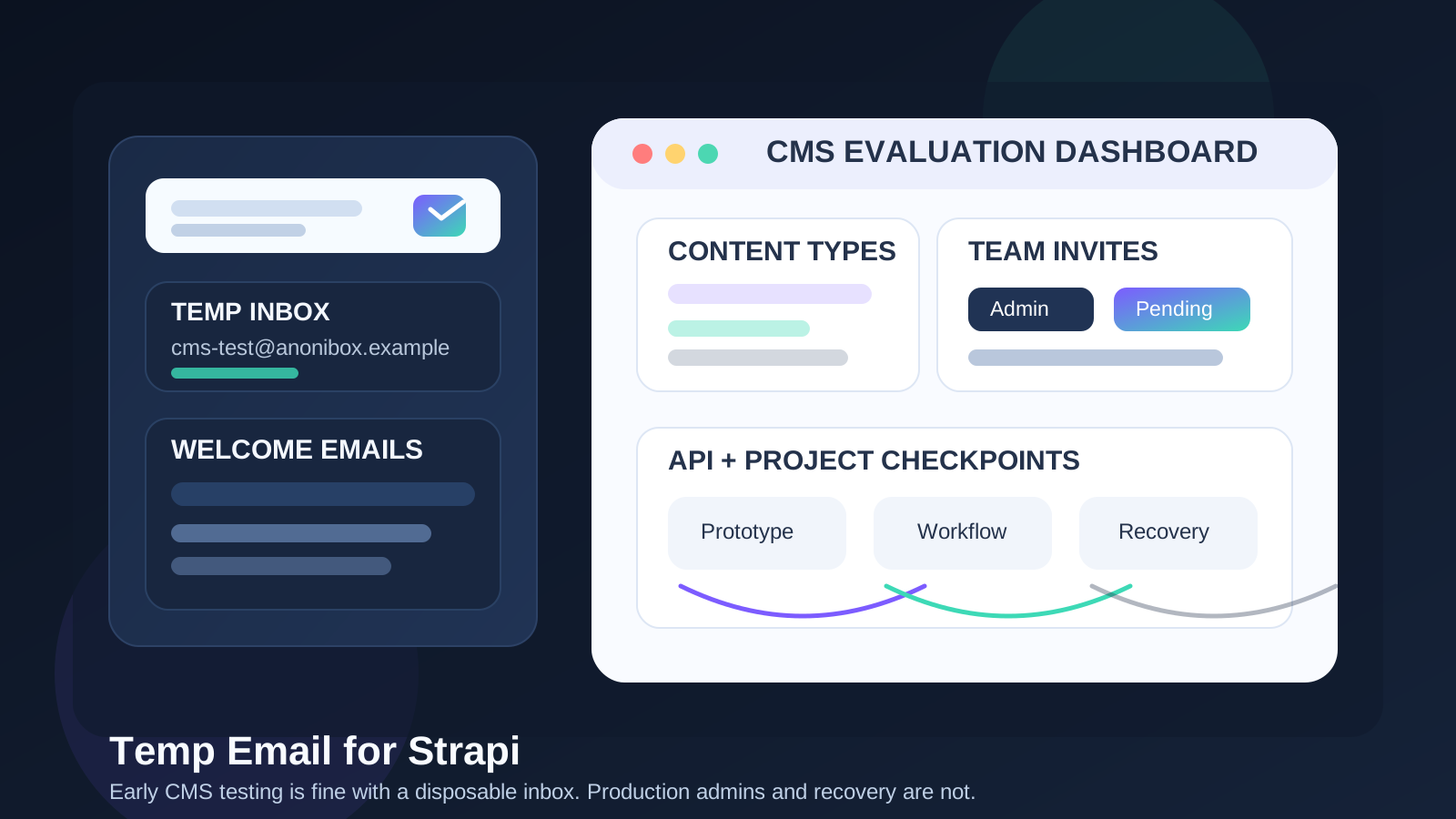
Why people consider a temp email for Strapi in the first place
Strapi is the kind of tool people rarely evaluate in isolation. It shows up during platform comparisons, CMS rebuild discussions, internal tool prototypes, landing page experiments, and app backends that may or may not become real projects. That means the early signup is often low-stakes. You may only want to verify an account, inspect the interface, read the onboarding steps, and decide whether the product deserves deeper attention.
That is exactly where a temporary inbox can help. It keeps the first verification message, the initial setup emails, and the early admin notifications away from your main work address while you decide whether the project is serious. If you already use Anonibox for low-stakes signups, Strapi is a sensible candidate for that habit.
When using a temporary email with Strapi makes sense
A disposable inbox is most useful when the work is exploratory rather than operational. Good examples include:
- Testing a Strapi signup flow before you commit to the platform
- Opening a sandbox project to compare it with other headless CMS tools
- Reviewing the admin experience, content type builder, and API feel
- Spinning up a demo for a pitch, prototype, or internal proof of concept
- Separating one-off product research from your long-term inbox
In all of those cases, the goal is speed and privacy, not durable ownership. You want access to the confirmation email and maybe a short onboarding sequence, but you do not necessarily want to hand over your primary address before you know whether Strapi belongs on the shortlist.
When it stops being a good idea
A temp email is helpful at the beginning, but it becomes risky surprisingly fast once the account matters. Stop using a disposable address if any of these become true:
- The Strapi environment is tied to a real production site or app
- You are inviting teammates, editors, or client stakeholders
- The account controls admin permissions or long-term project settings
- You may need reliable password resets or security notifications later
- The project is moving from experiment to shared infrastructure
At that point, the convenience flips into a liability. If the inbox disappears, you may lose access to recovery emails, invite flows, or important account notices. A temporary inbox is good for exploration. It is bad for systems your team depends on.
How to use a temp email for Strapi without causing future problems
1. Decide whether you are testing or building
Be honest about the stage of the project before you sign up. If the goal is pure evaluation, a temporary inbox is fine. If you already know the project will become real, start with a stable address and skip the cleanup later.
2. Use the temporary inbox only for the first checkpoint
The best workflow is simple: use the disposable address for account verification and early product exploration, then switch to a permanent address if Strapi survives the first round. That keeps your evaluation clean without locking the future account behind an inbox you do not fully control.
3. Save the messages that actually matter
Do not assume you will come back to the inbox days later and find everything still waiting. Save the useful items right away:
- The verification email
- Any initial invite or project access link
- Setup notes you may want to compare later
- Important onboarding instructions
If you decide Strapi is worth continuing with, move the account to a durable email before the project grows roots.
4. Keep one inbox per tool when comparing platforms
If you are testing multiple CMS products at once, do not dump them all into one temporary address. Separate inboxes make it easier to compare onboarding quality, invitation flow, and setup friction without losing track of which message belongs to which vendor.
What to evaluate inside Strapi during that early trial stage
The email address is not the point. It is just a tool for getting into the product. Once you are inside, focus on whether Strapi actually fits your work.
Content modeling
Can you create content types in a way that feels clear and maintainable? Do the relationships, fields, and editorial structure make sense for your project, or do they feel awkward once the schema grows?
Admin usability
Some CMS tools look good in marketing screenshots but feel clumsy once real people start creating entries. Check whether the admin experience seems workable for developers, editors, and stakeholders who are not living in the system full time.
API and frontend fit
If you are pairing Strapi with a frontend stack, the real question is not just whether the API exists. It is whether the content flow feels practical. Can your team fetch what it needs cleanly? Does the setup match the way your project actually ships content?
Team workflow
If the project might become collaborative, think early about how invites, permissions, and operational ownership would work. Even if you start with a temporary inbox, the long-term account needs a real home before shared access becomes important.
Upgrade path from prototype to production
A lot of experiments die because the prototype is easy but the next step is messy. Ask whether Strapi still feels manageable once you imagine real content editors, production changes, recovery needs, and handoff between teammates.
Real risks people forget about
Most of the danger is not dramatic. It is boring operational pain that shows up later.
- Lost recovery access: if the temporary inbox disappears, password resets can become a problem.
- Broken team invites: collaborators may be tied to an account nobody wants to manage properly.
- Confused ownership: the person who created the test project may leave the project, but the account email remains a disposable one.
- Missed notices: billing, security, or access-related emails may go somewhere nobody is watching.
None of that means you should never use a temp email. It just means you should treat it as a temporary evaluation tool, not a durable account foundation.
Signs you should switch to a real email immediately
If any of these happen, stop treating the setup like a throwaway test and move to a stable address:
- The project is now connected to a real business site or app
- You are inviting coworkers, contractors, or clients
- You expect to return to the environment after a break
- You are documenting the system for someone else to maintain
- You care about long-term security, recovery, or ownership clarity
The switch does not mean the temp email was a mistake. It just means the account has crossed the line from experiment to real asset.
Mistakes to avoid
- Using a disposable inbox for a production admin account: this is the biggest avoidable mistake.
- Forgetting which email you used: write it down during testing so you do not lock yourself out later.
- Leaving the account unchanged after the pilot succeeds: once Strapi becomes part of a real workflow, update the contact address.
- Confusing privacy with permanence: a temp inbox is great for reducing noise, but it is not a stable identity layer.
- Judging the tool by the signup flow alone: what matters is how Strapi handles content, structure, and team workflow once you are inside.
A simple decision rule
If you are testing Strapi for an hour, a day, or a quick prototype, a temp email is usually fine. If you are building something other people will rely on next week, next month, or next quarter, use a real address.
That rule is simple, but it prevents most of the problems people create for themselves. Temporary inboxes work best at the edges of evaluation, not at the center of operational ownership.
Final takeaway
A temp email for Strapi is a smart privacy move when you want to check the platform quickly, keep your main inbox cleaner, and compare headless CMS options without overcommitting. It helps with early verification, low-stakes demos, and proof-of-concept work.
But once Strapi is tied to real admins, shared projects, or anything you may need to recover later, the disposable address should go. Use the temporary inbox to explore, then graduate the account to a stable email before the project becomes important. That gives you the convenience now without creating a completely avoidable access headache later.