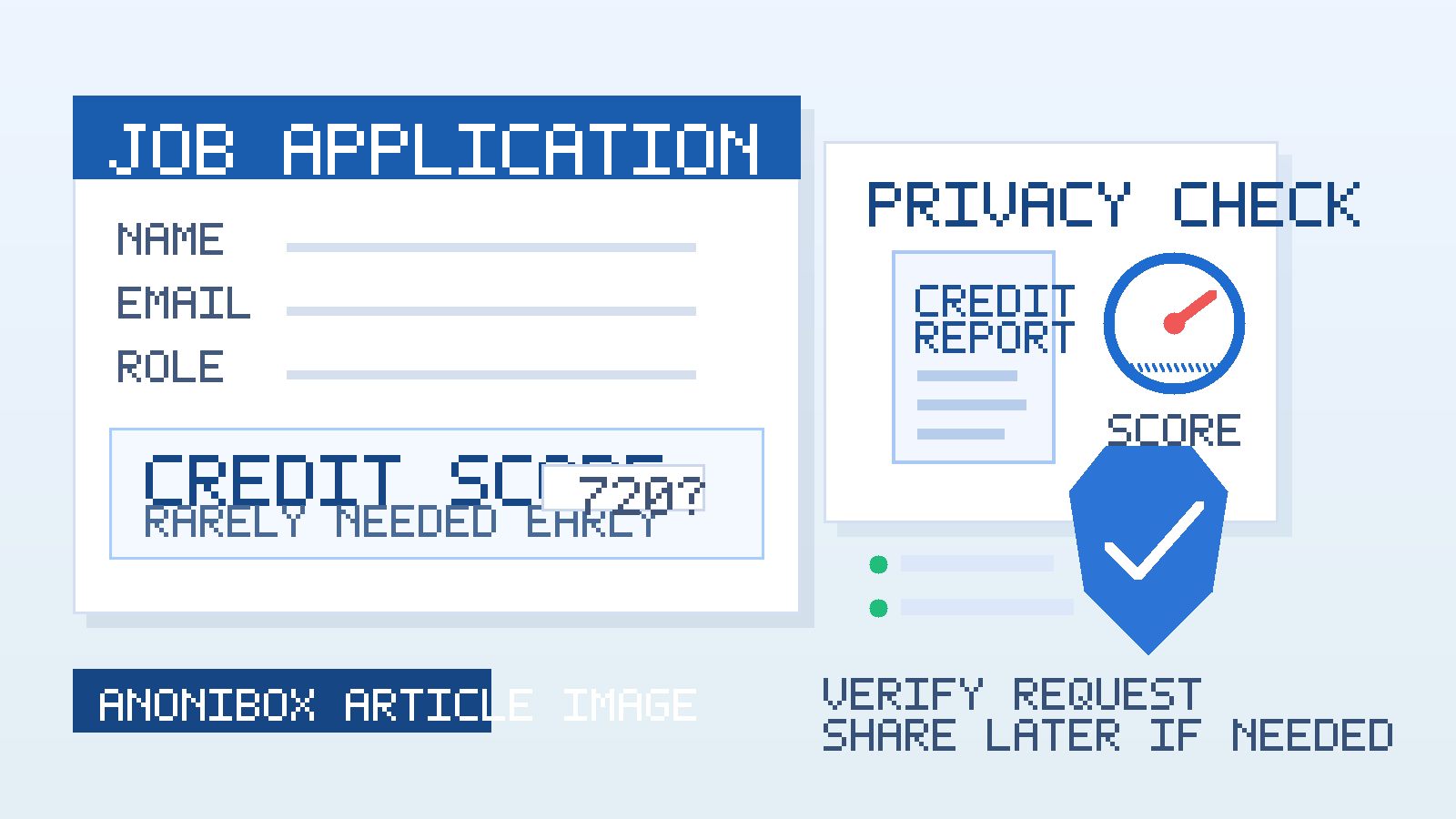
Usually no—you should not put your credit score on job applications. Most legitimate employers do not need your self-reported score at the first-application stage, and if credit screening matters later, they typically explain it and handle it through a separate, formal process.
Sharing it too early creates unnecessary privacy and scam risk. If an application asks for your credit score up front, slow down, verify the employer, and look for a safer way to answer the real concern without oversharing sensitive financial information.
Why this question comes up
Job seekers sometimes run into application forms that ask broad financial questions, especially for roles involving money handling, regulated industries, security-sensitive work, or positions with access to financial accounts. In other cases, the request does not come from the employer at all—it comes from a recruiter, an outsourced screening form, or a scammer using the language of “pre-employment verification.”
That is what makes this topic confusing. There is a real difference between an employer eventually deciding to run a relevant background or credit-related check and a random form asking you to type in a number before anyone has even interviewed you. The first can be legitimate. The second often deserves skepticism.
Short answer: a credit score is usually not a first-application field
Most employers care far more about your qualifications, availability, experience, references, and work authorization than your credit score. Even in industries where financial trust matters, employers usually do not expect candidates to self-report a score inside a basic application form.
Instead, if credit history is relevant to the role, the employer may address it later in the process through a separate disclosure, consent form, or screening workflow. They may review a credit report through an authorized screening provider rather than rely on a number you typed yourself. That is one reason sharing your score early is often unnecessary as well as risky.
Credit score, credit report, and employer screening are not the same thing
Many applicants hear the phrase “credit check” and assume they should provide a score immediately. That is not how most legitimate hiring processes work.
- Credit score: a simplified number meant to summarize parts of your credit profile.
- Credit report: a fuller record that may include account history, balances, payment patterns, and other details depending on the source.
- Employer screening: a separate step where a verified employer explains what they want to review and asks for permission if the role and location make that relevant.
Those are very different things. A request to type a raw score into an early application field can be a sign that the form is sloppy, unnecessary, or collecting more information than it should.
When credit-related screening may be legitimate later on
There are some situations where a real employer may eventually care about credit-related information. The keyword is eventually.
1. Roles involving direct financial responsibility
Jobs that involve handling company funds, approving payments, managing cash, overseeing accounting controls, or accessing sensitive financial systems may come with stricter screening. Even then, that usually happens after the employer has serious interest in you—not during the first click-to-apply step.
2. Highly regulated environments
Banks, some financial services employers, certain government-adjacent roles, and other regulated organizations may have more formal screening processes. A legitimate employer should still be able to explain what is being reviewed, why it matters, and when it becomes relevant.
3. Security-sensitive positions
Some security, fiduciary, or trust-heavy roles involve a deeper background review. That does not automatically mean “send us your credit score now.” It means there may be a later-stage process with clear documentation and a verified reason.
4. Final-stage screening after the employer is clearly real
If you have already interviewed, confirmed the employer, and moved into formal hiring paperwork, a discussion about background checks can be normal. That is very different from being asked for a score in a generic web form or over text message.
Why sharing your credit score too early is risky
It is more sensitive than it looks
A credit score may seem like just one number, but it signals financial history and can invite follow-up questions about debt, accounts, disputes, and identity verification. Once that conversation starts with an untrusted party, the risk can escalate quickly.
It can trigger scam follow-ups
Scammers often start with a small request that sounds reasonable, then push for more. If you disclose a score, the next message may ask for a screenshot, a paid credit-report link, identity documents, banking details, or a “processing fee” for pre-employment screening.
You may be solving the wrong problem
Sometimes the employer does not actually need your score. They may just need to know whether you are willing to complete a formal screening later if the role requires it. Sharing a number up front gives away more than the situation calls for.
Self-reported scores are a weak hiring signal anyway
Scores can change, vary by source, and lack context. A legitimate employer that truly needs credit-related screening usually wants a proper process, not a candidate-typed number that cannot be evaluated reliably on its own.
Red flags that mean you should pause
- The request appears at the very first application stage before any serious contact.
- You are asked to pay for your own “required” credit check through a link the recruiter sends.
- The recruiter wants screenshots, account logins, or a full credit report by email or chat.
- The employer cannot explain why the role needs this information.
- The company website is vague, thin, or inconsistent with the job posting.
- The conversation shifts quickly to text, WhatsApp, Telegram, or a personal email address.
- The credit request arrives alongside other sensitive fields like bank details, Social Security numbers, or identity-document photos.
Those are not minor details. In job-search scams, “pre-employment screening” language is often used to make intrusive requests sound routine.
What to do if an application asks for your credit score
1. Check whether the field is optional
If it is optional, leaving it blank is often the safest move unless you already know the employer and understand exactly why the information matters.
2. Figure out the real question behind the field
Sometimes the employer is really asking whether you are willing to complete relevant background screening later. That is different from demanding a score now. If there is space to clarify, you can indicate willingness to participate in legitimate screening without volunteering the number itself.
3. Verify the employer independently
Look up the company through its official website, careers page, and staff profiles. If a recruiter contacted you, verify that they actually work there and that the role exists. Do not rely only on the application form.
4. Ask for the purpose and timing
A legitimate employer should be able to answer basic questions such as:
- Why is this information needed for this role?
- At what stage is it actually reviewed?
- Is the request for a score, a report, or simply consent for later screening?
- Who handles the data and how is it submitted?
Clear answers lower risk. Evasive answers increase it.
5. Offer a safer response first
If appropriate, a simple response may be enough:
- “I am happy to complete any relevant, formal screening later in the process.”
- “I prefer not to share a personal credit score at the initial application stage.”
- “Please let me know the official screening process if this role requires it.”
That keeps you cooperative without handing over sensitive information too early.
Best practices before sharing any credit-related information
- Use the minimum necessary disclosure: do not offer a score just because a form leaves space for one.
- Separate early-stage applications from your main inbox: this makes suspicious follow-up easier to spot.
- Do not click screening links blindly: verify the company and the provider first.
- Never send account logins or screenshots from financial dashboards: a real employer should not need them.
- Keep notes about what you shared and when: useful if the process later feels inconsistent.
- Watch for urgency: pressure is one of the oldest scam tools in hiring.
How Anonibox fits naturally into this workflow
Many risky requests do not appear in the first form—they arrive later as follow-up messages, screening links, or “complete your application” reminders. That is one reason privacy-conscious job seekers often separate their early job-search traffic from their main inbox. Using Anonibox for initial applications, talent communities, or unfamiliar hiring portals can reduce clutter and make suspicious credit-check follow-ups easier to isolate.
That does not mean every serious hiring conversation should stay on a disposable address forever. Once you are clearly dealing with a legitimate employer and moving into formal interviews or onboarding, it can make sense to switch to a stable contact channel you control. The benefit is keeping the noisy early-stage funnel from mixing with the communications that actually matter.
A quick decision checklist
Before entering a credit score into a job application, ask yourself:
- Am I applying directly on a verified employer site?
- Is this an early application field or a later formal screening step?
- Does the employer clearly explain why credit-related information matters for this role?
- Am I being asked for a score when consent to later screening would be more appropriate?
- Would I still feel comfortable if this exact request came from a stranger over email or text?
If several answers make you uneasy, pause. Your application does not become stronger just because you share more sensitive data than necessary.
Final answer
So, should you put your credit score on job applications? In most cases, no. If a legitimate employer cares about credit-related screening, that conversation usually belongs later in the process, with a clear reason and a formal workflow—not in a generic early application field.
The safest approach is to share your qualifications, verify the employer, and hold back personal financial data until the request is clearly relevant and trustworthy. That protects your privacy, helps you spot scams faster, and keeps you from oversharing information that most employers do not need at the start.