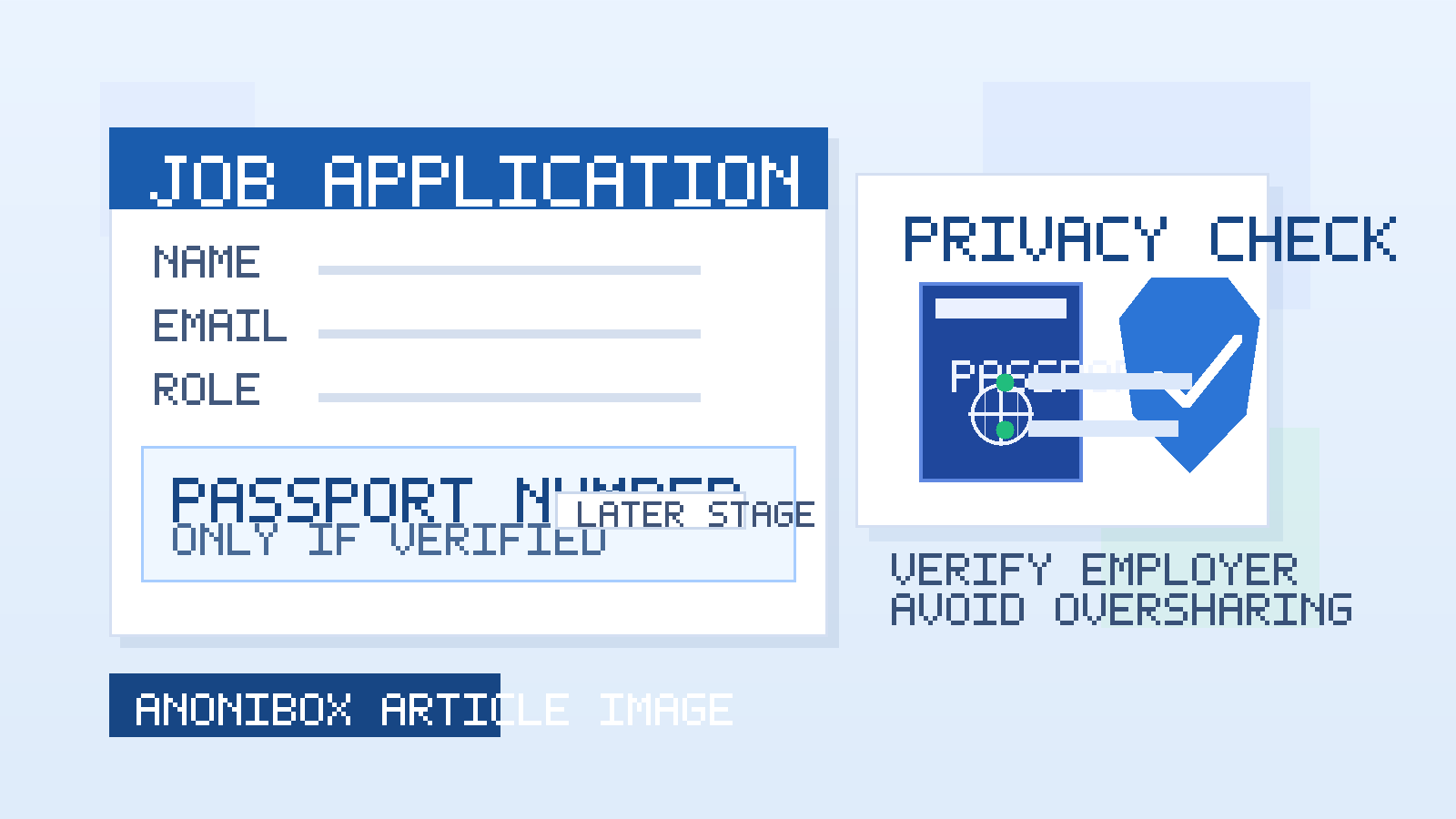
Usually, no—you should not put your passport number on job applications unless a verified employer has a specific, legitimate reason to request it later in the hiring process. Most early applications only need your contact details and work-authorization summary, not a passport number.
Sharing it too early creates unnecessary identity and scam risk. If a form asks for it up front, slow down, verify the employer, and look for a safer way to provide only the minimum information needed first.
Why this question matters
A passport number is not just another contact field. It is a government-issued identity detail that can be used to tie together travel records, identity documents, work-authorization paperwork, and other sensitive information. That makes it much more sensitive than a LinkedIn URL, phone number, or even a resume attachment.
Job seekers often run into this question when applying for international roles, travel-heavy jobs, government-adjacent work, or positions that mention relocation and visa support. Sometimes the request is legitimate. Sometimes it is premature. And sometimes it is a sign that the “employer” is collecting far more personal information than they should.
That is why the best answer is not just yes or no. It is understanding when a passport number might be appropriate, why it is risky to share early, and how to respond without sabotaging a real opportunity.
Short answer: passport number usually comes much later
For most standard job applications, a passport number should not be required at the first stage. Employers usually need to know things like:
- Your name and contact information
- Your work history and qualifications
- Whether you are authorized to work in the relevant country
- Whether you may need sponsorship or relocation support
That is very different from needing the exact number printed on your passport. In many hiring flows, a passport number only becomes relevant much later for verified identity checks, travel booking, immigration paperwork, or final onboarding tasks handled through official HR channels.
When it may be legitimate to share a passport number
There are situations where a real employer may eventually need this information. The key word is eventually.
1. Verified international hiring or relocation processes
If a company is formally sponsoring relocation, coordinating visas, or preparing cross-border employment paperwork, they may need passport details at some point. That usually happens after multiple stages of screening and once you are dealing with identifiable HR, legal, or mobility contacts.
2. Roles with employer-arranged travel after an offer is moving forward
Some consulting, maritime, aviation, field-service, or executive roles involve travel logistics. A passport number may be requested once real trip planning begins, not at the generic “apply now” stage.
3. Government, defense, or secure-facility workflows
Certain regulated employers may collect more formal identity information as part of a documented background, clearance, or onboarding process. Even then, the request should come through a structured, verifiable channel with a clear explanation.
4. Final identity verification after you have confirmed the employer is real
In some cases, a passport may be one acceptable proof-of-identity document among several options. That is still different from requiring the passport number in the first form you fill out on a careers site or third-party job board.
Why it is risky to share it too early
The danger is not only that bad actors might steal one number. The real problem is that a passport number is high-value identity data. When paired with your name, email, phone number, address, date of birth, or other documents, it can increase the damage from fraud or impersonation attempts.
Identity and document fraud risk
A recruiter or portal asking for too much too soon may be building a package of personal information rather than evaluating candidates. Even if one data point seems harmless in isolation, it becomes more sensitive when combined with other details you have already shared.
Scam escalation risk
Fake employers often start with innocent-seeming forms, then ask for more. If you provide a passport number early, the next request may be a passport scan, visa documents, banking details, or “processing fees.” That is how many job scams escalate: one small compliance step at a time.
Third-party platform exposure
If you are applying through a third-party job board, recruiting marketplace, outsourced screening form, or unfamiliar applicant portal, you may not have a clear view of where your data is stored, who can access it, or how long it is retained. Sensitive identity data should not be sprayed across low-trust systems by default.
Unnecessary oversharing
Most applications simply do not need it. When information is not necessary, sharing it only increases your exposure without improving your candidacy.
Passport number is not the same as work authorization
This distinction is where many job seekers get stuck. A legitimate employer may need to know whether you are:
- Authorized to work in a country
- A citizen or permanent resident
- In need of sponsorship now or later
- Available for international travel
Those are status questions. A passport number is a document-specific identifier. In most early-stage forms, you can answer the status question without handing over the document number.
For example, “Yes, I am authorized to work in the United States” or “Yes, I have a valid passport and can travel internationally if required” often communicates what the employer needs to know at that stage without exposing the actual passport number.
Red flags that mean you should pause immediately
Some requests are not just unnecessary—they are warning signs.
- The job board or recruiter asks for your passport number before any real interview.
- The employer wants a passport photo page by email or chat message.
- You are told the number is needed for “verification” but nobody can explain verification of what.
- The company has a vague website, no credible domain, or no traceable HR contact.
- The recruiter uses pressure: “urgent,” “required immediately,” or “complete this to reserve your spot.”
- The request appears alongside bank details, Social Security numbers, or payment demands.
- You are pushed off-platform to Telegram, WhatsApp, or a personal email address.
Any one of those can justify slowing down. Several together are a serious reason to stop and verify the employer independently before sharing anything else.
What to do if the application asks for it
1. Check whether the field is optional
Many forms include broad identity fields that are not actually required. If the passport number field is optional, leaving it blank is often the safest move unless you have a clear, legitimate reason to provide it.
2. See whether the employer only needs a status answer
If the real issue is travel readiness or work authorization, you may be able to answer with a yes/no statement instead of a document number. Look for nearby questions about sponsorship, citizenship, visa status, or travel availability.
3. Verify the employer outside the form
Do not rely only on the application page itself. Check the company domain, HR staff on LinkedIn, official careers pages, and whether the role exists in more than one credible place. If a recruiter contacted you directly, verify that they really work there.
4. Ask why it is needed and when it will be used
A legitimate employer should be able to explain why they need a passport number, who handles it, and at what stage. Clear answers reduce risk. Evasive answers increase it.
5. Offer a safer alternative first
If appropriate, respond with something like:
- “I am authorized to work in this country and can provide documentation at the appropriate stage.”
- “I have a valid passport and can travel if required, but I prefer not to share the document number until the employer and process are verified.”
- “I’m happy to provide identity documents through official HR onboarding channels after the next steps are confirmed.”
That keeps you cooperative without oversharing.
How Anonibox fits naturally into this workflow
Passport-number requests usually appear after an employer already has your basic contact details. That is one reason privacy-conscious job seekers often separate early-stage application traffic from their main inbox. A service like Anonibox can help you create distance during the discovery and application phase, especially when you are testing job boards, recruiter marketplaces, or unfamiliar portals that may generate long-term spam or phishing follow-up.
That does not mean sensitive identity documents belong in a disposable workflow forever. Serious employer conversations, offer paperwork, and verified onboarding should move through a stable channel you control. But reducing inbox clutter and isolating early-stage noise can make it easier to spot suspicious requests before they escalate.
Best practices before sharing any passport information
- Use the minimum necessary disclosure: status first, document details later.
- Confirm the employer independently: do not trust only the sender.
- Prefer secure portals over casual email threads: especially for formal documentation.
- Do not send scans or numbers through messaging apps: that is rarely the right channel.
- Keep records of what you shared and with whom: useful if something later feels wrong.
- Stop if the request becomes rushed or vague: urgency is a favorite scam tool.
A quick decision checklist
Before entering a passport number on a job application, ask yourself:
- Am I dealing with a verified employer on an official site?
- Have I already moved beyond the earliest screening stage?
- Does the employer clearly explain why this exact number is needed now?
- Could I answer with work-authorization or travel-availability information instead?
- Would I still feel comfortable if this same request came from a stranger on a job board?
If several answers are no, do not rush. Your application does not get stronger just because you disclose more than necessary.
Final answer
So, should you put your passport number on job applications? Usually not at the initial application stage. A verified employer may legitimately need it later for travel, relocation, immigration, or final identity checks, but most early forms should not require that level of sensitive detail.
The safest approach is simple: share your qualifications freely, share your work-authorization status when appropriate, and hold back document-specific identity data until the employer, purpose, and submission channel are clearly legitimate. That protects your privacy without making you look uncooperative—and it makes job scams much easier to spot before they go further.