A temp email for Granola can be useful for a short trial or first-pass evaluation, but it becomes a poor long-term choice once meeting notes, follow-ups, or account recovery start to matter.
Yes — if you only want to test Granola without handing your main inbox to another SaaS tool too early, a temporary inbox is a practical way to start.
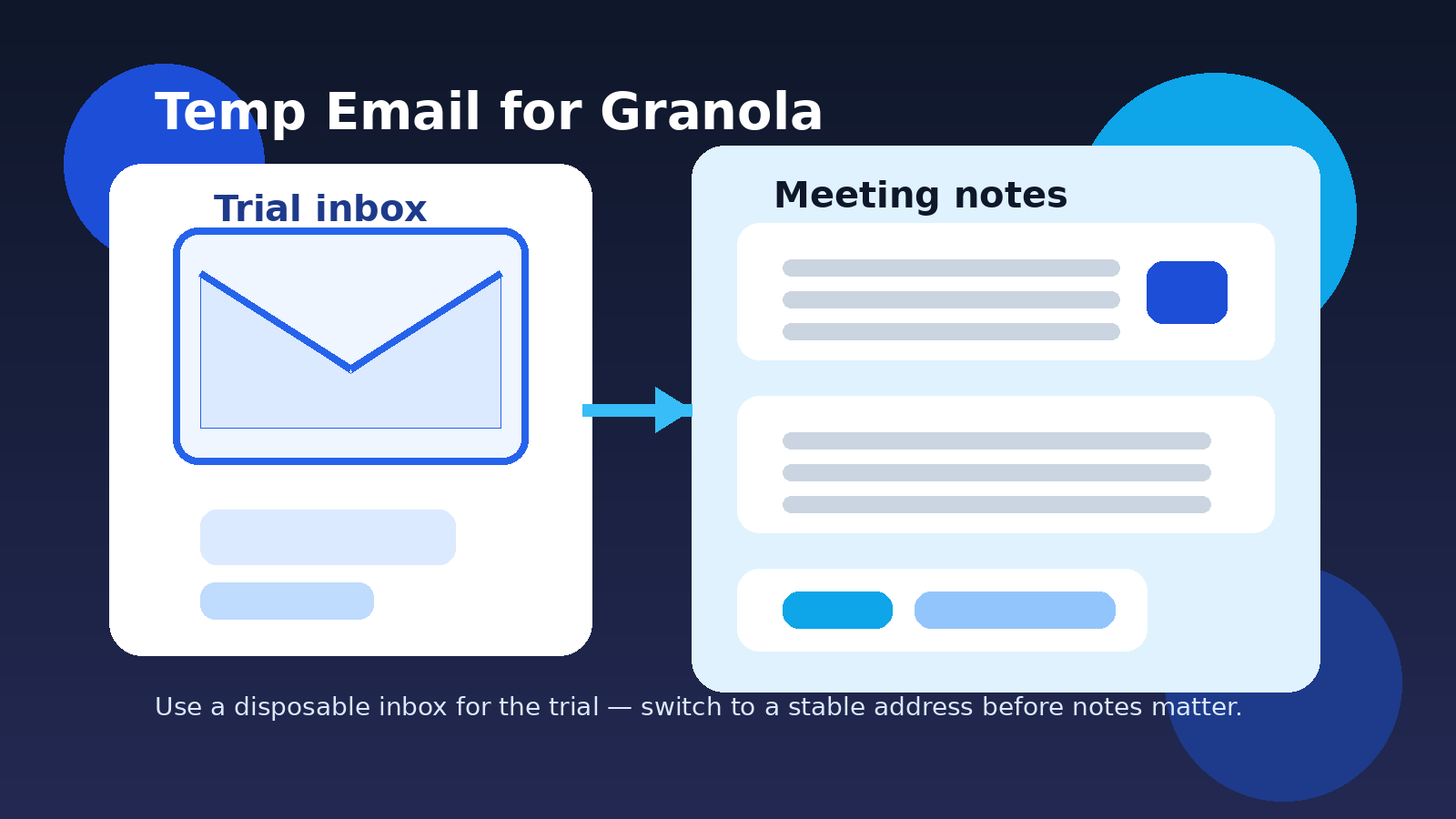
Why people look for a temp email for Granola
People usually search for a temp email for Granola because they want to evaluate the product without committing their main inbox on day one. That is a reasonable instinct. Meeting-note tools and AI productivity apps often ask for an email before they unlock the first workspace, onboarding sequence, or welcome flow. The problem is not the confirmation email itself. The problem is what usually follows: product tours, feature announcements, webinar invites, upgrade nudges, and follow-up outreach that keeps arriving even when the trial only lasted a few minutes.
If you are comparing several tools in the same week, inbox clutter becomes part of the evaluation problem. A temporary inbox gives you a cleaner way to verify the account, open the first messages, and decide whether the tool deserves deeper attention before your permanent email gets pulled into another long SaaS lifecycle.
What makes Granola different from a throwaway-only signup
Granola is not the kind of product where the email address stops mattering after the first click. Even if you start with a casual test, the account can become important quickly because the value of the tool is tied to notes, meeting context, and what happens after the call ends. That changes the privacy calculation.
For a one-time coupon or a throwaway download, a disposable inbox can be enough from start to finish. Granola sits in a different category. If you keep using it, the account may hold notes you want to revisit, summaries you want to rely on, and workflow habits you do not want to rebuild later. That is why a temp email can be smart for the first stage but weak for the long term.
When a temp email for Granola makes sense
A temporary inbox is most useful when the test is narrow, low stakes, and clearly temporary. Good examples include:
- Comparing Granola with other meeting-note tools before picking a shortlist
- Checking whether the signup flow, interface, and first-run experience feel promising
- Protecting your everyday inbox from another early-stage product sequence
- Running a quick solo evaluation before deciding whether the tool fits your workflow
- Testing on non-sensitive, low-importance meetings where losing the account would not hurt you
In those situations, the account is still disposable because the work inside it is disposable too. A service like Anonibox can help you receive the verification email, finish setup, and evaluate the basics without giving your main address to every tool you test.
When a temp email becomes the wrong tool
1. You start keeping notes you may need later
Many people sign up for “just a quick test” and then realize the notes are actually useful. The moment you think there is a real chance you will revisit those notes next week, next month, or during a follow-up conversation, the account should stop living behind a throwaway inbox. The more the content matters, the more the recovery path matters too.
2. The product becomes part of recurring meeting habits
Once you begin using a tool across real calls instead of a one-off trial, convenience changes sides. A temporary inbox may feel convenient at first, but it becomes fragile once the product sits inside your real work rhythm. If you depend on it for multiple meetings, the right long-term move is a stable address you control.
3. You care about continuity more than short-term privacy
There is a big difference between “I do not want more trial mail in my main inbox” and “I want this account to stay disposable forever.” A lot of people really want separation, not full disposability. If that is your situation, an alias or dedicated trial inbox is often a better tool than a fully temporary address.
4. You may need account recovery later
Password resets, suspicious-login checks, login confirmations, and ownership questions become much more annoying when the account depends on an inbox you no longer monitor. Even if you never plan to upgrade, account recovery becomes more important the second the tool holds anything you care about.
A smarter workflow for trying Granola without clogging your main inbox
Step 1: define the test before you sign up
Be clear about what you are evaluating. Are you testing note quality? Ease of review after a meeting? Whether the interface fits your workday? Whether it feels better than Otter AI, Fireflies AI, Krisp, Grain, or another meeting assistant already on your list? A defined test keeps the trial short and makes the email decision easier.
Step 2: use the temp inbox only for the first pass
Generate the temporary address before you open the signup page. Use it to confirm the account, read the first setup emails, and complete the initial evaluation. That keeps the trial contained. It also prevents your main inbox from being dragged into a product relationship before you know whether you want one.
Step 3: save the messages that actually matter
If the confirmation email, getting-started message, or setup notes contain anything you may need during the session, save them right away. Temporary inboxes are excellent for low-friction access, but they are not meant to be permanent archives.
Step 4: switch early if the product makes the shortlist
If Granola proves useful, do not wait too long to move to a durable address. Switch before important notes pile up, before any shared workflow depends on the account, and before the product becomes part of how you actually run meetings.
What to evaluate during a Granola trial
If you are going to spend time testing Granola, evaluate the things that actually determine whether the tool is worth keeping.
Does it reduce work after the meeting?
The main question is not whether the app feels modern. It is whether it reduces follow-up effort. After a meeting, does it help you remember what mattered? Does it make next steps clearer? Does it save time compared with your current workflow?
Are the notes good enough to trust?
Read the output like you would a day later, not just a minute later. Are the notes understandable? Would they still be useful if you returned to them after a busy week? A tool that feels impressive in the moment but produces fuzzy notes later is much less valuable than it first appears.
Can you actually find what you need again?
Meeting tools live or die on retrieval. Even if the first note looks fine, think about what happens after several calls. If finding the useful part later feels awkward, the product may add more friction than it removes.
Would you be comfortable building a habit around it?
This is the fork in the road. If the answer is no, then the temp inbox did its job: it let you test the product without long-term inbox exposure. If the answer is yes, that is your signal to move the account to a stable inbox and stop treating it like a disposable experiment.
Better alternatives if your real goal is privacy plus reliability
A temporary inbox is not the only way to protect your privacy during a SaaS evaluation. Depending on your situation, one of these may be better:
- Email alias: useful if you want separation and filtering while keeping recovery practical.
- Dedicated trial inbox: useful if you test many tools and revisit finalists later.
- Separate workstream address: useful if you want all vendor experiments isolated from your main personal or professional inbox.
These options usually make more sense once a trial stops being temporary but you still do not want your primary inbox carrying every vendor interaction.
Common mistakes to avoid
- Using a temp inbox for too long after the account starts holding useful notes
- Forgetting to save the confirmation or onboarding email you still need
- Assuming a disposable inbox solves every privacy issue around meeting software
- Testing with important or sensitive workflows before deciding whether the account should be permanent
- Confusing inbox separation with full account disposability
Final verdict
Using a temp email for Granola is a sensible move if you only want a short, low-stakes trial and you are mainly trying to avoid feeding your main inbox into another onboarding and follow-up sequence.
It becomes the wrong choice once the account starts holding notes you care about, becomes part of your recurring meeting routine, or needs a reliable recovery path. Use a temporary inbox for the first pass, keep the evaluation focused, and switch to a stable address as soon as the tool proves it belongs in your real workflow.
That gives you the privacy benefit up front without making future access harder than it needs to be.