Use a temp email for Frill when you want to test signup, feedback boards, roadmap updates, and notification flow without giving another product your main inbox too early.
Move to a permanent monitored address before real admins, team invites, customer feedback history, or account recovery depend on that inbox.
That is the short version, but the useful answer is really about timing. A platform like Frill often starts as a harmless experiment: you want to see how the board looks, how sign-in works, whether roadmap posts feel clean, and whether the notification flow is manageable. In that early stage, a temporary inbox can be genuinely practical. It lets you verify the account, inspect the workflow, and keep one more SaaS product from attaching itself to your main inbox before you even know whether you will keep it.
The risk is that feedback software does not always stay “just a test” for very long. A trial workspace can turn into the real customer-facing board, the real place where teammates respond to ideas, or the real admin account tied to recovery emails and account ownership. A tool like Anonibox is useful while the environment is clearly temporary. It is the wrong foundation once real workflows or real people depend on that email address.
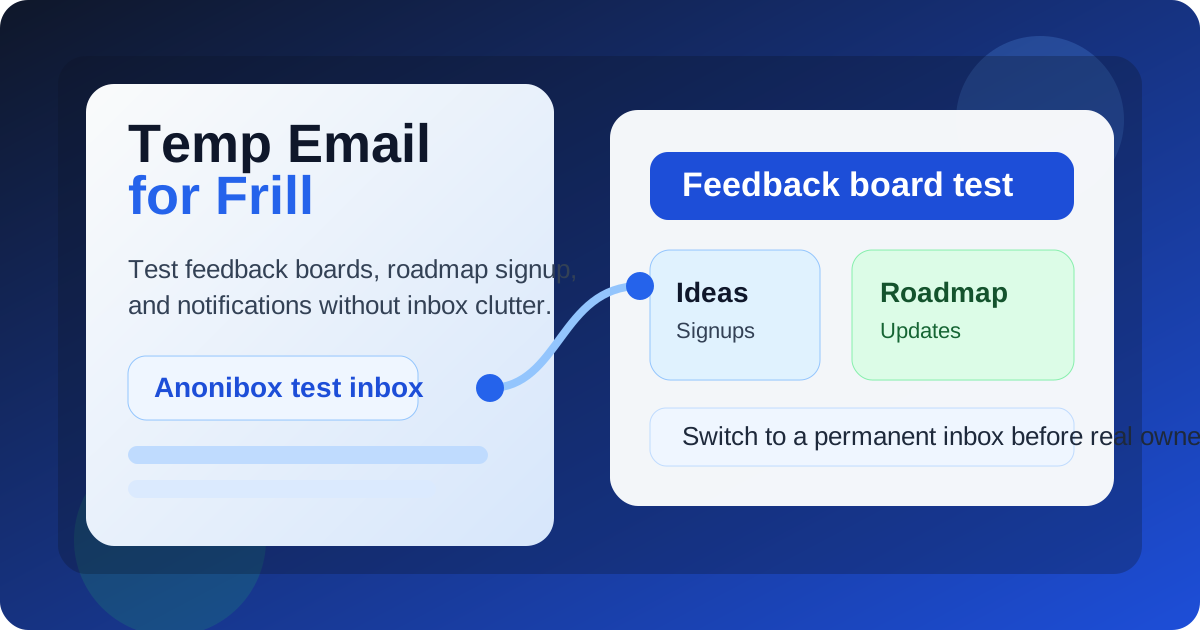
Why people look for a temp email for Frill
Frill fits a common pattern in SaaS evaluation. The first action looks small, but it opens a chain of email activity. You create a workspace, verify the account, invite a teammate, submit a test idea, follow a roadmap item, or inspect what a customer-facing board would look like. Suddenly there are welcome emails, verification links, invite notices, comment notifications, and product updates arriving in the same inbox you use for everything else.
That is why a disposable or temporary inbox sounds appealing. You may only want to answer a simple question at first: is this feedback board worth deeper setup? If the answer is no, you probably do not want weeks or months of follow-up sitting in your main email. A separate inbox keeps the evaluation clean and gives you some privacy while you compare tools.
There is also a workflow benefit. A temporary address isolates one product test from your daily work. If you are comparing Frill with other feedback or roadmap tools, separating each trial can make it much easier to see which one sends useful messages and which one creates noise.
When a temp email makes sense for Frill
A temp email is most useful when both the account and the purpose are temporary. Good use cases include:
- Trial signup: you want to inspect the product before connecting it to your permanent work inbox.
- Feedback board QA: you want to test signup, idea submission, voting, comments, or notification behavior in a safe environment.
- Roadmap preview: you want to see how the board feels from the inside before setting anything up for real users.
- Vendor comparison: you are evaluating several feedback tools and do not want every one of them writing to your main address right away.
- Short-lived exploratory access: you only need enough access to understand the setup, not to run a lasting workflow.
In those situations, the value of a temporary inbox is straightforward. You still receive the verification and onboarding emails you need, but you do not immediately widen your permanent email footprint for a tool that may never make it out of testing.
When it becomes risky
The problem starts when a disposable inbox stops being attached to a disposable decision. That shift can happen quietly if nobody pauses to clean up the setup.
1. The test account becomes the real admin account
If the first workspace owner stays the owner, the temporary inbox may end up controlling the live environment. That is fine for a throwaway sandbox. It is not fine for a real product-feedback system that the team expects to keep.
2. Team invites begin to matter
Once product managers, support leads, founders, or customer-success staff are joining the workspace, reliability matters more than inbox convenience. Team access and admin coordination should not depend on an address you only meant to use for a test.
3. Customer-facing feedback becomes real
If your board is going live, customers may start submitting ideas, following updates, and expecting replies. At that point, email ownership, moderation, and account recovery need to be stable. Disposable email is bad infrastructure for anything customer-facing.
4. Account recovery matters
Password resets are easy to ignore until you actually need one. If the inbox is temporary and you lose access when the workspace becomes important, you create avoidable friction at exactly the wrong moment.
5. Billing or ownership changes appear later
Even if you start with a free or trial workflow, real ownership questions often show up later. A team may decide to keep the tool, move plans, or hand control from one person to another. Those transitions are cleaner when the original email is permanent and monitored.
What kinds of Frill-related emails may show up
Even a simple test can create more email than people expect. Depending on how you use the workspace, you may see:
- account verification or confirmation messages,
- workspace or team invitation emails,
- idea or comment notifications,
- roadmap or update-following messages,
- password-reset and account-security emails,
- general onboarding and product follow-up messages.
That list explains both sides of the decision. It explains why a temp inbox can help during evaluation, and it also explains why a disposable address becomes a liability when the workspace turns into something real.
How to use a temp email for Frill safely
1. Decide whether this is a true test or a likely production setup
If you already suspect the workspace could become the live one, start with a permanent monitored address instead. Temporary email is most useful when the environment is genuinely disposable.
2. Label the workspace clearly as a test
Do not let the account look permanent by accident. Clear naming reduces the chance that teammates assume the first test owner is the correct long-term owner.
3. Save the messages you actually need
If the inbox is temporary, do not rely on it for indefinite reference. Save the verification message, any setup links you need, and the basic details that would be annoying to recreate.
4. Test the notification flow on purpose
A temporary inbox is not just about privacy. It is a chance to evaluate whether the email behavior is sensible. Ask practical questions:
- Is signup smooth?
- Are notifications clear or noisy?
- Would team invites feel manageable at scale?
- Would a real customer-facing board create too much inbox traffic?
- Does the workflow stay understandable when comments and updates start happening?
That is a better use of temporary email than using it out of habit. The point is to learn something useful from the test.
5. Switch to a permanent inbox before launch or shared ownership
Do not wait until the workspace becomes important. The best time to switch is before the board is live, before teammates rely on it, and before recovery or ownership questions become urgent.
Best practices for product teams
For teams, the safest pattern is simple: separate evaluation from ownership. A trial identity does not need to become the permanent owner of the environment. If Frill survives evaluation and becomes part of your real product workflow, move critical access to a durable inbox your team controls.
- Keep testing separate from governance: use temporary email for early exploration, not for long-term ownership.
- Document the switch point: decide in advance when a workspace must move from test email to monitored team email.
- Avoid disposable email for shared admin control: once more than one person cares about the account, the inbox should be stable.
- Clean up abandoned test workspaces: if the evaluation ends, close the loop instead of letting a dead trial sit around.
- Use Anonibox intentionally: it is a strong fit for quick evaluation, but not as a substitute for operational account hygiene.
Those habits keep temporary email useful rather than sloppy. Used well, it protects your main inbox and keeps tool comparisons cleaner. Used lazily, it creates a fragile admin chain that nobody wants to untangle later.
Should individual users or community testers use a temp email too?
Sometimes yes. If someone only wants to explore a feedback board, inspect how sign-up works, or make a low-stakes test submission, a temporary inbox can be reasonable. It keeps one more notification stream away from the person’s main inbox until they decide whether the board is worth following.
But if that same person wants to stay subscribed to updates, track roadmap movement, receive replies, or keep a durable relationship with the product team, temporary email stops making sense. The rule is consistent on both sides: it is useful for exploration, weak for long-term dependency.
A quick decision checklist
Before using a temp email for Frill, ask:
- Is this only for short-term evaluation?
- Could this account become the real admin account later?
- Will teammates or customers depend on this workspace soon?
- Am I testing notification flow, board access, or signup behavior rather than creating long-term ownership?
- Do I already know I will need reliable recovery and monitored access?
If the answers point toward a true test environment, a temp inbox is reasonable. If the answers point toward shared ownership or live customer use, start with a stable permanent address instead.
Final answer
A temp email for Frill is a smart choice during early feedback-board testing, vendor comparison, and short-lived workspace evaluation. It helps you verify the account, inspect notification flow, and keep another SaaS product from settling into your main inbox before you know whether it deserves a permanent place.
It becomes a bad idea once the workspace is tied to real admins, live customer feedback, team invites, or account recovery. Use temporary email to test Frill, not to anchor the long-term account your product team will actually rely on.