Yes, you can use a temp email for Nolt when you are testing a feedback board, trying a roadmap tool, or checking early notification flow without handing over your main inbox too soon.
It stops being a smart choice once the workspace becomes real, because admin ownership, team invites, account recovery, and customer feedback follow-up all depend on a stable email address.
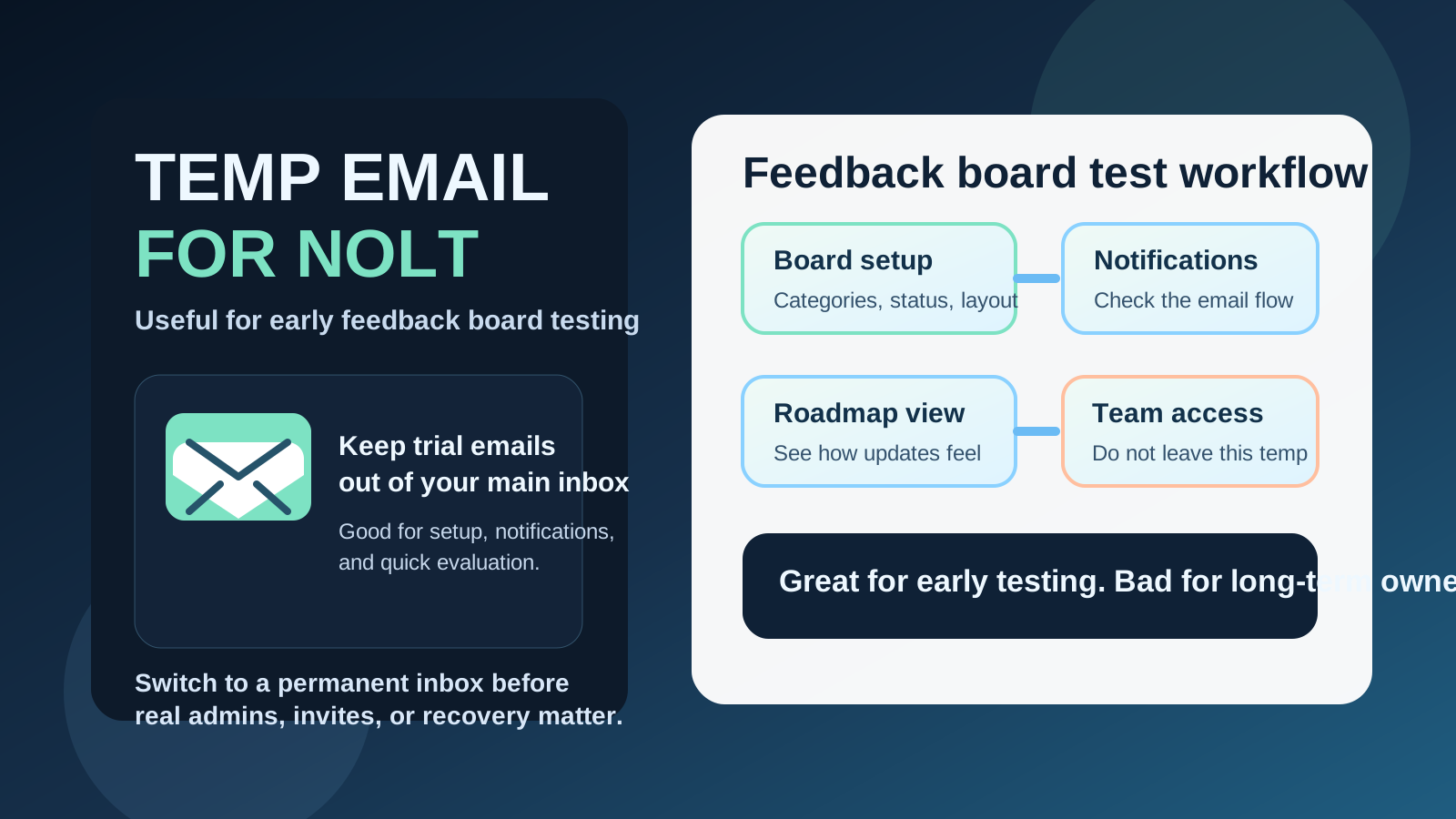
Nolt sits in that awkward middle ground where a temporary inbox can be genuinely helpful at the start but quietly becomes risky if you keep using it after the evaluation phase. On one hand, it is perfectly reasonable to want a separate inbox for testing a public feedback board, reviewing roadmap presentation, or seeing how the product feels before you commit. On the other hand, the whole point of a feedback platform is continuity. If users, teammates, or clients are going to rely on that space, the inbox behind it needs to stay available.
That is why the best answer is not “always use temp email” or “never use temp email.” The better answer is to use temporary email for the disposable stage only, then switch to a permanent monitored inbox before the workspace matters. If you keep that boundary clear, tools like Anonibox are genuinely useful. If you blur it, you create unnecessary admin risk later.
Why people look for a temp email for Nolt
Nolt is the kind of product people often test quickly. A founder wants to see whether a simple feedback board looks cleaner than a spreadsheet. A product team wants to compare it with alternatives like Canny, Featurebase, Frill, or UserVoice. An agency wants to mock up a client-facing board without mixing trial messages into the same inbox used for live work. In all of those cases, email becomes part of the setup before the tool has earned long-term trust.
That creates a practical privacy problem. Early product trials usually trigger welcome messages, onboarding sequences, reminder emails, change notifications, and occasional sales follow-up. If you are comparing several tools at once, your main inbox can fill up with noise before you have even decided which one deserves serious attention. A temporary inbox solves that part well. You get the verification link, the first setup messages, and the initial test environment without giving another SaaS trial permanent access to your daily inbox.
When a temp email makes sense for Nolt
A disposable inbox is most useful when the Nolt workspace is clearly temporary, exploratory, or low-stakes.
- Testing the signup and board setup: you want to see how fast you can create a board, shape categories, and understand the admin side.
- Comparing feedback tools: you are looking at Nolt alongside competing roadmap or idea-board products and want to keep each test isolated.
- Mocking up a client concept: you need a quick demonstration environment without tying it to a real long-term owner address yet.
- Checking notification flow: you want to confirm what kinds of emails the product sends during early setup and basic interaction.
- Protecting inbox hygiene: you want the evaluation phase separated from your real support, sales, or product inboxes.
Those are all good reasons. In that phase, the account itself is temporary, so using a temporary inbox is consistent with the level of commitment you actually have.
When a temp email becomes risky
The problem is not temporary email by itself. The problem is letting a temporary inbox become the hidden foundation of a permanent workspace.
Primary admin ownership
If the address controls the main workspace owner account, you are creating future friction for yourself. Password resets, ownership questions, and admin notices do not feel urgent on day one, but they become very urgent the moment you need them.
Real customer or community feedback
Once real people are posting ideas, voting, or expecting updates, the workspace stops being a toy. At that point, losing access to the inbox behind the account can create confusion well beyond your own convenience.
Team invites and handoffs
Feedback tools often start as one person’s experiment and then expand into a shared workflow. If your Nolt board is going to involve a cofounder, product manager, support lead, or client team, it is better to move to a stable inbox before handoffs begin.
Account recovery and operational continuity
Even a simple tool becomes fragile when the recovery path points to an inbox you no longer monitor. A temporary address is fine for a throwaway test. It is a bad long-term system for something your team may need to revisit months later.
A simple rule that prevents most mistakes
If the Nolt workspace exists to help you evaluate something, temp email is reasonable. If the workspace exists to own something real, use a permanent inbox.
That rule keeps the convenience in the right place. It lets you stay private during low-stakes testing without pretending a disposable inbox is an acceptable long-term admin strategy.
How to use a temp email for Nolt safely
1. Decide the purpose before you sign up
Be explicit about whether this is a genuine evaluation, a short-lived proof of concept, or the start of a real production board. If it is only for testing, a temp address is fine. If you already suspect the board may go live, start with a permanent monitored address and save yourself the migration step.
2. Keep one inbox per workspace
Using the same temporary inbox for several unrelated product trials creates clutter fast. Verification messages, board notifications, and invite emails get mixed together. One inbox per test keeps the trail clear and makes later cleanup easier.
3. Save the messages that matter right away
When the verification email, first login link, or admin setup message arrives, capture what you need immediately. Temporary inboxes are useful because they are lightweight, but that also means you should not assume they will stay convenient forever.
4. Test the important flows while the inbox is still active
Do not stop at “the signup worked.” Use the disposable phase to check the parts that actually matter. Create a test item. Trigger a notification if possible. Review how updates feel from the inbox side. See whether the workflow is clean enough to deserve a permanent place in your stack.
5. Switch before real people depend on the board
The right moment to migrate is earlier than most people think. Move to a permanent address before you share the board widely, before you invite collaborators who will depend on it, and definitely before you treat the workspace as a durable part of your product process.
What to evaluate in Nolt during the test phase
If you are going to use a temp email during evaluation, make the test useful.
Board setup and clarity
How quickly can you understand the structure? Is the board easy to shape into something users can actually navigate? A fast test should reveal whether the product feels lightweight in a good way or oversimplified for your use case.
Feedback submission experience
Try to think from the contributor side, not only the admin side. Would customers, beta users, or internal stakeholders understand how to submit ideas and follow updates? A clean feedback process matters more than a pretty admin dashboard.
Notification usefulness
Email volume is part of the product experience. During evaluation, pay attention to whether the messages feel helpful, noisy, or vague. A temporary inbox is ideal for this because it lets you review the notification pattern without committing your real inbox to every experiment.
Roadmap communication
If you expect to use Nolt partly as a roadmap surface, check whether updates feel understandable and presentable enough for the audience you care about. That might be customers, a private beta group, or internal stakeholders.
Admin and collaboration workflow
If there is any chance the workspace will become shared, ask whether the admin model feels sustainable. Even in a short test, it is smart to imagine what happens when the board is no longer just yours.
Common mistakes people make
- Leaving the temp inbox in place too long: the test board slowly becomes the real board.
- Treating admin ownership as an afterthought: later nobody is fully sure which inbox controls what.
- Testing only signup but not ongoing flow: the first login is easy; the long-tail email behavior matters more.
- Using one disposable address everywhere: this removes the organizational benefit that temporary inboxes are supposed to provide.
- Assuming “privacy” and “continuity” are the same thing: they solve different problems and you usually need both at different stages.
Temp email vs separate permanent work inbox
This distinction matters. A temp email helps with short-term privacy, low commitment, and trial clutter. A separate permanent work inbox helps with long-term control, shared ownership, and reliable recovery. People often blur those together, but they are not interchangeable.
For Nolt, the healthiest workflow is usually both, just at different moments. Use a temp inbox for the first-pass evaluation if you want to stay lean. Then, if the board survives that stage, move it onto a stable address your team can actually manage. That gives you privacy early without sacrificing continuity later.
A practical workflow that works well
- Create a temporary inbox for the initial Nolt trial.
- Use it to verify the account and test the first board setup.
- Review the basic notification and feedback flow.
- Decide whether the workspace is disposable, internal-only, or likely to go live.
- If it has long-term value, migrate to a permanent monitored inbox before wider rollout.
That sequence keeps the early stage clean while making sure the mature version of the workspace is not anchored to something fragile.
Final takeaway
A temp email for Nolt is a smart tool for early feedback-board testing, roadmap experiments, and lightweight evaluation. It keeps trial messages out of your main inbox and gives you a low-friction way to inspect whether the product is worth keeping.
But the moment the board starts looking real, the inbox behind it should become real too. Use temporary email for the evaluation phase, not for long-term workspace ownership. That is the simplest way to get the privacy benefit without creating a future recovery headache.