Yes, a temp email for Userback can make sense when you only want to test signup, verify a workspace, or evaluate the feedback workflow without tying another software trial to your main inbox right away.
No, it is not a good long-term setup once real customer feedback, team invites, account recovery, or billing responsibility depend on that address, so you should switch to a permanent inbox before the workspace becomes important.
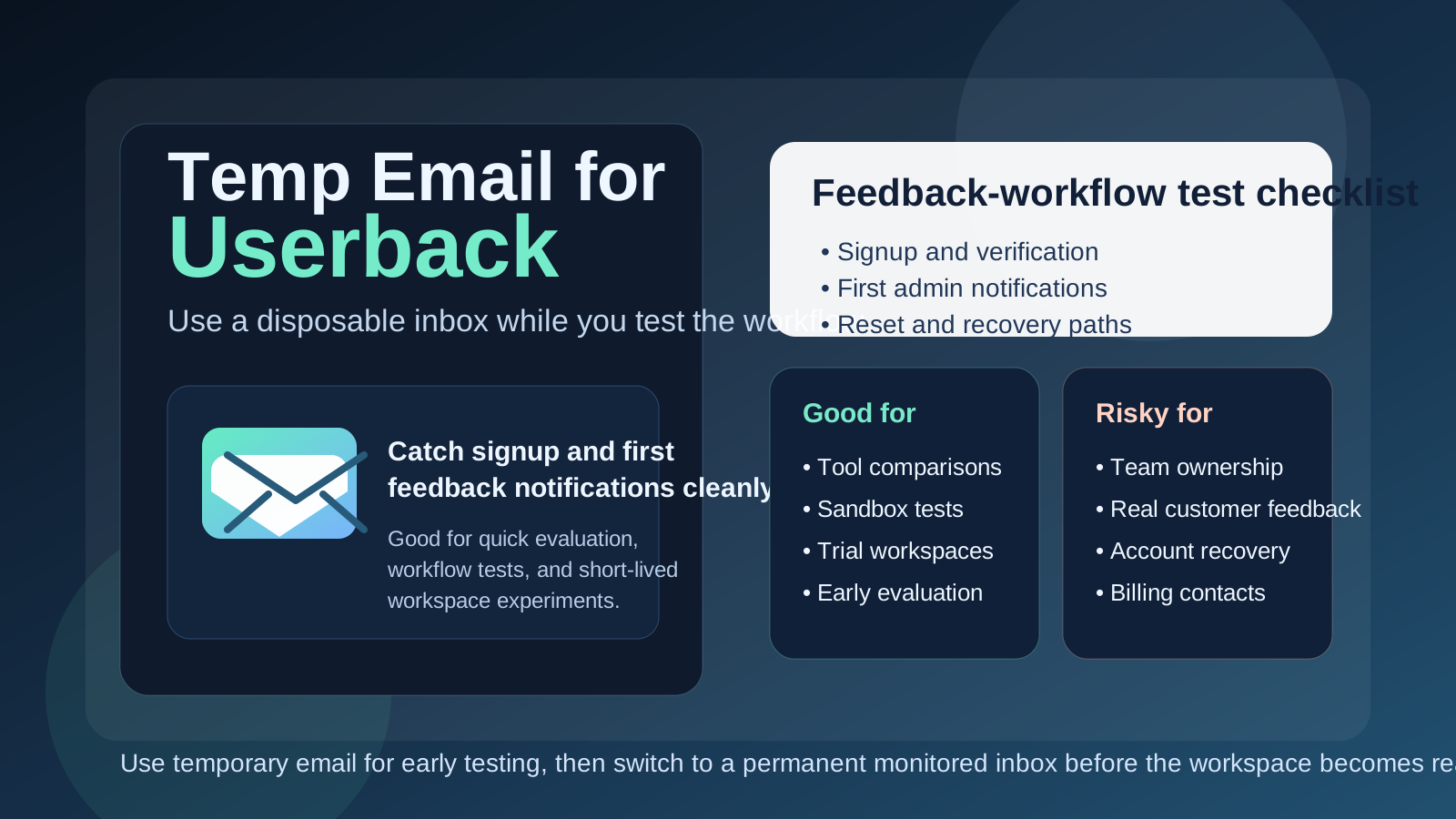
Why people look for a temp email for Userback
Userback sits in a category where people often want to test quickly before they commit. A product team may want to see how feedback collection feels on a staging site. An agency may want to compare several customer-feedback tools before recommending one to a client. A founder may only want to inspect onboarding, notification behavior, and the first admin screens before deciding whether the platform fits their workflow.
That early stage is exactly where a temporary inbox can help. You get the verification email, the first setup messages, and any short-lived test notifications you need, but you do not automatically add another SaaS vendor to your permanent inbox. If you are already reviewing multiple product-feedback or bug-reporting tools, that separation can make the evaluation phase much calmer.
That is also where Anonibox fits naturally. It gives you a clean inbox for the disposable part of the experiment, then lets you keep your primary inbox out of the picture until the account proves it deserves a permanent place in your stack.
When a temp email makes sense for Userback
Temporary email is most useful when the Userback account is clearly supporting a short-lived test rather than owning a real business workflow. Good examples include:
- Evaluating Userback alongside tools like Canny, UserVoice, Frill, Featurebase, Nolt, or Upvoty
- Testing the signup and verification flow before you decide whether the workspace is worth keeping
- Reviewing how feedback requests, notifications, or sample submissions behave in a sandbox environment
- Running a quick client proof of concept before the real project inbox is chosen
- Keeping trial messages and vendor follow-up out of your primary work inbox
- Creating a short-lived workspace only to inspect the admin experience and then discard it
In those situations, the inbox is helping you test something disposable. That is exactly the kind of job a temp inbox handles well.
When a temp email becomes risky
The trouble starts when a throwaway testing setup quietly stops being throwaway. That happens all the time with SaaS tools. Someone opens an account just to “take a quick look,” then the team likes it, then more people get invited, then feedback starts arriving, and before long the original inbox controls a workspace that now matters.
A temp email is the wrong tool if it is tied to:
- The main workspace owner or a long-term admin account
- Real customer feedback that your team needs to receive and respond to
- Team invitations, shared workflows, or internal ownership handoffs
- Password resets, security notices, or account recovery
- Billing contacts, vendor communication, or subscription management
- Any production environment where losing inbox access would create confusion or downtime
Once the workspace has real operational value, inbox stability matters more than inbox privacy. A disposable address is convenient only until you actually need it later.
A simple rule that prevents most mistakes
If the account exists only to test, compare, or inspect something, a temp email can be reasonable. If the account exists to own, recover, or receive something important, switch to a permanent monitored inbox.
That single rule covers most edge cases. It keeps you from treating a short-term privacy tool like a long-term account foundation.
How to use a temp email for Userback safely
1. Decide whether the workspace is disposable before you sign up
Do not pick a temporary inbox just because it is convenient. Ask first whether this is truly a test workspace, a comparison exercise, or a one-off proof of concept. If there is a real chance the same Userback setup will become the production workspace, start with a permanent address instead.
2. Keep one inbox per experiment
If you reuse the same temp inbox across several feedback tools, it becomes harder to tell which verification email or notification belongs to which trial. One inbox per workspace keeps the comparison cleaner and reduces mistakes.
3. Save the few messages that matter
During an early evaluation, you usually only need a small set of emails: the verification message, perhaps a welcome message, maybe the first notification or reset link, and any important admin instructions. Capture those early. Temporary inboxes are useful because they are lightweight, but that also means they should not be treated like permanent archives.
4. Switch before inviting real teammates
The best time to migrate away from the temp inbox is before the account becomes shared. Once multiple people depend on the workspace, leaving a disposable inbox in control creates unnecessary risk and confusion.
5. Move earlier than you think you need to
The mistake is rarely using a temp inbox at the beginning. The mistake is leaving it in place after the account starts mattering. If the workspace looks promising, change the ownership email while the setup is still simple.
What to test while the temp inbox is still in place
If you are going to use temporary email during the evaluation stage, use that window well. The point is not only to confirm that a message arrives. The point is to learn whether the email-dependent parts of the workflow feel manageable for your team.
Signup and verification
Check whether the initial signup and confirmation process is smooth or unnecessarily fussy. A platform that creates friction before you even reach the dashboard may create more friction later too.
Admin notifications
See what kinds of notifications arrive during early setup and testing. Are they useful, noisy, delayed, or confusing? Even a quick trial can show whether the product is likely to become a source of inbox clutter.
Feedback flow behavior
If your test includes sample submissions, comments, or basic workflow checks, use the temporary inbox to observe how the first round of messages behaves. You want to know whether the notification flow feels manageable before the system reaches production use.
Password reset and recovery paths
Do not only test the happy path. Trigger a reset and see what happens. Recovery flows are often where account ownership risks become obvious, especially if you are still relying on a temporary inbox.
Overall workflow fit
The bigger question is not whether a temp inbox works. The bigger question is whether Userback fits the way your team collects, triages, and shares feedback. Temporary email helps keep the evaluation tidy, but it should not distract you from the operational decision underneath it.
Common mistakes people make
- Leaving the temp inbox in place too long: the trial workspace quietly becomes the real workspace.
- Using one inbox across several tool comparisons: verification and reset messages get mixed together.
- Inviting teammates too early: now more people depend on an account tied to a disposable inbox.
- Testing signup but not recovery: the reset path often matters more than the first login.
- Forgetting that production feedback needs durable ownership: privacy during testing is not the same thing as long-term control.
Temp email vs a separate permanent project inbox
It helps to separate two ideas that people often blur together:
- Temp email: good for short-lived tests, low-stakes comparisons, and quick evaluation
- Separate permanent project inbox: good for shared ownership, operational continuity, recovery, and subscription management
Both can improve privacy, but they solve different problems. A temp inbox reduces short-term exposure and clutter. A permanent project inbox gives your team durable control. In serious production use, the second matters much more than the first.
A practical workflow that works well
- Create a temporary inbox for the first Userback trial or proof of concept.
- Use it to verify the account and inspect the first notifications and workflows.
- Decide whether the workspace is disposable, ongoing, or likely to become production.
- If the tool makes the shortlist, move ownership to a permanent monitored inbox.
- Only then attach real team use, customer feedback responsibility, or billing to the account.
This gives you the privacy benefit during evaluation without turning a convenient shortcut into a long-term admin problem.
Where Anonibox fits
Anonibox is most useful at the front of the process. It gives you a clean, isolated inbox for the quick test stage: account creation, verification, first notifications, and a small amount of trial traffic. That keeps your main inbox cleaner while you decide whether the tool is worth keeping.
What it should not do is remain the permanent control point for a workspace your team actually depends on. If Userback becomes part of a real feedback workflow, the inbox behind it should be durable, monitored, and owned on purpose.
Final takeaway
A temp email for Userback is a smart move when you are comparing tools, checking the signup flow, or running a short-lived feedback-workflow test. It limits clutter and helps you keep early experimentation separate from your main inbox.
But once the workspace starts handling real team use, customer feedback, or any workflow where account recovery matters, switch to a permanent inbox immediately. Temporary email is great for early evaluation. It is the wrong foundation for long-term workspace ownership.