Yes, you can use a temp email for Hoppscotch when you only need a low-stakes account for quick API testing, trial exploration, or a one-off workspace check.
No, it is not a good long-term choice if the account will hold shared workspaces, important project history, production-related settings, or recovery access your team may need later.
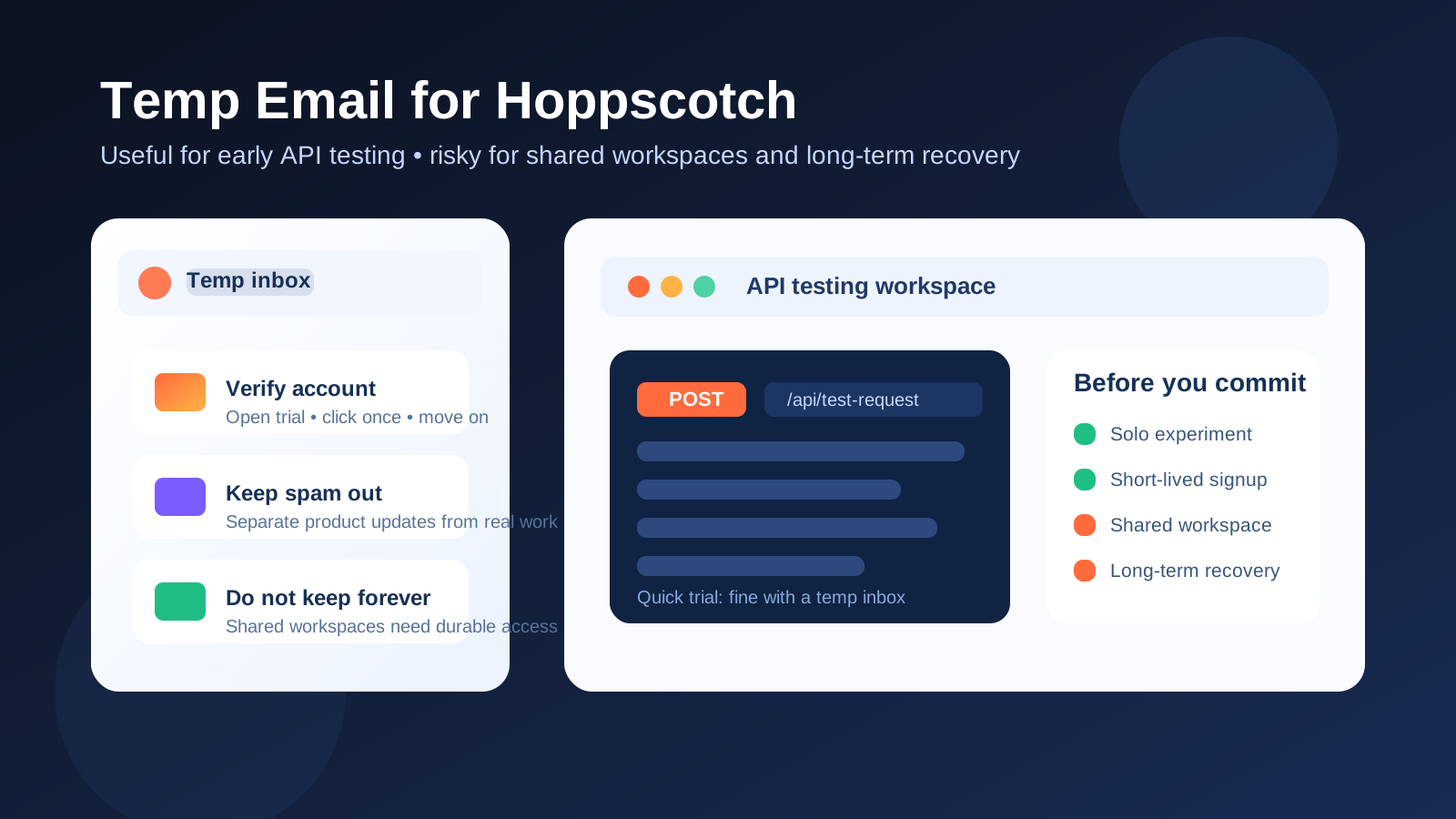
That is the short answer, but the real decision depends on how you plan to use Hoppscotch. Some people only want to compare it with Postman or Insomnia, test a couple of requests, and see whether the interface fits their workflow. In that case, a temporary inbox can be sensible. Other people are setting up collaborative workspaces, saving environments, sharing collections, or tying the account to broader development work. In those situations, a disposable address can create more problems than it solves.
Hoppscotch sits in a category where privacy and practicality pull in opposite directions. On one side, developers often want to protect their primary inbox from trial spam, product updates, webinar invites, and follow-up outreach. On the other side, API tools become more valuable when they store durable project context. The right answer is not “always use a temporary address” or “never do it.” The right answer is to match the inbox to the importance of the account.
Why people consider a temp email for Hoppscotch
There are a few normal reasons someone might want a disposable inbox for Hoppscotch:
- They are comparing API tools and do not want another long-term vendor list in their main inbox.
- They only need to verify an account for a short product evaluation.
- They want to separate low-stakes testing from their permanent work identity.
- They are exploring shared features before deciding whether Hoppscotch will become part of a real workflow.
Those are all reasonable. Temporary email is often less about secrecy and more about reducing clutter. If you are signing up for multiple developer tools in the same week, the welcome sequences and follow-up messages add up fast. A separate inbox can keep that noise away from your real work mail.
When using a temp email for Hoppscotch makes sense
A temp email for Hoppscotch is usually fine when the account is disposable in the everyday sense of the word. That means you would not be upset if the inbox disappears later because nothing mission-critical depends on it.
1. You are doing a fast product comparison
If you want to spend thirty minutes comparing Hoppscotch against tools like Postman or Insomnia, a temporary inbox is practical. You can verify the account, look at the interface, send a few requests, try environments or collections, and decide whether the tool deserves a deeper look.
2. You are testing alone
Solo experiments are the safest place for disposable email. If you are not inviting teammates, not creating shared ownership, and not storing anything you truly need to preserve, the downside stays small.
3. You only need short-term access
Some signups are genuinely temporary: a workshop, a one-day comparison, an internal note, or a quick validation of how onboarding works. If the account has a clear expiration date in your head, a temporary inbox is easier to justify.
4. You want to protect your main inbox during early research
This is one of the better reasons. If you are in the “just browsing” stage, there is no reason every test account has to attach itself to the email address you use for daily development work, client communication, or security alerts.
When a temporary inbox is a bad idea
This is where people get tripped up. Hoppscotch can start as a casual tool evaluation and become important surprisingly quickly. Once that happens, a disposable inbox stops being convenient and starts being fragile.
1. The account will be tied to a team workspace
If coworkers are going to share requests, environments, history, or collaboration inside the account, use an address you control long term. Team workflows need dependable ownership. A throwaway inbox is the opposite of dependable ownership.
2. You may need account recovery later
Recovery is the most obvious risk. If you lose access to the mailbox, you may lose access to password resets, login links, security notices, or ownership verification. That might be tolerable for a throwaway trial and painful for a real project.
3. The account will hold important environments or project context
API tools can quickly stop being “just a test.” You may save headers, base URLs, variable names, mock flows, GraphQL queries, or collaboration notes you actually want to keep. Once that starts happening, move to a durable inbox.
4. You expect long-term notifications to matter
Product updates, invite notices, access changes, or security alerts may seem unimportant at the beginning. They become more important when the tool turns into part of your stack. A temporary inbox is bad at long-term continuity by design.
A practical rule: temporary for evaluation, durable for adoption
The cleanest rule is simple: use a temporary inbox for evaluation, then switch to a stable inbox for adoption. That keeps the privacy benefits without pretending a throwaway address should carry a real collaborative workload forever.
For example, if you use Anonibox or another temporary inbox to explore Hoppscotch for the first time, that is perfectly reasonable. Verify the account, test the UI, and judge the tool. But the moment you decide, “Yes, this will be part of our actual API workflow,” you should treat the account like real infrastructure and attach it to an inbox you control long term.
What can go wrong if you keep the temp email too long?
The main risks are not abstract. They are boring, practical, and annoying — which is exactly why they cause trouble.
- Lost resets: you need to log back in weeks later and the recovery email is gone.
- Broken collaboration: teammates depend on a workspace that is tied to an inbox nobody actively controls.
- Missed notifications: ownership changes, invite acceptance, or security messages never reach you in time.
- Messy handoffs: a quick solo test quietly becomes a shared internal tool, but the account foundation is still disposable.
None of these issues are dramatic when they happen on day one. They become expensive when they surface after real work has already piled up on the account.
How to use a temp email for Hoppscotch safely
If you do want to use a temporary inbox, treat it as a controlled experiment rather than a default habit.
Step 1: decide what the account is for before you sign up
Ask yourself one question first: “Am I evaluating Hoppscotch, or am I setting it up for ongoing use?” If the honest answer is evaluation, a temp email may be fine. If the honest answer is ongoing use, skip the disposable route.
Step 2: keep the test scope narrow
Use the account for low-risk tasks only: a quick onboarding pass, a few sample requests, a small comparison with another API client, or a first look at collaboration features. Do not let the test quietly become production-adjacent work.
Step 3: save what matters outside the mailbox
If there are setup steps, URLs, or notes you may need later, copy them into your own documentation. Temporary inboxes are good for reducing clutter, not for acting as your long-term source of truth.
Step 4: migrate early if the tool proves useful
The minute Hoppscotch looks like a keeper, move to a stable address. Do not wait until you have invited teammates, stored a pile of environments, or forgotten which mailbox was used.
Better alternatives than a pure throwaway inbox
If you like the privacy benefits of temp email but hate the fragility, there are middle-ground options that are often better.
Use a dedicated developer inbox
A separate long-term inbox just for software trials, API tools, and technical evaluations is often the best compromise. It protects your primary inbox without making recovery impossible.
Use an alias you control
An alias keeps signups organized while still routing to an address you own. That can be much better than a fully disposable inbox if you think the tool might matter later.
Use a team-managed address for shared ownership
If the account is likely to become collaborative, start with a mailbox that can survive role changes and handoffs. That matters much more than short-term inbox neatness.
Who should avoid disposable email for Hoppscotch right away?
A few groups should be more cautious from the start:
- Engineering teams evaluating the tool for standardization because the account may turn into shared infrastructure quickly.
- Consultants setting up client-facing workspaces because ownership and handoff clarity matter.
- Anyone storing meaningful project assets because future recovery may matter more than short-term privacy.
- People who already know they like the tool because the “temporary” phase is basically over before it starts.
Who is the best fit for a temp email here?
Temporary email is a stronger fit for:
- solo developers doing one-off tool comparisons
- students or learners exploring API clients for practice
- short-lived internal experiments with no shared dependency
- privacy-conscious users who want to avoid extra marketing mail during early testing
In those cases, the trade-off makes sense because the account is genuinely disposable, not just treated that way temporarily.
A quick decision checklist
- Will this account still matter in a month?
- Will anyone besides me depend on it?
- Would losing mailbox access be annoying or damaging?
- Am I testing Hoppscotch casually or adopting it seriously?
- Would a dedicated permanent alias solve the same problem with less risk?
If your answers lean toward short-term, solo, and low-risk, a temp email for Hoppscotch is reasonable. If they lean toward shared, durable, and important, use a stable inbox instead.
Final answer
A temp email for Hoppscotch is useful for early API testing, account verification, and short product evaluations where you want less inbox clutter and more privacy. It becomes a bad fit once the account starts to matter for team access, shared workspaces, recovery, or anything close to long-term operational use.
So yes, use temporary email if your goal is quick evaluation. Just do not confuse a short-lived testing convenience with a safe foundation for an account your future self or your team will actually need to keep.