A temp email for Authentik is useful for early identity testing, verification checks, and disposable staging accounts.
It is a bad fit for production admins, shared team access, or any account you may need to recover later.
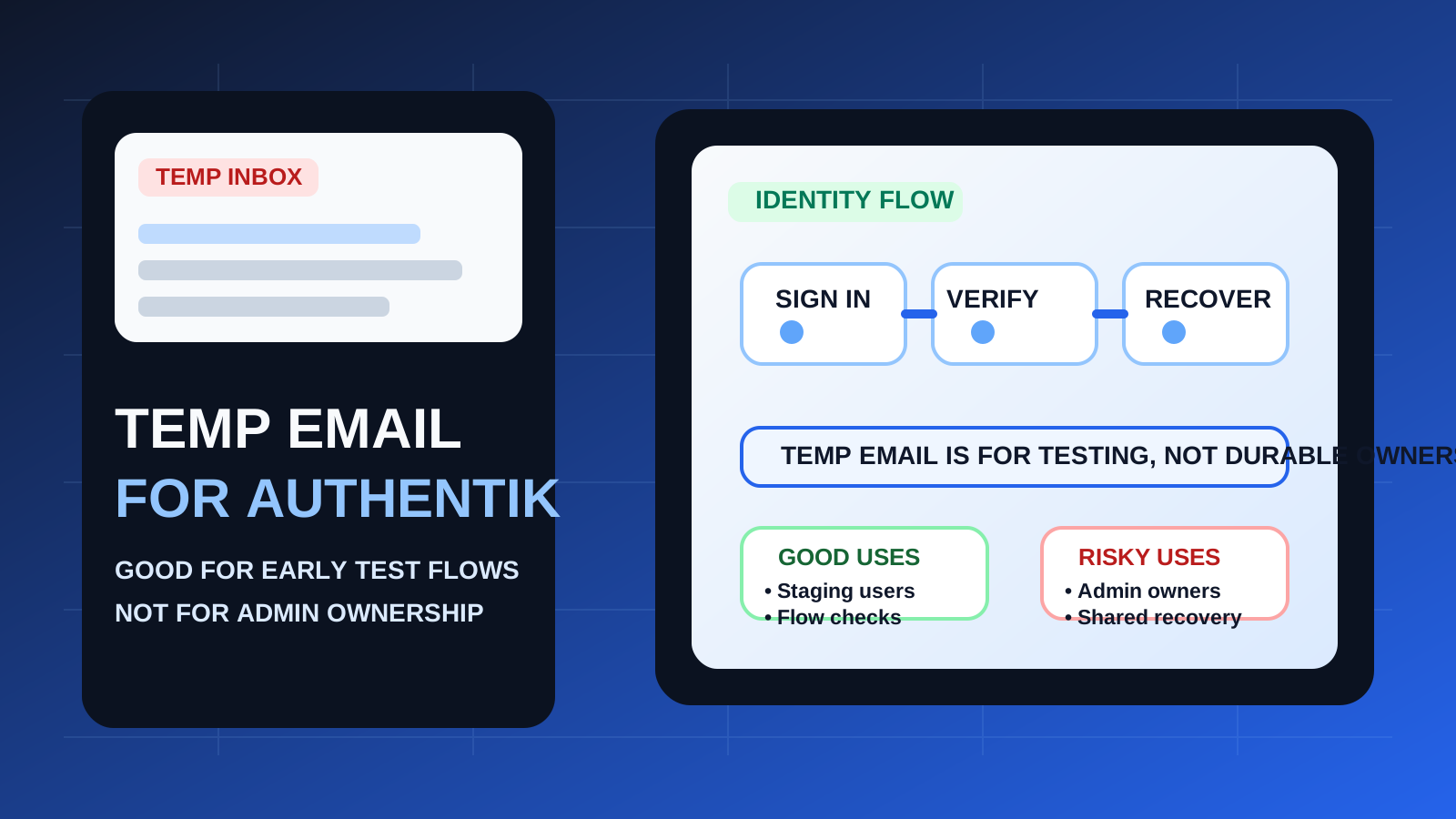
If you are evaluating Authentik, email usually becomes relevant earlier than people expect. Even when the bigger goal is identity, access control, or login flow validation, you still end up dealing with inbox-dependent steps: account setup, verification messages, invites, recovery checks, and admin access changes. That is why people look for a temp email for Authentik in the first place. They want to test the flow without tying yet another platform to a personal or team inbox forever.
That is a sensible instinct for early testing. A disposable inbox can be genuinely useful when you are spinning up a proof of concept, checking whether an email-triggered flow behaves correctly, or creating short-lived accounts for staging and QA. But temporary email stops being smart the moment the account itself stops being temporary. If the inbox belongs to an admin, a shared operator account, or any identity your team may depend on later, the convenience drops fast and the recovery risk rises just as quickly.
The practical answer is simple: use temporary email for temporary Authentik work. Use a stable inbox for anything operational, collaborative, or long-lived.
Why people use temporary email with Authentik
Most people are not trying to be sneaky. They are trying to stay organized while they test identity workflows.
- Inbox control: early testing can trigger multiple verification and recovery emails, and not everyone wants those mixed into a daily mailbox.
- Fast throwaway testing: disposable inboxes let you create short-lived users without managing a pile of permanent test addresses.
- Cleaner comparisons: if you are evaluating Authentik next to other identity tools, separate inboxes make each test easier to isolate.
- Lower commitment during exploration: before you decide whether the platform deserves deeper effort, a temp inbox helps you avoid turning casual evaluation into a long-term email relationship.
That is where a service like Anonibox fits naturally. It lets you complete the immediate inbox step and move on without carrying every experimental login into your normal email environment.
When a temp email for Authentik makes sense
There are several situations where temporary email is a good and sensible fit.
1. Early sign-up and verification checks
If you only want to see whether setup works, whether a verification email arrives, and whether the basic identity flow behaves as expected, a temporary inbox is usually fine. The account exists to answer a short testing question, not to become a durable part of your stack.
2. Staging or sandbox accounts
Identity work often requires multiple fresh users. You may want one for a basic user role, another for admin review, and a third for an edge case or alternate flow. Temporary inboxes are helpful when those accounts are intentionally disposable and live only inside a staging environment.
3. Password-reset and recovery flow testing
A lot of identity evaluation comes down to the details around the core login. Recovery, verification, and email-triggered security steps often matter as much as the sign-in page itself. If you are simply testing whether those messages send correctly and point to the right screens, a temporary inbox can save time.
4. Comparing identity platforms before a real decision
Teams rarely evaluate just one identity product in isolation. You may be comparing setup complexity, user experience, or admin friction across several options. In that early phase, a separate disposable inbox for each test can reduce clutter and make it easier to abandon accounts that never move beyond the shortlist stage.
Where temporary email becomes risky
Temporary email only works well when the surrounding account is temporary too. Problems start when the account becomes important but the inbox behind it still is not reliable.
1. Production admins need durable recovery
If an Authentik account has real administrative importance, the recovery path matters. You may need that inbox later for a password reset, a security confirmation, an invitation, or proof of control. A throwaway inbox is weak support for a long-lived admin identity.
2. Shared team access outgrows disposable email quickly
The moment more than one person cares about an account, stable ownership becomes much more important. Teams change, people go on leave, responsibilities move, and operational access gets handed off. If the account depends on a temporary inbox that nobody still controls, a small shortcut becomes unnecessary friction for everyone.
3. Long-running pilots quietly stop being temporary
This is one of the most common mistakes. Someone creates an account “just to test,” the product looks promising, and that same login ends up sticking around for weeks or months. Now settings, notes, connectors, and habits accumulate around an inbox that was never meant to last. That is how disposable convenience turns into avoidable technical debt.
4. Recovery-sensitive workflows deserve better
If you expect to revisit the account, audit changes, validate ownership, or confirm admin actions later, use a stable address from the start. Identity tools are precisely the kind of systems where long-tail recovery problems can hurt more than early inbox clutter.
A practical rule of thumb
Use a temp email for Authentik when you are testing behavior. Do not use one when you are establishing durable ownership.
That rule keeps the decision honest. If the account is disposable, the inbox can be disposable. If the account may matter to your product, your team, or your recovery path later, the inbox should not be temporary.
How to test Authentik responsibly with a temp inbox
1. Decide upfront whether the account is short-term or long-term
Do not let that answer drift. Before you create the account, decide whether it is only for evaluation, staging, or one-time QA. If there is even a fair chance it will become your real admin or shared team account, use a permanent inbox from the beginning.
2. Keep throwaway users separate from meaningful identities
Temporary accounts are easiest to manage when they are clearly labeled and obviously disposable. If you blur test users together with meaningful accounts, people forget which ones can safely disappear and which ones cannot.
3. Save the testing observations that matter
If the inbox helped you confirm something important, capture it while the messages are still available. Useful notes might include:
- how quickly verification or reset emails arrived
- whether the links pointed to the correct screens
- any copy, formatting, or routing problems in the messages
- what would need to change before you would trust the flow in a real environment
A temporary inbox is a testing tool, not your long-term documentation system.
4. Migrate early if the account starts to matter
If a proof of concept starts turning into something real, switch the email while the account is still easy to clean up. Waiting until the account holds meaningful settings or becomes central to team workflows makes the transition harder than it needs to be.
5. Avoid using one throwaway inbox for everything
When you test multiple flows, environments, or user roles through the same temporary inbox, the messages become harder to interpret. Separate tests are easier to reason about when each one has its own clean context.
Good examples of temporary-email use with Authentik
- checking a first-run setup flow
- testing verification or password-reset emails in staging
- creating disposable QA users for edge-case testing
- comparing Authentik against other identity options before making a decision
- reviewing message delivery and link behavior during a short proof of concept
Bad examples of temporary-email use with Authentik
- creating a real production admin account
- setting up a shared operator or owner login for your team
- using a throwaway inbox for any account you may need to recover later
- keeping a disposable address attached after a pilot becomes real operational infrastructure
- relying on temp email for long-running client, stakeholder, or internal admin workflows
How this compares with nearby identity-tool articles
The same logic shows up across similar identity platforms. If you have already looked at articles such as Temp Email for Auth0, Temp Email for Keycloak, Temp Email for LoginRadius, or Temp Email for WorkOS, the pattern will feel familiar: temporary email is excellent for early access-flow testing and poor for anything that depends on long-term continuity. Authentik fits that exact category. The inbox choice matters less during experimentation and much more once ownership and recovery become real.
Common mistakes to avoid
- Letting a test account become permanent by accident: this is the most common source of later pain.
- Using disposable email for admin identities: short-term convenience is not worth long-term recovery trouble.
- Ignoring shared ownership: an account that multiple people depend on needs a stable foundation.
- Forgetting to document what you tested: save the useful observations before the inbox disappears.
- Thinking only about spam: inbox clutter matters, but continuity and recovery matter more in identity systems.
Should you use a temp email for Authentik?
Yes, if you are doing short-lived evaluation, staging checks, verification testing, or disposable QA work.
No, if the account is becoming important to your team, your environment, or your recovery path. Identity platforms are exactly where stable ownership usually matters more than people realize on day one.
Final takeaway
A temp email for Authentik is a practical choice when you need quick inbox access for sign-up checks, staging identities, verification flows, or recovery-path testing during evaluation.
It becomes risky once the account is tied to real admin authority, shared team workflows, or any setup you may need to recover later. Use temporary email for short-lived testing, then move to a permanent address before the account stops being temporary.