Yes, you can use SimpleLogin for informational interviews if the alias is stable, forwards reliably, and you can reply without making the conversation messy or easy to lose.
No, it is not a great choice if you plan to rotate aliases quickly, ignore the forwarded inbox, or treat the setup like a throwaway address when the contact may follow up weeks later.
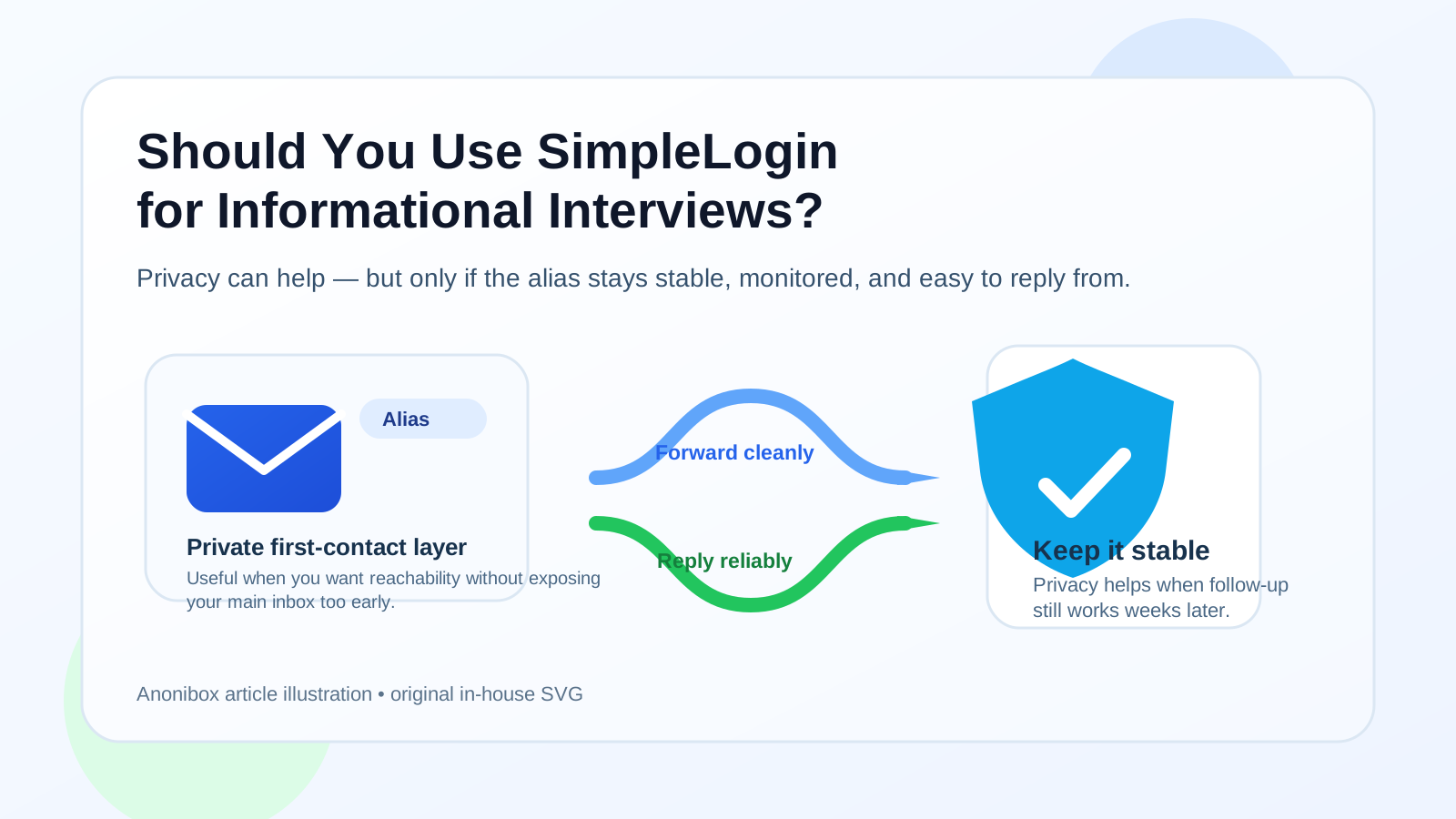
That is the real trade-off behind this question. Informational interviews are usually lower pressure than formal job interviews, but they still matter. You may be talking to an alum, recruiter, hiring manager, founder, or industry contact to learn how a team works, what a role is really like, or whether a company is worth pursuing. Many of those conversations end after one helpful exchange. Some turn into referrals, introductions, or later opportunities. Because of that, you want some privacy without creating a fragile communication setup.
SimpleLogin appeals to privacy-minded job seekers because it sits in the middle. It is not the same as giving out your main inbox everywhere, and it is not the same as using a disposable address you expect to abandon quickly. In principle, that makes it a solid fit for informational interviews. In practice, it only works well when you use it like a real communication tool instead of a clever privacy trick.
Why people consider SimpleLogin for informational interviews
Most people who ask this are trying to solve one of three problems.
- They do not want to hand out their main inbox too early. A separate alias creates some distance while still letting someone reach them.
- They want better organization. Informational interviews often happen during a broader job search, and a dedicated alias can help separate networking messages from everyday personal email.
- They want privacy without looking flaky. A throwaway inbox can feel risky for follow-up, while a stable alias feels more professional if it is handled well.
That middle-ground appeal is the strongest argument for using SimpleLogin here. You are not necessarily trying to disappear. You are trying to control access while still staying reachable.
Why informational interviews need more stability than casual signups
Informational interviews are awkward because they are both low-stakes and potentially high-value. A quick conversation with an alum might go nowhere. Then again, that same person might email three weeks later with a referral link, a role opening, or an introduction to someone else on the team.
That delayed follow-up matters. It means your email setup should not be judged only by whether the first message arrives. It should be judged by whether the whole conversation can continue smoothly later. If an alias breaks, gets turned off, becomes confusing to manage, or makes your reply flow clumsy, you may lose the most valuable part of the interaction.
That is why a stable alias system can work better than a disposable inbox for this use case. The point is not just privacy on day one. The point is preserving privacy without sacrificing continuity.
When SimpleLogin is a good fit
You are doing broad exploratory networking
If you are reaching out to many alumni, community members, second-degree contacts, and recruiters at once, it can be helpful to avoid using your main everyday inbox for every first conversation. A dedicated alias gives you breathing room and keeps those messages in a more controlled lane.
You care about privacy but still expect serious follow-up
Some people know they do not want to use a disposable inbox, but they also do not want to hand over the same address they use for banks, family, subscriptions, and everything else. That is exactly the gap where an alias can make sense.
You already have a clean system behind the alias
SimpleLogin works best when the forwarding destination is an inbox you actually check, organize, and trust. If you already have a separate job-search inbox or a networking-focused workflow, the alias can fit naturally into it instead of becoming one more thing to forget.
You want per-contact or per-context separation
One practical benefit of alias-based tools is that they can help you control how much exposure each context gets. That can be useful when you want to keep informational-interview outreach separate from applications, newsletters, events, or recruiter blasts. Used carefully, that separation can make your search feel calmer and easier to audit later.
When SimpleLogin can create friction
You do not fully understand your own reply flow
This is the biggest risk. Forwarding mail into your real inbox is only half the story. Before you use any alias service for important conversations, you should know exactly how replies behave in your setup. If you are unsure whether your response will preserve the alias correctly, or whether the other person will suddenly see a different underlying address than expected, test it before using it with a live contact.
That does not mean the tool is bad. It means informational interviews are not the place to discover your setup’s rough edges.
You plan to rotate aliases too aggressively
An informational interview is not a one-minute coupon signup. If you create an alias and then disable it quickly, or if you treat every new contact as disposable, you may block a useful follow-up later. Privacy tools become counterproductive when they cut off legitimate relationship-building.
You already struggle with job-search organization
Some people add privacy layers when what they really need is a simpler process. If your notes are scattered, your follow-up is inconsistent, and your inbox is already chaotic, adding an alias system may increase complexity instead of reducing it. Better organization beats clever routing every time.
You are using it because you distrust every contact equally
It is fine to want boundaries. It is less helpful to build a workflow around assuming every informational-interview contact is a threat. Career conversations work better when your privacy choices are deliberate rather than defensive. The goal is controlled reachability, not paranoia.
How SimpleLogin compares with other options
Compared with your main personal email
Your main address is simple and dependable, which is why many people use it. The downside is that once it spreads through networking, recruiter lists, newsletters, event follow-ups, and future outreach, it is hard to take back. A stable alias gives you more control while staying fairly professional.
Compared with a temporary or burner inbox
For informational interviews, SimpleLogin is usually the better fit because it is designed around continuity rather than short life. A disposable inbox may be fine for low-stakes signups or quick content unlocks. An informational interview often deserves something sturdier.
If you want fast separation for lower-stakes outreach, a service like Anonibox can still be useful for early filtering or short-lived exposure. But when the whole point is to keep a genuine professional conversation reachable over time, a stable alias tends to be the safer choice.
Compared with a general email alias or forwarding setup
The broad question is not just whether aliases are useful. It is whether this specific alias setup stays simple enough under real use. That is where SimpleLogin can be a good option if you value privacy and already know how to manage the alias cleanly. If you do not, a plain separate email account may actually be easier.
Best practices if you use SimpleLogin for informational interviews
1. Test the full loop before you share it
Send a message to the alias, confirm it forwards correctly, and confirm your reply behaves the way you expect. Do not test halfway. You want to know that incoming mail, outgoing replies, and ongoing threads all feel normal enough that you will not think about them during a real conversation.
2. Keep the alias alive long enough to matter
Informational interviews can produce delayed follow-up. Keep the alias active for the full period during which a realistic opportunity, introduction, or question might still come back. Do not shut it down the moment the first conversation ends.
3. Use clear notes for context
If you are speaking with multiple people, save their names, company names, where you met, and why the conversation matters. Privacy tools help with exposure, but they do not replace context. You still need to know who is who when someone replies after a few weeks.
4. Pair the alias with a stable underlying inbox
A forwarding alias is only as useful as the inbox behind it. If the destination inbox is neglected, overfiltered, or rarely checked, the alias becomes a liability. Reliability matters more than cleverness.
5. Switch channels when the relationship becomes real
You do not need to keep every valuable contact in alias mode forever. Once the relationship becomes active, trusted, and ongoing, it may make sense to continue with the same alias or move to a more direct address you intend to keep long term. What matters is that the transition is intentional rather than rushed.
Common mistakes to avoid
- Using an alias without understanding how replies work: if the setup feels mysterious to you, it will eventually cause friction.
- Turning off aliases too soon: delayed follow-up is common in networking.
- Assuming privacy tools replace judgment: they help with boundaries, not with deciding who deserves a reply.
- Overcomplicating your communication stack: one clean system is better than five privacy tools you barely manage.
- Using a disposable mentality for serious contacts: informational interviews can quietly become real opportunities.
What makes a contact setup feel professional?
Most informational-interview contacts are not evaluating you based on whether you use an alias tool. They are paying attention to whether you are prepared, respectful, easy to schedule with, and responsive afterward. A privacy-friendly setup is fine if it stays invisible in the good sense: the conversation works normally, and the other person never has to wonder whether you will miss their follow-up.
That means professionalism here is mostly operational. Do you reply on time? Do you thank them afterward? Do you keep the line open long enough for real follow-up? Do your messages feel consistent? If yes, the alias is not likely to be the problem.
Red flags where you may not want to share any email yet
- The person is vague about who they are or why they want to talk.
- The conversation jumps quickly to pressure, urgency, or sensitive requests.
- You are being pushed off a trusted platform before basic context is clear.
- The contact asks for personal data that has nothing to do with an informational interview.
In those cases, the better move may be not sharing an alias at all yet. Privacy is not only about choosing the right email structure. Sometimes it is about recognizing when a contact has not earned direct access of any kind.
A practical decision checklist
- Do I want privacy, better organization, or both?
- Have I tested how the alias forwards and how replies behave?
- Will I keep the alias active long enough for delayed follow-up?
- Is the underlying inbox one I actually monitor?
- Would a simple separate email account be easier for me than an alias workflow?
If those answers point toward stability and intentional use, SimpleLogin can be a strong option. If the setup still feels experimental, choose something simpler.
Final answer
Yes, you can use SimpleLogin for informational interviews, and for many privacy-conscious job seekers it is a sensible middle ground between oversharing a main inbox and relying on a disposable address. The key benefit is controlled reachability: you can protect your primary email while still keeping the conversation alive.
The catch is that alias-based privacy only helps when the setup is stable, tested, and easy to manage. If you know your forwarding and reply flow works, and you will keep the alias active long enough for real follow-up, SimpleLogin can be a practical and professional choice for informational interviews.