Telegram can work for informational interviews, but it is usually not the best default channel for first outreach or serious career conversations. It makes the most sense when both people already use Telegram, the conversation is warm rather than cold, and you are deliberately trying to limit how much personal contact information you share.
For most informational interviews, email or LinkedIn is still the safer and more professional first step. Telegram is better as an optional follow-up channel than as the main place to introduce yourself, schedule the conversation, and keep a long-term record.
Why this question comes up
Informational interviews live in an awkward middle ground. They are not formal job interviews, but they are not casual social chats either. You are usually asking someone for advice, context about a company, perspective on a role, or insight into an industry. That means the conversation needs enough warmth to feel human and enough structure to feel respectful.
Telegram enters the picture because it solves a few real problems. It lets people chat quickly, it can reduce dependence on sharing a phone number, and in some communities it is a normal way to stay in touch. If you met someone at an event, got introduced through a mutual contact, or belong to an industry group that already uses Telegram, moving the conversation there can feel easy.
Easy is not always the same as wise. The real question is whether Telegram helps you build trust while keeping reasonable boundaries. Sometimes it does. Sometimes it quietly makes you look less organized, less formal, or harder to verify than you intended.
Short answer: fine for warm context, weaker for first-contact professionalism
If you already know the person, were introduced by someone they trust, or the community already uses Telegram, the app can be perfectly workable for light coordination and brief follow-up. If you are reaching out cold, trying to make a strong first impression, or hoping to build a durable professional relationship, email or LinkedIn usually gives you a better starting point.
That is because informational interviews depend on tone, credibility, and follow-through. People are giving you their time, not processing you through a formal hiring system. The more frictionless and trustworthy you make the exchange, the better your odds of getting a yes.
What Telegram does well in this situation
1. It can protect a little more personal contact data than SMS
One reason people consider Telegram is that it can sometimes let you connect through a username instead of immediately exposing a phone number in the same way standard texting does. For privacy-conscious job seekers, that feels cleaner. If you are trying to keep your job search separate from your everyday contacts, that separation can matter.
This is especially relevant if you are talking to multiple alumni, mentors, recruiters, or founders in a short period and you do not want every conversation tied directly to your primary number from the start.
2. It works well for quick back-and-forth scheduling
Once the relationship already exists, Telegram can be convenient for messages like “Would Tuesday or Thursday work?” or “Here is the Zoom link” or “Running five minutes late.” It is faster than long email threads and more fluid than some professional platforms.
That convenience becomes more valuable when both people already check Telegram regularly. If one person treats it as a primary messaging tool and the other barely opens it, the advantage disappears fast.
3. It can fit international or startup-heavy circles
Some professional communities use Telegram much more casually than others. In certain startup, crypto, developer, policy, and international networks, it may feel normal enough that using it does not raise eyebrows. Context matters. A medium that seems too casual in one industry may be ordinary in another.
Even then, ordinary is not the same as ideal. A familiar tool can still be a weaker place for documentation, credibility, and long-term follow-up.
Where Telegram can create problems
1. It may feel too casual for a first impression
An informational interview is often the first real professional conversation between two people. That first interaction shapes whether you seem thoughtful, credible, and respectful of the other person’s time. Email and LinkedIn naturally signal that you understand professional context. Telegram does that less reliably.
If you message someone out of the blue on Telegram, the contact can feel abrupt or oddly intimate. Even if your note is polite, the channel itself may make the approach feel less grounded than a well-written email or a concise LinkedIn message.
2. Identity verification is weaker
On email, people can see domains. On LinkedIn, they can review your profile, work history, and mutual connections. On Telegram, identity cues can be thinner. A display name, a handle, and a profile picture are not always enough to create trust. That matters when you are asking a stranger or weak tie to spend time helping you.
It also matters for your own safety. If someone claims to be an employee, founder, alumnus, or hiring manager, Telegram by itself gives you fewer built-in signals that the person is who they say they are.
3. Long-term recordkeeping is weaker than email
Informational interviews usually create follow-up tasks: thank-you notes, articles to send, referrals to pursue, names to remember, advice to revisit, and sometimes later job leads. Email threads are better for this kind of durable record. They are easier to search, easier to archive, and easier to revisit months later when you want to reconnect.
Telegram threads can work, but they are easier to lose in the flow of daily chat. If you use the app for friends, communities, news channels, and work-adjacent conversations, an important career thread can get buried surprisingly fast.
4. Boundaries can get blurry
Informational interviews go best when both people know what the relationship is. Telegram can blur that line a little. A mentor-like contact can start feeling like a casual chat contact, which may lead to too many follow-ups, off-hours messages, or a tone that becomes more familiar than the relationship actually is.
That is not a Telegram-specific flaw so much as a messaging-app dynamic. Still, it matters because career conversations often involve power imbalance. You are asking for time, perspective, or access. A channel with weaker built-in boundaries can make it easier to misread the social rules.
When Telegram is a reasonable choice
Telegram is usually most reasonable when at least one of these conditions is true:
- You were introduced by a mutual contact and Telegram is how that network already communicates.
- The other person explicitly offered their Telegram handle.
- You already had a short conversation elsewhere and are only moving to Telegram for scheduling or quick follow-up.
- The interaction is time-sensitive and both people clearly prefer Telegram.
- You want a faster coordination channel after trust has already been established.
In those situations, using Telegram is not automatically unprofessional. It just works best when it is responding to established context rather than forcing a new one.
When you should probably avoid it
You should usually avoid Telegram as the main channel when:
- You are reaching out cold to someone you have never spoken to.
- You want to make a polished first impression on an alumnus, manager, or senior professional.
- You need a reliable record of attachments, scheduling details, and follow-up promises.
- You are unsure whether the other person actually uses Telegram often.
- You are talking about sensitive career questions and want a cleaner professional boundary.
In those cases, email usually wins on clarity and LinkedIn usually wins on context. Telegram may still become useful later, but it rarely needs to be the first move.
Safer alternatives for most informational interviews
Email is still the strongest default if you want a calm, professional, searchable thread. It gives the other person time to respond on their own schedule, makes it easy to share context, and creates a record you can return to later.
If privacy is part of your concern, many job seekers use a separate address for outreach so career conversations do not mix with personal inbox traffic. That is where a tool like Anonibox can be useful during the early outreach phase, especially if you want to keep your primary inbox from collecting newsletters, recruiter follow-ups, or unexpected forwarding chains. For longer-term professional relationships, though, you should still move important contacts into an address you monitor reliably.
LinkedIn Messages
LinkedIn is often a strong first-contact option because it answers the basic “Who are you?” question immediately. Your profile, mutual contacts, and role history do part of the credibility work for you. If the person accepts messages there, it is usually a more natural starting point than Telegram.
Calendar plus email for confirmed conversations
Once someone agrees to talk, email still tends to be the cleanest place to confirm time, send a calendar invite, and share a video link. Even if you continue lighter chat elsewhere, keeping the core logistics in email reduces confusion.
If you do use Telegram, how should you use it well?
Lead with context
Do not open with a vague “Hi” or an immediate ask. State who introduced you, where you met, or why you are reaching out. The other person should understand the context within one short message.
Keep the ask modest
Informational interviews work best when the request feels specific and easy to answer. Ask for 15 to 20 minutes, not “a long chat.” Say what you want to learn. Make it easy to say yes.
Move important details into a durable format
If the conversation becomes real, consider shifting scheduling, documents, or follow-up resources into email. Telegram can handle speed, but email handles memory better.
Respect working hours and reply pace
Messaging apps create a false sense of immediacy. That does not mean the other person owes you a fast response. Treat Telegram like a convenience, not a claim on someone’s attention.
Be cautious with sensitive information
Do not overshare personal details, résumés, identity documents, or confidential job-search information just because the chat feels informal. Informal channels can make people drop their guard.
Red flags to watch for
- The person refuses to verify who they are through any professional channel.
- The conversation jumps quickly from “career advice” to pressure about an opportunity.
- You are pushed to move off a verifiable channel before trust exists.
- The contact avoids reasonable questions about role, company, or background.
- You are asked for money, identity documents, or codes.
Those are not normal informational-interview dynamics. They are signs to slow down or stop.
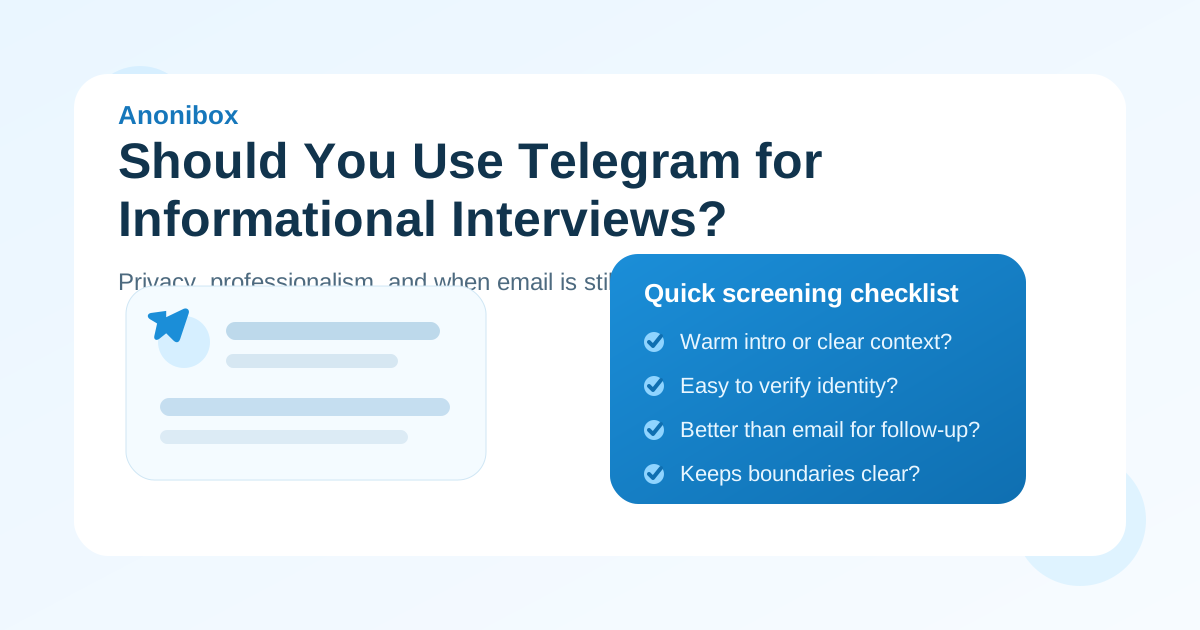
A simple decision checklist
- Did the other person offer Telegram first?
- Is this a warm introduction rather than cold outreach?
- Will Telegram make scheduling easier without hurting professionalism?
- Do I have another channel for durable follow-up if this conversation becomes important?
- Am I using Telegram for convenience, or because I am avoiding a more credible channel?
If your answers point to warm context, mutual comfort, and low-risk coordination, Telegram can be fine. If your answers point to uncertainty, weak verification, or a need for a stronger first impression, use email or LinkedIn instead.
Final answer
Telegram can be acceptable for informational interviews, but it is usually better as a secondary channel than as the main professional doorway. It works best when the relationship already has context, both people already use the app, and you are using it for light coordination rather than trying to build credibility from zero.
If you want the safest default, start with email or LinkedIn. Use Telegram only when it genuinely improves convenience without making the interaction feel less trustworthy, less professional, or harder to track. That balance matters more than the app itself.