Usually no — your college email is rarely the best address for data broker removal services because these requests can trigger follow-up messages months later, while school accounts often expire, change policies, or stay tied to an institution you do not fully control.
If you want privacy and long-term access, a personal account you control or a dedicated separate inbox is usually safer than a student address, especially once graduation, alumni changes, or forwarding problems enter the picture.
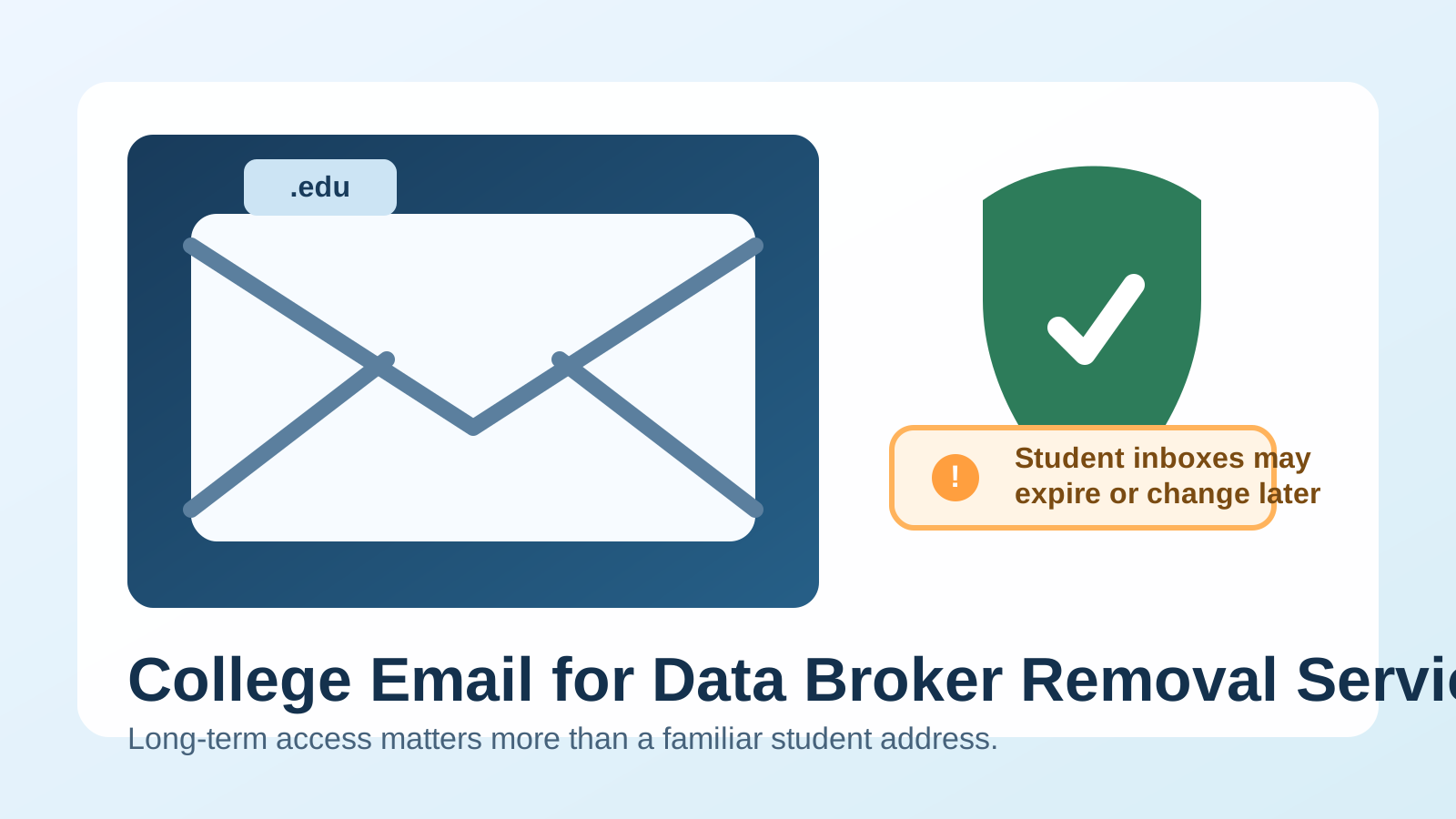
At first glance, a college email can seem like a smart privacy buffer. It is separate from your oldest personal inbox, it may feel more professional than a random free address, and some people trust it more because it came from a university. But data broker removal is not a one-and-done interaction. It often involves confirmation links, opt-out receipts, follow-up notices, identity-verification replies, and occasional re-contact over time. That makes stability almost as important as privacy.
For most people, the better question is not “Can I use my college email?” but “Will I still control that inbox when a broker, vendor, or removal service writes back six months from now?” If the answer is uncertain, your student address is a weak foundation for a long-running privacy workflow.
Why people consider using a college email in the first place
The idea is understandable. A college address can create separation from your primary personal inbox, and that separation is often useful. If you are already cautious about who gets your main contact details, using a student address may feel like a reasonable middle ground between your real personal email and a throwaway inbox.
People are usually drawn to college email for a few practical reasons:
- It feels semi-separate: you are not exposing your oldest personal inbox to every privacy request, broker, or third-party form.
- It may look credible: some users assume an institutional address appears more trustworthy than a disposable-looking free inbox.
- It may already be organized: students often keep school-related forms, research accounts, and identity paperwork in one place.
- It can reduce clutter in the short term: if a removal request generates several follow-up messages, at least they do not hit your daily inbox right away.
Those advantages are real, but they are usually short-term advantages. Data broker removal is a long-term maintenance project, not just a sign-up event. That is where a college address starts to look less practical.
The biggest risk: you may lose access later
This is the core problem. Many college email accounts do not last forever. Some schools deactivate them after graduation. Others convert them into limited alumni accounts. Some keep them active for years and then change the rules. Even when a school says alumni access continues, storage limits, forwarding behavior, login requirements, or account-recovery rules can change later.
That matters because data broker removal work often stretches out. You may need to:
- confirm an opt-out request,
- respond to a verification email,
- track whether a broker repopulated your data,
- receive a new message when a vendor changes policy, or
- revisit the same broker months later after your data appears again.
If your inbox disappears or becomes hard to access, you can lose the paper trail that proves what you requested and when. That creates friction exactly when you are trying to keep better control over your privacy.
A college account is still an institutional account
Even if you personally use the inbox every day, a school-issued address is not the same thing as a private address that you control independently. The institution sets the login rules, retention practices, suspension policies, and recovery path. You are borrowing that identity layer more than you are fully owning it.
That does not mean your school is reading your messages or doing anything improper. It simply means the account exists inside someone else’s system and under someone else’s policies. For ordinary student life, that may be perfectly fine. For a privacy project built around long-term control, it is not ideal.
In practical terms, institutional dependence can show up as:
- mandatory password resets or multifactor changes,
- account lockouts after inactivity,
- forwarding restrictions,
- policy changes after you leave school, or
- difficulty recovering the account once you are no longer part of the normal student support flow.
Why long-term follow-up matters for data broker removal
Temporary email can be useful when the goal is a quick sign-up, a one-time code, or a low-trust form you may never need again. Data broker removal is different. In many cases, you want to keep access to the inbox because the work is iterative.
For example, you may submit an opt-out today, receive confirmation next week, and then need to revisit that exact thread later if the listing comes back. You might also need to compare timestamps, reference prior messages, or show that you made an earlier request. A stable inbox makes that easy. A school account with uncertain long-term access does not.
This is also why a completely disposable inbox is often the wrong final destination for broker removal even if a temporary email tool is useful earlier in your privacy workflow. Tools like Anonibox make sense when you want to keep low-trust signups or early research away from your main inbox, but for broker-removal records you usually want an address you can deliberately keep, monitor, and organize over time.
When a college email might be acceptable
There are a few situations where using a college email is not automatically a bad idea.
- You have confirmed permanent alumni access: not just vague hope, but a clear school policy you understand.
- You already use that inbox as a long-term personal admin address: meaning you genuinely plan to keep monitoring it.
- You are handling a narrow, short list of requests: rather than a broad ongoing removal project.
- You do not have a better separated option yet: and you need something more stable than a throwaway inbox today.
Even then, it is better to treat a college email as a compromise rather than the gold standard. If you can choose an address that is both separate and fully yours, that is usually the stronger privacy decision.
Better alternatives than a college email
If the goal is privacy without losing long-term access, you have better options than a student inbox.
1. A separate personal inbox dedicated to privacy tasks
This is the simplest answer for most people. Create a separate address you control yourself and reserve it for privacy requests, opt-outs, and related follow-up. It keeps your everyday inbox cleaner without creating institutional dependency.
2. An alias or forwarding setup you can rotate
If you already use aliasing, a dedicated alias for broker-removal work can help you organize incoming mail and identify where later spam or exposure originated. The key is that the alias should forward into an inbox you actually control long term.
3. A custom-domain email if you want maximum portability
For people who care a lot about long-term control, a custom-domain address gives you the ability to move providers without changing the public-facing address. That is often overkill for casual users, but it is stronger than relying on a school account you may not keep.
4. A temporary inbox for low-trust intake only
If you are researching brokers, comparing removal vendors, or testing which sites demand an email before you even understand their process, a temporary inbox can help reduce exposure at that early stage. Just do not confuse early-stage shielding with the best address for your durable records.
A practical workflow that works better
If you want a human-first setup that balances privacy with follow-up, use a simple layered workflow:
- Use a temporary or low-exposure address for low-trust research, vendor comparisons, or forms you are not sure you will revisit.
- Move serious broker-removal activity to a dedicated long-term inbox you own and check regularly.
- Keep a simple record of which broker got which address so you can trace future clutter or repopulation.
- Review access once in a while to make sure recovery methods, forwarding rules, and folders still work.
This gives you most of the privacy benefit people want from a college email without inheriting the uncertainty that comes with a school-managed account.
If you already used your college email, do not panic
You do not need to start over from scratch just because you already used a student address. The smarter move is to stabilize the situation now.
- Save important confirmation emails and opt-out receipts.
- Update contact details where services let you change your address.
- Forward or migrate useful broker-removal threads into an inbox you control.
- Check your school’s alumni-access and retention rules before assuming the account will last.
- Use a separate long-term address for new requests going forward.
That way, you reduce the risk of losing continuity later even if the college inbox was your starting point.
Quick checklist before you use any address for broker removal
- Will I still control this inbox in one year?
- Can I recover it easily if I lose access?
- Does it keep this project separate from my main personal inbox?
- Can I search and organize long follow-up threads here?
- If this address starts attracting junk later, do I have a clean way to rotate or isolate it?
If a college email fails the first question, it is usually not the right long-term choice.
Bottom line
You can use a college email for data broker removal services, but for most people it is not the best option. The main weakness is not professionalism or deliverability. It is control. A student address may be separate today, but if your access changes after graduation, inactivity, or a policy shift, you can lose the exact message history that makes long-term privacy work easier.
A better approach is to use an address you own, monitor, and can keep for as long as the cleanup process lasts. That could be a separate personal inbox, a stable alias setup, or a custom-domain address if you want more portability. And if you want to keep early low-trust forms away from your main inbox, Anonibox can help at the intake stage without forcing you to anchor your long-term removal record to a school-managed account.
In short: separation is good, but ownership matters more. For data broker removal, choose the inbox you will still control when the follow-up arrives later.