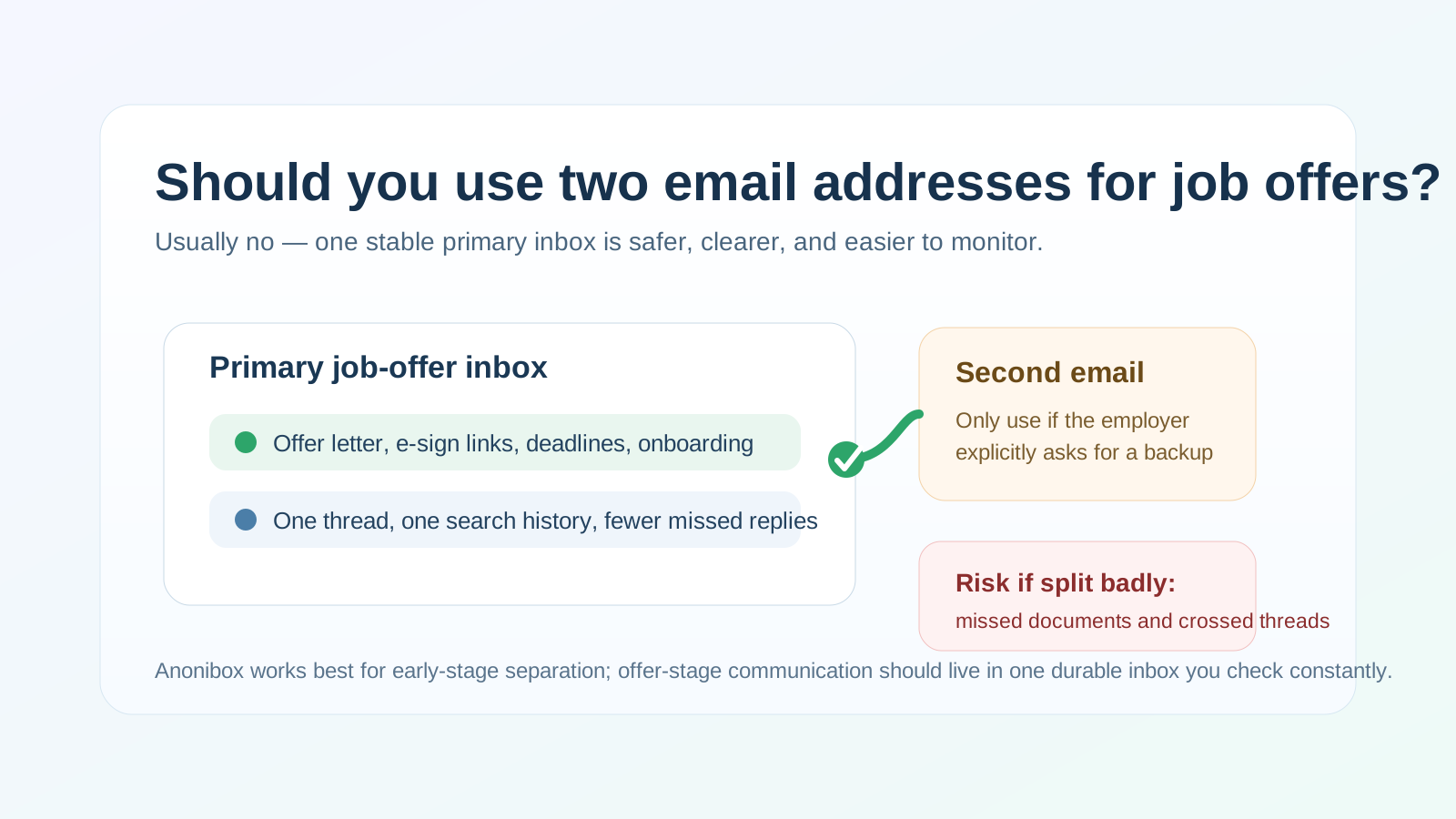
Usually no — for job offers, one stable primary inbox is better than splitting the conversation across two email addresses unless the employer explicitly asks for a backup.
Two addresses can create confusion, scatter offer letters and e-sign links, and make it easier to miss a deadline right when the stakes are highest.
Why people even consider using two email addresses for job offers
The question makes sense. Earlier in a job search, a lot of people try to keep their contact details compartmentalized. They may use one inbox for job boards, another for direct applications, and maybe a privacy-focused alias or forwarding setup for lower-trust sites. That can be smart when the main risk is spam, recruiter overflow, or unwanted marketing.
The offer stage feels different. You might want one address for the recruiter and another for HR. You might want to keep negotiation emails separate from onboarding paperwork. Or you may have started the search with one account and now wonder whether you should add a second, more permanent one before signing anything.
That is a reasonable instinct, but the best answer at the offer stage is usually clarity over complexity. A written offer, compensation summary, benefits packet, background-check link, and start-date message should not be bouncing between multiple inboxes unless there is a very specific reason.
Short answer: one durable inbox is usually the safer choice
Most job seekers are better off using one professional, stable, closely monitored email address for the entire offer process. That gives recruiters, hiring managers, HR staff, and outside onboarding vendors one clear point of contact. It also gives you one place to search when you need to find the signed letter, the updated compensation attachment, the deadline reminder, or the original thread that explained the next steps.
The biggest danger with two email addresses is not that employers will judge you for it. The bigger danger is operational: one reply goes to the wrong thread, one automated form uses the old address, one vendor sends a verification link to the other inbox, and suddenly you are spending the offer window untangling your own communication setup.
Why two email addresses can backfire during job offers
1. Important documents can land in the wrong inbox
Offer-stage communication is often document-heavy. One message may include the written offer, another may include an e-signature request, another may come from a background-check provider, and another may contain payroll or benefits instructions. If two addresses are in play, it becomes much easier for one step to go to the wrong place.
That matters because employers do not always send everything from the same person. The recruiter may write from one domain, HR from another, and a benefits or screening vendor from a third. If some contacts know one address and others know the second, the result can be a messy split you do not notice until a deadline is already close.
2. Reply chains get fragmented
Email threads are fragile. If you respond from one account, forward to another, or switch addresses midstream without clearly resetting expectations, people can lose context. One person replies to the old thread. Another starts a new thread. A third CCs the wrong mailbox. None of that feels dramatic until you are trying to confirm salary, start date, relocation timing, or signature status under time pressure.
3. Automated systems are not always flexible
Many offer-stage workflows are partly automated. A recruiting system may have one email on file. An onboarding portal may inherit it. A background-check vendor may use the address stored earlier in the process. If you suddenly introduce a second inbox, it may not become the real source of truth. Instead, you create a mismatch between what humans think they should use and what software keeps using.
4. You can miss urgent follow-up
At the application stage, missing one non-urgent recruiter follow-up is annoying. At the offer stage, missing an expiration notice, revised attachment, or scheduling question can matter a lot more. The more places you have to monitor, the easier it is to miss something time-sensitive.
When a second email address actually can make sense
Using two email addresses is not always wrong. It just should not be the default.
The employer explicitly asks for a backup contact
If a company requests a secondary email for continuity, recovery, or emergency contact routing, giving one can be fine. In that case, the second address is not replacing your primary inbox. It is a backup that the employer intentionally asked for.
You started with a risky or temporary setup and need to transition
If you began the search using a temporary inbox, a forwarding alias you no longer trust, or a low-maintenance account you do not want tied to a real offer, switching to a durable account makes sense. But even then, the goal should usually be to replace the old address, not run both in parallel forever.
This is where a service like Anonibox fits naturally. Early-stage separation can be useful when you are testing job boards, filtering recruiter noise, or protecting your primary inbox from spam. Once a legitimate job offer is in play, though, you usually want to consolidate into one dependable long-term address you fully control and check constantly.
You need internal separation, not external complexity
Some people keep one visible address for recruiters and one internal archive mailbox behind forwarding rules. That can work if the employer still sees only one address and you still manage everything from one reliable inbox. The important distinction is whether you are organizing things behind the scenes or whether the employer now has two different addresses to choose from.
Better alternatives than giving two email addresses
1. Use one dedicated job-search inbox
If you want separation from your everyday personal life, a dedicated long-term email account is usually the best middle ground. It can be separate from your main personal inbox without being temporary, disposable, or confusing.
A good offer-stage inbox should be:
- stable for months, not days
- easy for you to check several times a day
- professional enough that it will not distract from the conversation
- fully under your control, including password recovery and notifications
2. Use one alias that still routes into one mailbox
If you like the privacy and sorting benefits of aliases, a single alias that forwards into one main monitored inbox is usually cleaner than giving two unrelated addresses. That preserves organization without creating a split communication path.
3. Change addresses once, clearly, if you must
If you truly need to move from one email address to another, do it once and do it explicitly. Tell the recruiter and HR contact that going forward, all offer-related communication should use the new address. Ask them to confirm the update. Update any portal or onboarding system as soon as possible. The key is a clean handoff, not indefinite overlap.
If you already gave one address and now want to change it
Do not silently start replying from a second inbox and hope everyone adapts. Instead:
- Pick the one address you want to use going forward.
- Email the recruiter or HR contact from that address.
- State clearly that you would like all future job-offer communication sent there.
- Ask them to update the address on file for any related systems or vendors.
- Check both inboxes closely until they confirm the transition.
This approach is much safer than casually keeping two active addresses in circulation without clear ownership.
What if you want a backup anyway?
If you still prefer having a second address available, treat it as a backup rather than an equal communication lane. In practice, that means:
- one clearly designated primary email for all real communication
- the second address shared only if someone explicitly needs a fallback
- no switching back and forth mid-negotiation
- no mixing one inbox for recruiter messages and another for documents unless the employer specifically directs it
The employer should never have to guess which address you want them to use.
Situations where one inbox is especially important
Using one primary email matters even more when:
- you are comparing multiple offers and need clean records
- the employer uses e-signature or background-check vendors
- there are deadlines for acceptance, relocation, or notice periods
- you are coordinating with recruiter, hiring manager, and HR at the same time
- you expect benefits or onboarding documents to arrive in stages
All of those situations reward clarity. The last thing you want is to wonder which inbox contains the version you actually need.
Red flags to avoid
Be cautious if someone handling a supposed offer:
- pushes you to move to random personal email accounts instead of company domains
- changes contact methods repeatedly without explanation
- sends sensitive requests to different addresses in a way that feels sloppy or inconsistent
- asks for personal documents before you can verify who they are
Those are not automatic proof of fraud, but they are good reasons to slow down and confirm who is actually contacting you.
Quick checklist
- Do I have one stable inbox I can monitor closely?
- Is the second address solving a real problem or just adding complexity?
- Have I clearly told the employer which address is primary?
- Could an alias or forwarding rule solve this more cleanly?
- Am I moving away from an early-stage temporary setup before the offer gets more document-heavy?
Final answer
For most people, the best answer is no: do not use two email addresses for job offers unless there is a clear, practical reason and one address is still designated as the main one. The offer stage rewards reliability, continuity, and simple communication.
If privacy matters, keep using a separate long-term inbox or a controlled alias strategy. Just do not let privacy tools that work well earlier in the job search create confusion once the conversation shifts to offer letters, signatures, deadlines, and onboarding. At that point, one durable inbox is usually the smartest move.