Usually no — employment verification works best with one stable, well-monitored email address, not two.
If you want more privacy, use one separate verification inbox or an alias that routes into a single mailbox, rather than listing two addresses and hoping HR or a screening vendor uses the right one.
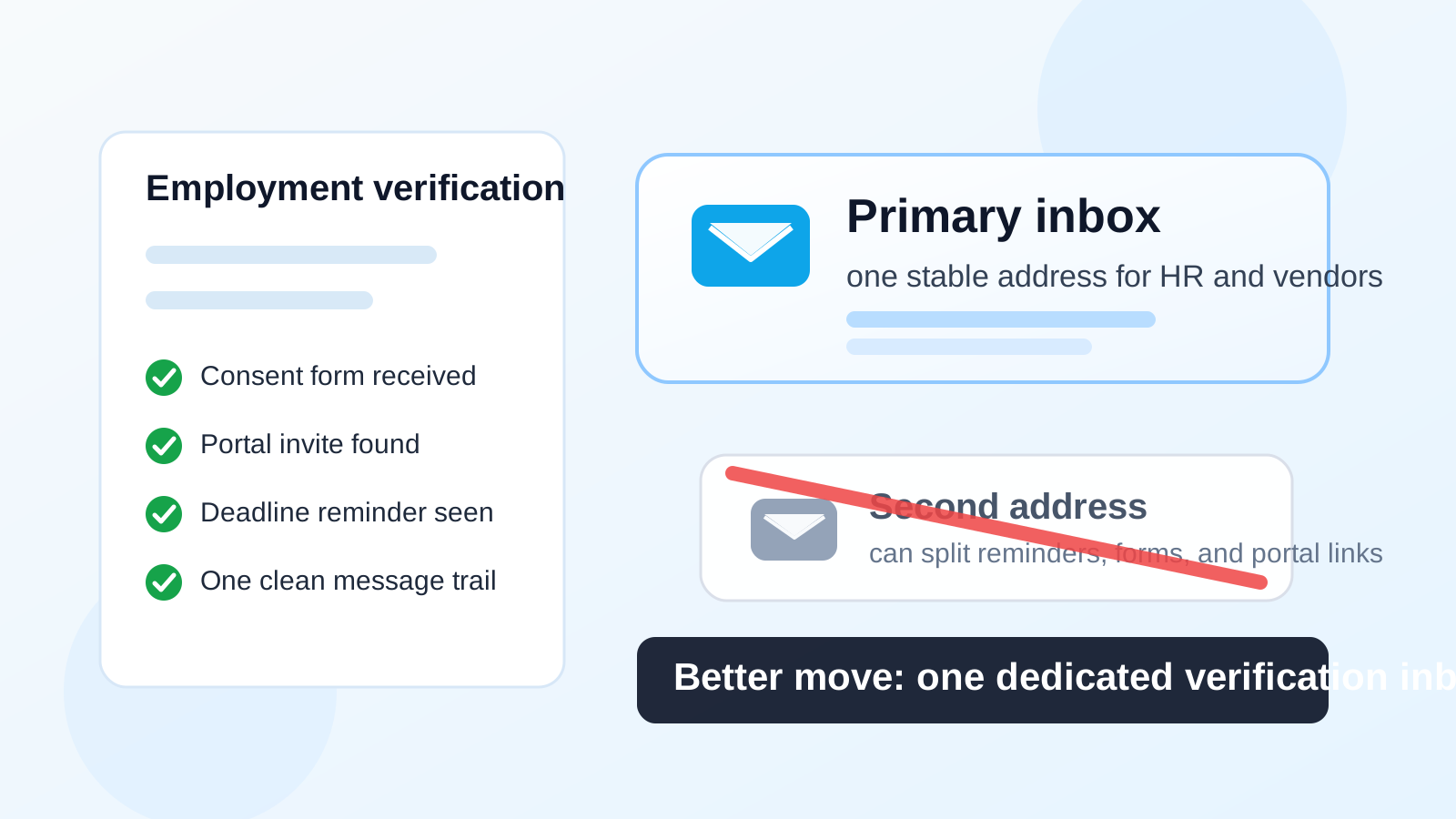
That short answer covers most real situations. By the time employment verification starts, your goal is no longer broad outreach or spam control. You are in a narrower, more serious part of the hiring process where timing, continuity, and recordkeeping matter more than experimentation.
Employment verification messages often include consent forms, portal invitations, reminders from third-party screening vendors, requests to confirm dates or titles, and notices about missing information. Those details are easy to manage when everything lands in one reliable inbox. They become much easier to miss when you split the process across two public email addresses.
Why people think two email addresses might help
The idea is understandable. Many job seekers have already used more than one email address earlier in their search. One inbox may have been used for job boards, another for direct applications, and sometimes a temporary or masked address was used to reduce spam during the top of the funnel.
So when employment verification begins, it can feel natural to think, “Maybe I should give both.” One address could be the private one. The other could be the “serious” one. One might feel better for forms, and the other might feel better for recruiter follow-up.
The problem is that employment verification is not a stage where parallel contact paths usually help. It is a stage where clarity matters more than optionality. HR teams, recruiters, and verification vendors generally want one dependable record, not a contact puzzle.
Why listing two email addresses usually creates problems
1. Verification systems usually standardize around one address anyway
Most hiring systems, background-check portals, and verification vendors are built around one primary candidate email. Even if you provide two addresses somewhere, the system or coordinator will usually choose one and ignore the other. That means you do not actually gain much control. You just create uncertainty about which inbox will matter.
In practice, the first address on the form, the address already attached to your applicant record, or the one a recruiter happened to use first often becomes the de facto primary inbox. If that is not the inbox you are monitoring most carefully, you create avoidable risk.
2. Important messages can get split across two inboxes
Employment verification tends to involve sequences, not single emails. One message may contain a consent form. Another may contain the portal login. A third may request clarification about dates. A fourth may warn that your deadline is approaching. If those messages land in different inboxes, the chance of missing a step goes up fast.
This is especially risky when one address is more heavily filtered than the other, when one is checked on mobile and the other only on desktop, or when one has old spam or promotion rules that quietly bury vendor messages.
3. Two addresses can create identity confusion
Verification is partly an administrative process. Consistency helps. If your application used one email, your offer paperwork used another, and your verification vendor sees two more, you may create minor but annoying mismatches. None of them are catastrophic on their own, but they can slow down follow-up when a coordinator is trying to match a person, a candidate record, and a consent trail.
Any time a process depends on timestamps, signed forms, or account-specific portal links, a clean single-contact trail is an advantage.
4. Security and recovery become messier
Verification workflows sometimes involve magic links, one-time portal access, or password resets. If you are not certain which address is attached to which step, recovering access becomes more frustrating than it needs to be. That is the wrong moment to be hunting across inboxes for the email that actually contains the valid login link.
The better setup: one stable verification inbox
For most people, the best answer is not “use your main personal inbox forever” and not “give two addresses.” It is “choose one stable inbox for this stage and use it consistently.”
That inbox can absolutely be separate from your oldest personal address. In fact, a dedicated job-search or hiring-process inbox is often the cleanest option. The important part is that it must be stable enough to keep using through verification, onboarding, late-stage follow-up, and any corrections that arrive afterward.
A good verification inbox should be:
- Reliable: you expect to keep it active for months, not hours.
- Easy to monitor: it is checked regularly on the devices you actually use.
- Searchable: you can quickly find forms, reminders, and vendor threads later.
- Professional enough: the address does not distract from the process.
- Under your control: it is not owned by a current employer.
When a second address can still help behind the scenes
A second address is not always a bad idea. It is just usually a bad idea to list both as public contact points during employment verification.
A second address can still be useful if:
- You are forwarding an older job-search inbox into your newer main verification inbox during a transition.
- You want aliases that all route into one mailbox, so you can track where messages came from without splitting your actual reading workflow.
- You need a backup recovery address for account security.
- A form explicitly asks for an alternate contact email.
In each of those cases, the second address is helping your internal setup. It is not being presented as a competing public destination for the same verification thread.
What to do if you already used a temporary or masked address earlier
This is one of the most common reasons people consider two addresses. Maybe you used a privacy-first address, an alias, or a temporary inbox while applying broadly. That can make sense earlier in the search, especially when you are trying to keep low-trust signups and recruiter spam away from your long-term inbox.
Employment verification is usually the point where you should simplify rather than add more public addresses. If the earlier inbox is not durable enough for forms, corrections, and follow-up, move to one stable inbox now. Tell the recruiter or coordinator which address you want used going forward, and make sure future vendor invites are sent there.
That keeps the privacy benefits of your earlier workflow without carrying inbox fragmentation into a stage where the consequences of a missed message are much higher.
That is also the most natural place for a service like Anonibox in the broader process. Anonibox can help reduce exposure during exploratory signups or lower-trust early-stage outreach, but employment verification is generally where you want continuity, not disposability.
Should you use your current work email as one of the two addresses?
Usually no. If one of the two addresses you are considering is a current employer-owned inbox, that is an even stronger reason to simplify away from the two-address idea.
Your work email is rarely the right place for outside hiring paperwork because:
- Your employer may retain or monitor account activity under company policy.
- You could lose access unexpectedly if your role changes or you leave.
- Notifications may appear on managed devices you do not fully control.
- It blurs the line between your current employment and a future employer’s process.
If privacy and continuity matter, choose one personal inbox you control directly instead.
When giving two addresses may actually make sense
There are a few edge cases where two addresses are not unreasonable, but they are rarer than most people expect.
- The form explicitly requests an alternate email. If the employer or vendor asks for both primary and backup contact details, follow the instructions.
- You are actively transitioning addresses. If you recently changed inboxes and want to catch stragglers, a short overlap can be practical.
- You are working through an unusual coordination setup. For example, an assistant, attorney, or relocation coordinator may need copies in a specialized situation.
Even then, clarity matters. Label the preferred address clearly, monitor both, and move back to one primary inbox as soon as possible.
A simple setup that works better than two listed email addresses
- Pick one stable inbox for all verification communication.
- Forward older addresses into it if you need continuity during a transition.
- Create a label or folder for employment verification so forms and reminders stay easy to find.
- Whitelist likely senders such as the recruiter, HR contact, and background-check vendor.
- Check that inbox daily until the process is fully complete.
This gives you the organization and privacy benefits people usually want from two addresses, but without the confusion that comes from asking a third party to guess which inbox matters most.
Quick decision checklist
Before you enter your email on an employment verification form, ask yourself:
- Do I want one clean, searchable thread for this process?
- Will both addresses really be monitored equally well?
- Am I creating unnecessary confusion for HR or the verification vendor?
- Would one separate inbox or alias give me the same privacy with less risk?
- Is either address tied to my current employer?
If your honest answer is that one well-managed inbox would be simpler, that is usually the right answer.
Final answer
Usually, no — you should not use two email addresses for employment verification. One stable inbox is easier for HR, easier for vendors, and easier for you to manage when consent forms, deadlines, and follow-up requests matter.
If you want privacy, the better move is one separate verification email or a forwarding alias that still routes into a single mailbox you control. That gives you separation without sacrificing reliability, and reliability is what matters most once the hiring process reaches verification.