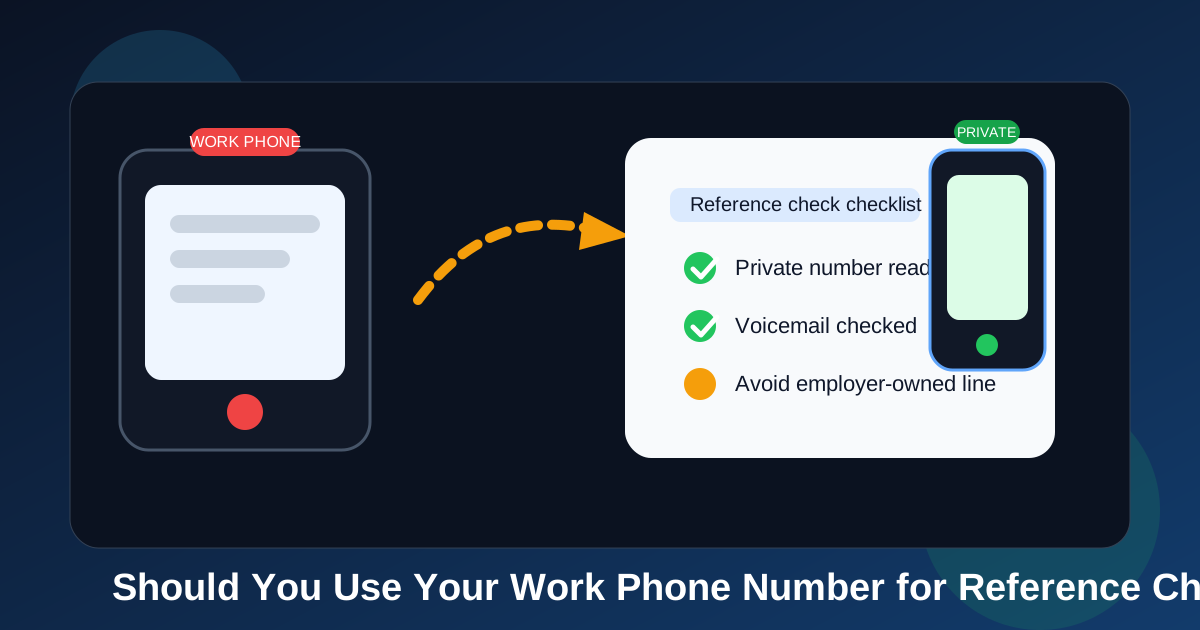
Usually no. Using your work phone number for reference checks is rarely the safest default, especially if you still work there or do not fully control who can see calls, texts, and voicemail.
For most job seekers, a personal number or a separate long-term job-search number is better because reference checks can be time-sensitive, confidential, and awkward if employer-owned devices or shared call records get involved.
Why this question matters more than it seems
Reference checks often happen near the end of a hiring process, when the employer is serious enough to verify your work history, performance, or professional relationships. At that point, people sometimes treat contact details as a small administrative choice. They are not. A phone number can shape how private, smooth, and low-stress that final stage feels.
A work phone number sounds convenient on paper. You may answer it reliably during business hours. It may already be in your email signature. If your references know you through your current job, it may even feel like the most “professional” number you have. But convenience and professionalism are not the same as privacy and control.
The real issue is not whether a work number can technically receive a call. It is whether that number is fully yours to manage through a late-stage hiring process that may involve missed calls, voicemail, call logs, follow-up messages, and timing you cannot predict.
Short answer: avoid it unless you have unusual control and low risk
There are edge cases where using a work phone is workable. If you are self-employed, if the number is effectively your own business line, or if you fully control the device and billing, the risk may be lower.
For most employees, though, the safer answer is simple: do not use your work phone number for reference checks if a private number is available. The potential downsides are not dramatic in every case, but they are unnecessary when better alternatives exist.
The biggest risks of using your work phone
1. Employer visibility
The most obvious problem is that a work phone is tied to work. Depending on the company, the device, and the carrier setup, your employer may have more visibility into call records, device management, app policies, or business communications than you would like. Even if nobody is actively watching, the possibility changes the privacy equation.
Reference checks are often confidential enough that you do not want unexpected outside numbers showing up on a line connected to your current employer. You also do not want to wonder whether a manager, admin team, or mobile-device policy could expose more than you intended.
2. Shared access and blurred ownership
Some work numbers are not truly personal lines. They may be part of a team system, a desk phone rotation, a softphone account, or a company-managed mobile plan. Even if the number mostly reaches you, you may not be the only person with practical access to logs, voicemail setup, or device administration.
That is a bad fit for a process involving sensitive hiring follow-up. A reference-check vendor calling back twice should not create anxiety about who else might notice.
3. Missed after-hours follow-up
Reference checks do not always move on your schedule. A recruiter, coordinator, or screening vendor may call when you are away from your desk, in transit, on leave, or trying to avoid work-related interruptions after hours. If your work phone is something you mute at night or leave in the office, you may miss the very message you needed.
This matters because late-stage hiring often involves short windows: “Please confirm this detail,” “We need a quick callback,” or “Your reference could not be reached; can you help?” Those messages are not always emergencies, but they can delay an offer when they sit unanswered.
4. Awkward overlap with your current role
If you are still employed while job searching, a work number creates an avoidable emotional problem: it ties your exit planning to the same line your current employer expects you to use for current work. Even if nothing goes wrong technically, it can feel like you are inviting job-search stress into the most visible contact channel you use each day.
That is especially uncomfortable if you are trying to keep your search quiet, manage internal politics carefully, or avoid drawing attention before you are ready.
5. Poor long-term continuity
Reference checks are supposed to be close to the finish line, but they still slip. A reference may respond late. A vendor may need clarification. A hiring team may pause and restart. If you change jobs, go on leave, or lose access to the work number, you can end up creating unnecessary friction at exactly the wrong time.
A private number you control completely is usually better because it stays with you regardless of what happens at your current employer.
When using a work phone might be reasonable
There are a few situations where using a work-associated number is not automatically a mistake.
- You own the business or number yourself. If the “work phone” is really your own professional line, you may control it well enough for the risk to be low.
- You are in a short-term consulting or freelance setup where the number is already your primary professional contact and not heavily managed by someone else.
- You have no meaningful personal privacy concern because the device is effectively yours, not employer-administered, and not shared.
- You know reference-check communication will be minimal and you can move to a private number immediately if the process gets more complex.
Even then, “acceptable” is not the same as “best.” The question is not just whether it can work. It is whether there is a better option that gives you more control with fewer tradeoffs.
What is usually better?
Your personal mobile number
For many people, the simplest answer is still the best one. Your personal mobile is under your control, easy to monitor, and likely to stay with you through the whole hiring and onboarding timeline. If you are comfortable sharing it with a legitimate employer or reference-check vendor, it is often the most reliable choice.
A separate job-search number
If you want more privacy than your main number gives you, a separate long-term number is often the sweet spot. It can be a second SIM, a dedicated mobile line, or another lawful number-management setup that you actually monitor. The key is that it should feel stable, not disposable.
This option is especially appealing if you already separate job-search communication elsewhere. Many people use Anonibox or another separate email workflow earlier in the process to keep recruiter traffic and low-trust signups away from their everyday inbox. A separate phone number follows the same logic without dragging a company-owned line into the mix.
A stable virtual number you already trust
A virtual number can work if it behaves like a real contact method. That means you have tested calls, voicemail, and message alerts, and you know you will notice follow-up quickly. The goal is not novelty. The goal is control plus reliability.
If you already listed your work phone, what should you do?
Do not panic. Using a work phone once does not automatically ruin anything. The smart move is to reduce future friction quickly.
- Switch early if you can. If reference checks have not started yet, ask the recruiter or coordinator to use a private number instead.
- Check your work voicemail immediately. Make sure it is not full, generic, or inaccessible when you are away from work.
- Watch for unknown calls closely. Screening vendors may not call from recognizable numbers.
- Avoid texting sensitive information through a work-managed line. A callback or scheduling text is one thing; identity documents or personal data are another.
- Move reference-related communication off the work device when possible. The earlier you compartmentalize, the easier the process becomes.
A practical example
Imagine you are still employed and quietly interviewing elsewhere. A new employer starts reference checks and a third-party coordinator calls your work phone while you are in a meeting. You miss the call. The voicemail lands on a company-managed line you do not always review after hours. The coordinator follows up the next morning while you are on-site with your current team. Nothing catastrophic happens, but the whole situation is tighter and more exposed than it needed to be.
Now compare that with a personal or separate number you fully control. The call still might be missed, but it reaches you in a space that belongs to you, on your schedule, without mixing job-search logistics into employer-owned infrastructure. That difference is exactly why private numbers are usually the better choice.
Questions to ask before you share any number
- Who actually controls this number and device?
- Can anyone besides me see logs, voicemail, or notifications?
- Will I definitely keep access to this number through the full hiring timeline?
- Do I answer it reliably outside work hours and away from my desk?
- Would a personal or separate number make this process cleaner and more private?
If those questions make your work number sound even slightly fragile, believe that signal. Reference checks are important enough that you should not use a contact method you only half trust.
Bottom line
Usually no. You should not use your work phone number for reference checks unless you have unusual control over that line and very little privacy risk. For most people, it adds unnecessary exposure, awkwardness, and continuity problems to a stage of hiring that works better with calm, private, dependable communication.
A personal mobile or separate long-term job-search number is usually safer. You stay easier to reach, keep your current employer out of the loop, and avoid turning a simple hiring checkpoint into a privacy headache.