Usually no — you should not put your citizenship on job applications unless the role clearly requires citizenship or the employer is asking in a legitimate, relevant application step. In most cases, employers only need to know whether you are authorized to work, not your exact citizenship details at the first screening stage.
If the field is optional, leaving it blank is often the safer move. If it is required, slow down, verify the employer, and make sure the request is really about job eligibility rather than careless data collection or a low-trust application flow.
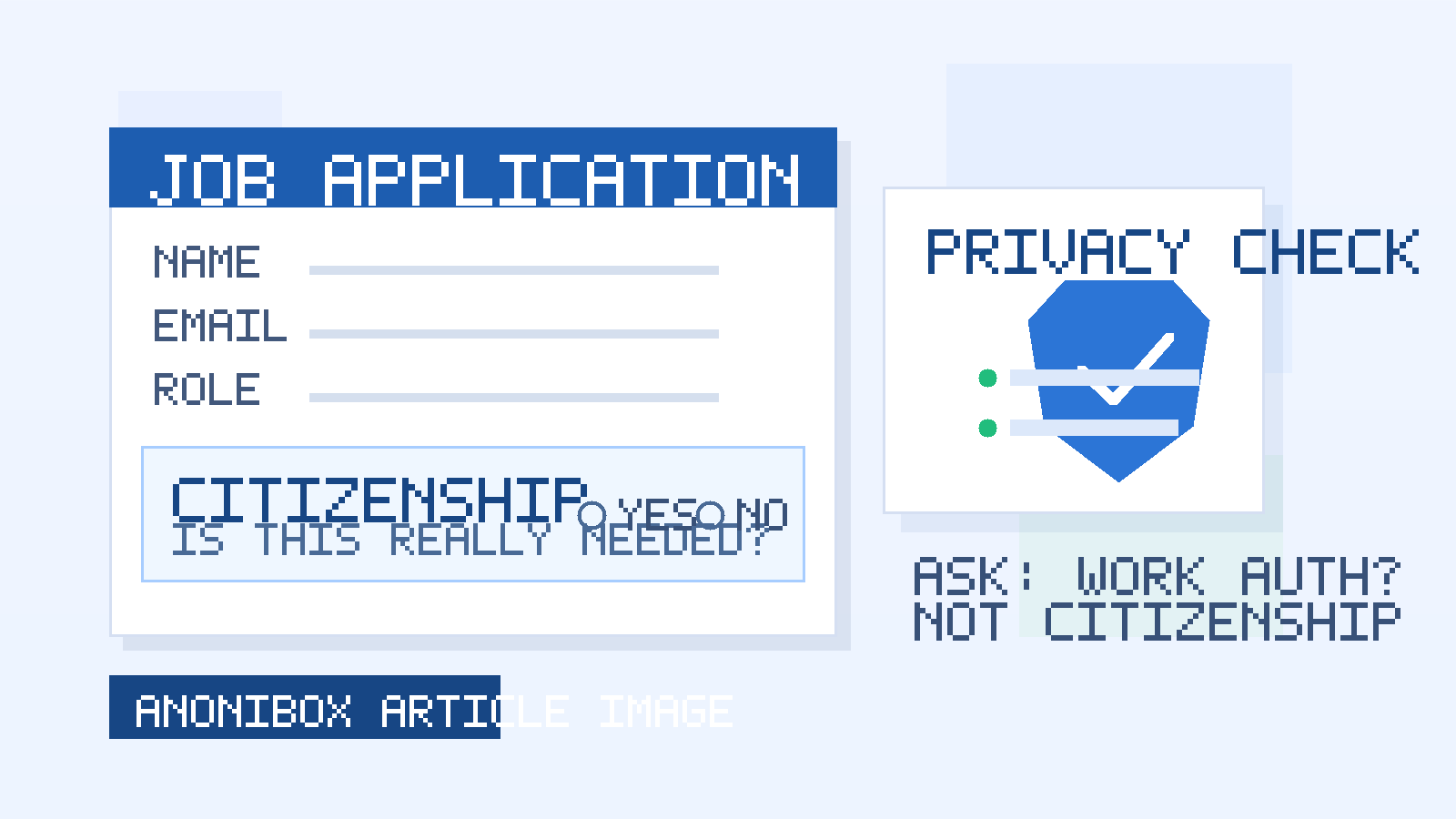
This is a useful distinction because “citizenship” sounds straightforward, but it often gets mixed up with nationality, immigration status, sponsorship needs, and work authorization. Those are related topics, but they are not identical. A job seeker can be legally authorized to work without needing to disclose every citizenship detail at the earliest point in the process.
That nuance matters for privacy. The more personal information you give away before a real employer has a real reason to ask, the more identity data ends up stored across applicant tracking systems, job boards, third-party recruiter tools, and inboxes you do not control. A privacy-minded job search means sharing what is necessary, holding back what is not, and checking whether the application process deserves your trust before you overexpose yourself.
Short answer: most employers do not need your citizenship first
For most private-sector roles, the practical early-stage question is not “What is your citizenship?” but “Are you legally authorized to work here?” and sometimes “Will you need sponsorship now or later?” Those questions help employers understand eligibility without collecting extra personal data too soon.
That is why many job seekers should treat a citizenship field carefully. If the employer can evaluate your fit, schedule interviews, and decide whether to move forward without your citizenship, there is usually no benefit to volunteering it early.
Citizenship is not the same as work authorization
This is the most important distinction in the whole topic. Citizenship refers to your legal membership in a country. Work authorization refers to whether you are allowed to work in that country under the law. In some cases those overlap. In many others they do not.
For example, a person may not be a citizen but may still be fully authorized to work. Another person may be a dual citizen. Another may have permanent residency or another status that allows employment. From the employer’s perspective, work authorization is often the operational question that matters first.
That is why a citizenship request can feel broader than necessary. It may reveal more than the employer needs at the first application stage, especially when a simpler eligibility question would do the job.
Why some employers ask about citizenship
Not every citizenship question is inappropriate. Sometimes there is a real reason behind it.
- Government or public-sector roles: some jobs have formal citizenship requirements.
- Security-clearance or national-security work: certain positions may require citizenship because of law, contract rules, or clearance eligibility.
- Export-controlled or regulated work: some employers screen for legal eligibility tied to specific compliance obligations.
- Internal application templates: occasionally the field appears because the system was built broadly, even if the role does not truly require the answer yet.
The problem is not that citizenship can never matter. The problem is that some forms ask for it before the employer has justified why it matters for this role, at this stage, through this system.
When it may make sense to disclose citizenship
There are situations where sharing your citizenship can be reasonable or necessary.
- The job posting clearly states that citizenship is a legal requirement.
- You are applying for a government, defense, or clearance-linked role where the requirement is expected and specific.
- The employer is verified, the application channel is legitimate, and the question appears in a normal compliance context.
- You are at a later stage of hiring where formal eligibility documentation is a normal next step.
In those cases, the question may be part of a legitimate workflow rather than a privacy overreach. Even then, the safest habit is to answer the exact question being asked and not volunteer more detail than necessary.
When you should be cautious
You should slow down if any of the following are true:
- The role is a generic private-sector job with no obvious citizenship requirement.
- The application is happening on a vague third-party site rather than a verified employer page.
- The recruiter cannot explain why citizenship is needed at the first stage.
- The form also asks for other sensitive details too early, such as ID numbers, bank details, or document uploads.
- The opportunity already shows other scam signs like urgency, poor branding, or pressure to move off-platform fast.
Those signals do not always mean fraud, but they are strong reasons to avoid sharing more than necessary. Early overcollection is a privacy issue even when the employer is real, and it is a bigger risk when the employer is not.
Privacy risks of sharing citizenship too early
1. It reveals more identity information than many employers need
Your citizenship may feel less sensitive than a Social Security number, but it is still a personal identity detail that can be combined with your name, address, email, phone number, date of birth, and work history. The more of that profile you distribute early, the less control you keep over where it ends up.
2. It can increase profiling and bias concerns
Citizenship can indirectly signal immigration history, family background, or assumptions about language and origin. Whether or not an employer intends to misuse that information, many job seekers prefer not to surface it until there is a clear reason.
3. It can make scam outreach more convincing
Scammers often work by combining several pieces of partial personal information. Once someone knows you are job hunting and has collected more than basic contact details, their follow-up messages can sound more legitimate than ordinary spam.
4. It can sit in too many systems for too long
Applicant tracking systems, recruiter CRMs, outsourcing vendors, background-check portals, and job boards do not all have the same privacy standards. Even if no one uses the information maliciously, oversharing increases avoidable exposure.
Optional field versus required field
If the citizenship field is optional, leaving it blank is often the best answer unless the role clearly calls for it. Optional means the employer should be able to continue evaluating you without that information.
If the field is required, you have to make a more deliberate decision. That does not automatically mean the employer is doing something wrong, but it does mean you should ask whether the request fits the role, the timing, and the trust level of the application channel.
What to do if the field is optional
If the field is optional, ask yourself one simple question: Does answering this help my candidacy in a meaningful way? For most standard roles, the answer is probably no.
That means leaving it blank is often perfectly reasonable. A legitimate employer that later needs formal eligibility details can request them through a more appropriate, more secure workflow.
What to do if the field is required
1. Verify the employer independently
Do not rely only on the link you clicked from a job board or message. Visit the company’s official site yourself, confirm the posting exists, and make sure the domain, branding, and contacts line up.
2. Check whether the role actually requires citizenship
If the job involves government work, defense, export controls, or a specific legal requirement, the request may make sense. If it is an ordinary role with no stated reason, the field may be broader than necessary.
3. Look for a human explanation
If a recruiter or HR contact is available, ask whether the application can proceed with a work-authorization answer first and citizenship details later if needed. A real employer should be able to explain the requirement clearly.
4. Decide whether the trade-off is worth it
Sometimes the opportunity is credible, but the process still asks for more personal information than you want to share that early. That does not make you difficult. It means you are making an informed privacy decision.
Better ways to answer eligibility questions
In many cases, the employer does not need your full citizenship story. They just need to know whether you are allowed to work and whether sponsorship is an issue. That is why “authorized to work” questions are often more appropriate than citizenship questions.
If the form gives you a lawful, accurate way to answer in terms of work authorization instead of detailed citizenship, that is often the cleaner option. The goal is to be truthful without volunteering more than the situation requires.
This is also where adjacent topics come in. If you are sorting out whether to mention nationality on job applications or visa status on job applications, the same principle applies: answer the legitimate eligibility question, but avoid unnecessary oversharing at the first screen.
Red flags that should make you stop
- The recruiter uses a personal email address and asks for citizenship details immediately.
- The application wants citizenship plus other sensitive documents before any real interview process.
- The company identity is vague, inconsistent, or hard to verify.
- You are pressured to respond fast or move to text, WhatsApp, or Telegram right away.
- The role looks copied, overly vague, or strangely high paying for the description.
When a citizenship question appears inside a larger pile of early sensitive requests, it is usually smarter to pause than to push through automatically.
How a separate inbox helps without solving everything
Job-search privacy is bigger than one field. Many job seekers already try to reduce exposure by using a separate email for applications, recruiter signups, and talent-community forms. That is a good habit because it keeps follow-up messages, alerts, and spam out of your everyday inbox.
A tool like Anonibox can help with that early-stage separation, especially when you are testing lower-trust job boards, talent pools, or one-off applications. But a separate inbox only protects one part of the process. It does not turn an invasive application into a safe one. You still need to decide whether citizenship, ID, or other personal details truly belong in that form yet.
A quick decision checklist
Before you answer a citizenship question on a job application, ask yourself:
- Is this a verified employer and a legitimate application channel?
- Does the role clearly require citizenship, or would work authorization be enough?
- Is the field optional or required?
- Am I being asked for this at the first stage or at a later, justified stage?
- Would I still feel comfortable if this system kept my data longer than expected?
- Does anything else about the process feel excessive or suspicious?
If your answers leave you uneasy, that is a sign to slow down and protect your information rather than treating the field like routine admin.
Final answer
No, you usually should not put your citizenship on job applications unless the role clearly requires it or the employer has a legitimate reason to ask at that stage. For most ordinary jobs, work authorization is the more relevant question, and citizenship details often reveal more than the employer needs upfront.
If the field is optional, leaving it blank is often the safer choice. If it is required, verify the employer, understand why the request matters, and answer as narrowly and truthfully as the situation allows. That lets you stay eligible for real opportunities without handing out more identity information than necessary.