A temporary email generator for GRC software free trials is a practical way to compare governance, risk, and compliance platforms without turning early research into months of vendor follow-up in your main inbox. Use it to verify signups, collect onboarding links, and keep the evaluation contained until a vendor becomes a serious finalist.
The right time to switch is when the project moves from curiosity to real buying work. Once procurement, security review, legal review, or shared ownership starts, move the account to a permanent team-managed address so nothing important lives in a short-term inbox.
That balance matters because GRC trials are rarely casual. Even a simple “start free trial” or “request sandbox access” flow can trigger welcome sequences, analyst reports, framework mapping emails, webinar invites, demo nudges, and follow-up from sales or solutions teams. If you are comparing several vendors at once, the noise adds up fast.
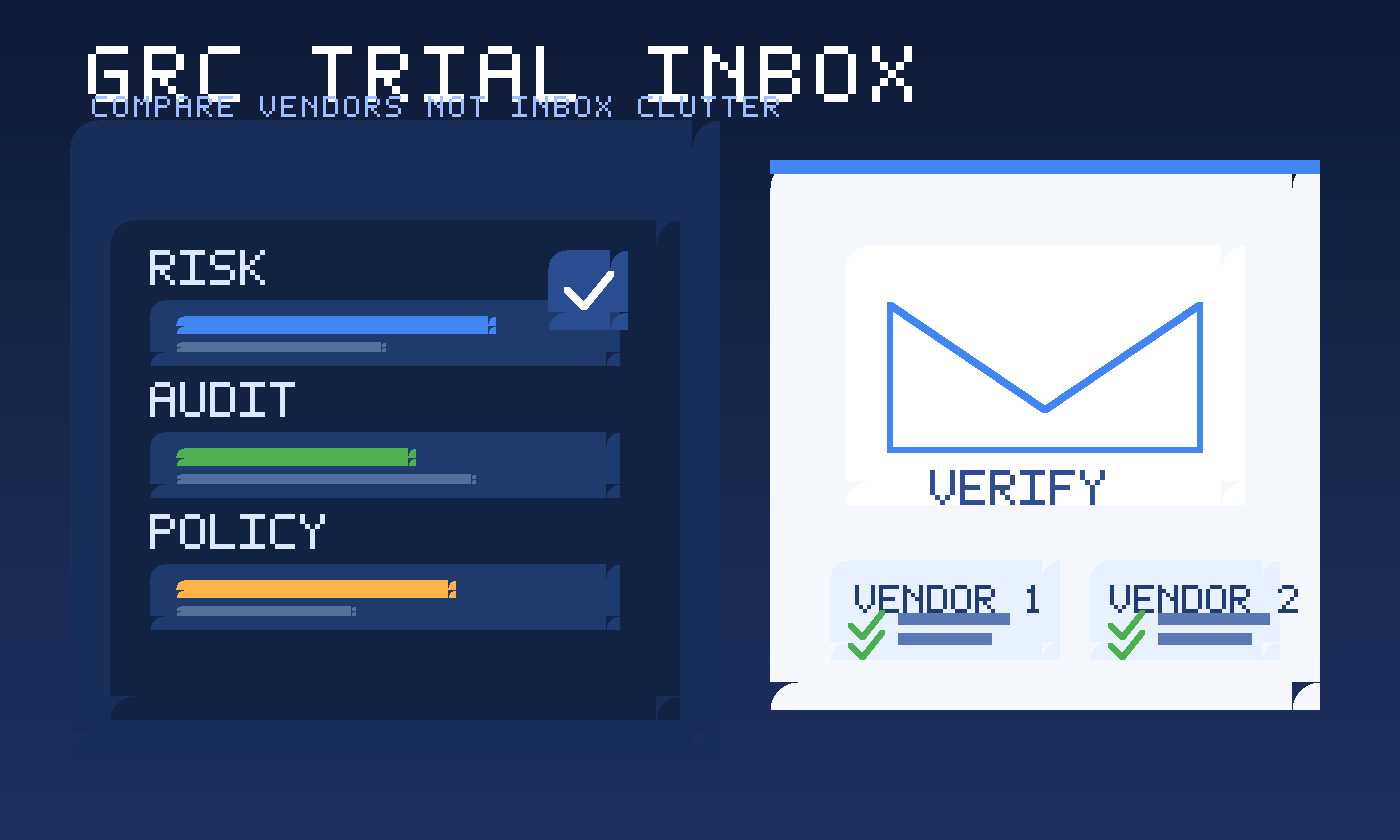
Why this workflow fits GRC evaluations
Governance, risk, and compliance software sits in a category where buyers often want to learn a lot before starting a full sales motion. Teams may be evaluating risk registers, control mapping, policy workflows, third-party risk questionnaires, evidence collection, audit readiness, and reporting all at once. That usually means comparing more than one platform, sharing notes internally, and deciding whether a tool is realistic for the organization before anyone wants a packed inbox full of nurture campaigns.
A temporary inbox helps keep that first stage tidy. You still receive the verification message you need to enter the product. You can still open setup instructions, download a comparison sheet, or grab the first onboarding guide. What you avoid is mixing every exploratory signup into the same permanent mailbox before you even know whether the vendor belongs on the shortlist.
Tools like Anonibox are useful in that early window because they let you separate research from commitment. That does not replace due diligence, and it does not magically solve vendor management. It simply keeps the inbox side of early evaluation more organized.
What usually happens after you sign up for a GRC trial
People sometimes assume a free trial is just a login plus a product tour. In GRC, it is often more layered than that. Depending on the vendor, you may get:
- a verification email and welcome sequence,
- framework overviews for ISO 27001, SOC 2, HIPAA, PCI DSS, or internal controls,
- invitations to book a compliance walkthrough,
- emails about evidence automation and integrations,
- follow-up from account executives or solutions consultants, and
- reminders to involve legal, procurement, IT, or security stakeholders.
None of that is unusual. It is just a lot when you are still in the exploratory stage. A temporary inbox gives you breathing room while you decide whether the product deserves deeper attention.
When a temporary inbox is useful for GRC software free trials
- You are comparing several vendors at once. Separate inboxes make it easier to keep welcome links and product notes from blending together.
- You want to inspect the product before taking meetings. Many teams want to see dashboards, workflow depth, and reporting quality before scheduling demos.
- You are doing research for a future project. Maybe you are building a market map now, but the budget decision is months away.
- You want to contain inbox clutter. This is the most obvious use case: keep trial traffic out of the mailbox you use every day.
- You are protecting a personal or broadly shared address. Early-stage vendor research does not always need immediate access to your long-term inbox identity.
When not to rely on a temporary email address
A temporary inbox is best for the comparison phase, not the ownership phase. Once a platform becomes a real contender, switch to a stable address that your team controls. That is especially important when:
- multiple stakeholders need access to the account,
- you are starting a proof of concept that will run for weeks,
- you need procurement or legal documents to land in a monitored mailbox,
- you expect security questionnaires, pricing follow-up, or contract discussion, or
- the vendor requires a verifiable corporate identity for advanced features or support continuity.
In other words, a temporary inbox is a filter, not a forever home. Use it to protect attention and privacy early. Retire it once the conversation becomes operational.
How to use a temporary email generator for GRC software free trials
1. Start with a tight shortlist
Do not sign up for every platform you can find. Pick the three to five vendors that best match your use case. For example, are you focused on audit readiness, third-party risk, policy management, internal control mapping, or a broader GRC suite? A narrower list makes the inbox strategy cleaner and the comparison more honest.
2. Use a separate inbox for each vendor or evaluation batch
If you are testing two or three tools side by side, do not dump them into one catch-all address unless you enjoy confusion. Use one inbox per vendor or at least one per evaluation batch so welcome links, reminders, and follow-up notes stay traceable.
3. Save the messages that actually matter
For most trials, the only essential emails are the verification link, welcome email, setup guide, and maybe one or two product resources you genuinely want to keep. Save those and ignore the rest. The goal is not to archive every nurture sequence. The goal is to reach the product quickly and evaluate it on its merits.
4. Judge the platform by workflow, not by email volume
Some vendors send polished follow-up. Some send almost none. Neither is a substitute for product fit. Inside the trial, ask questions such as:
- Can the platform map controls clearly across frameworks?
- Is evidence collection practical or painfully manual?
- How usable are the risk registers, issue workflows, and remediation tracking?
- Does policy management feel structured enough for real teams?
- How strong are the integrations with ticketing, identity, cloud, or documentation systems?
- Can executives, auditors, and operators each get reporting that makes sense to them?
5. Move finalists to a permanent address before serious follow-up
As soon as one or two tools look legitimate, switch them to a real work address. That avoids losing access later and makes sure pricing, support, and internal collaboration happen in the right place.
What to evaluate inside the trial
If the point of the article were only “use a disposable inbox,” it would not be very helpful. The real value is staying organized enough to evaluate the product properly. For GRC platforms, the useful comparison points usually include:
- Framework coverage: Does the product support the standards and internal control structures you actually care about?
- Evidence workflows: Can you request, store, review, and reuse evidence without turning every audit into a spreadsheet exercise?
- Risk visibility: Are risks easy to score, assign, review, and escalate?
- Third-party risk: If vendor reviews matter to you, can the system handle questionnaires, assessments, and exceptions well?
- Policy lifecycle: Drafting, approvals, attestations, and version history should feel manageable, not bolted on.
- Reporting: Leadership summaries and operator-level detail both matter. A pretty dashboard is not enough if the workflow is weak.
A temporary inbox helps only if it supports that process. If it becomes one more thing to juggle, simplify. The whole point is reducing friction.
A practical example
Imagine a small security and compliance team comparing three GRC vendors before a SOC 2 expansion project. They want to understand which tool handles evidence requests, cross-framework control mapping, and vendor risk reviews best. Instead of using the same permanent inbox for all three signups, they create separate temporary addresses for the first round.
That gives them a cleaner evaluation. Vendor A sends a verification email and a basic quick-start guide. Vendor B pushes several webinar invitations and demo nudges before the team has even opened the dashboard. Vendor C sends a welcome email plus an implementation checklist. None of that decides the winner. It just shows how much inbox noise each platform creates around the product.
After a few days, the team rules one vendor out quickly, keeps one as a backup, and advances one as a serious finalist. At that point, they move the finalist account to a permanent monitored address so pricing, stakeholder collaboration, and support requests live in the right place. That is the ideal workflow: temporary inbox for the noisy research stage, permanent inbox for the real buying stage.
Common mistakes to avoid
- Using a temporary inbox for long-running ownership. If the pilot is serious, move the account.
- Forgetting to save key links. Keep the welcome email or setup details you may need later.
- Testing too many vendors at once. A messy shortlist creates messy conclusions.
- Confusing vendor outreach with product quality. Strong marketing copy is not strong governance workflow.
- Assuming privacy tools remove all risk. They help manage exposure, but they do not replace normal purchasing, security, or legal judgment.
Quick checklist before you sign up
- Do I know what part of GRC I am actually evaluating?
- Is this an early comparison or an active buying process?
- Would a temporary inbox keep the research cleaner?
- Which emails do I need to save immediately?
- At what point will I move the account to a permanent team address?
Final takeaway
A temporary email generator for GRC software free trials is not about hiding from vendors. It is about protecting attention during early research. You still get the verification email, the welcome links, and the first setup materials you need. You just avoid stuffing your main inbox with follow-up from every platform you explore.
Used well, it creates a cleaner boundary between exploration and commitment. Compare the vendors, keep the inbox noise contained, and switch serious finalists to a permanent work address once the evaluation becomes real. That simple workflow change can make GRC research much easier to manage.