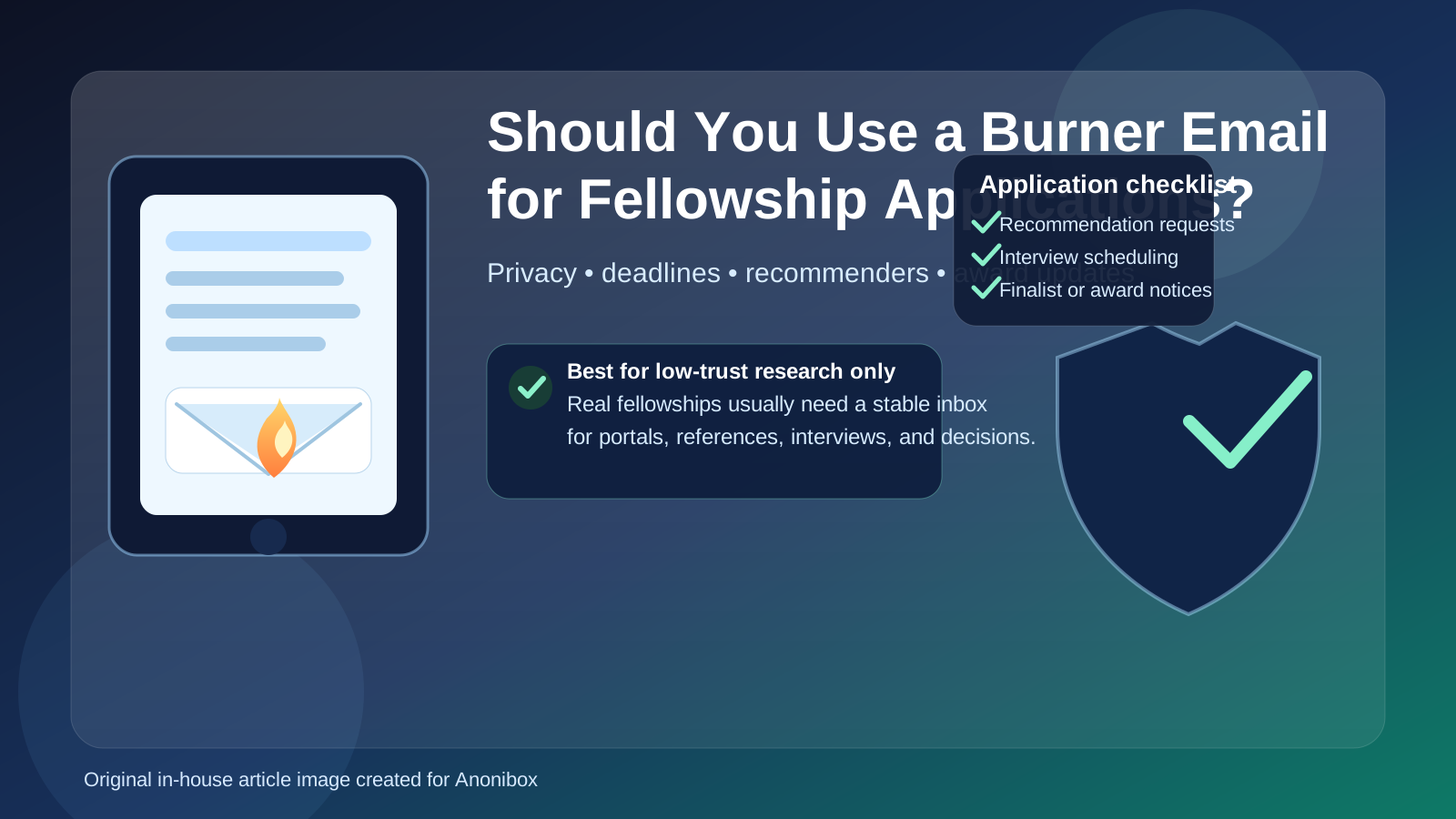
Usually no—not for the full fellowship process. A burner email can help with low-trust inquiry forms or early program research, but real fellowship applications need a stable address for recommendation requests, interview scheduling, portal access, and award updates.
If you want privacy without missing something important, treat a burner inbox as a short-term filter, not the main address for a serious fellowship application.
Why people consider a burner email for fellowships
The idea makes sense at first. Fellowship applications often begin with a messy research phase: mailing lists, interest forms, informational webinars, third-party directories, university portals, nonprofit program pages, and “request more information” buttons that do not always make clear who will keep your address or how often they will email you later.
If you are comparing several programs at once, you may not want all of that landing in the same inbox you use for work, family, travel, banking, and everything else. A burner email feels like a clean boundary. It can keep early browsing private, reduce long-tail clutter, and help you avoid handing your main address to every low-trust form you encounter.
That instinct is reasonable. The problem is that fellowship applications rarely stay simple for long.
What “burner email” actually means here
People use the phrase burner email loosely. Sometimes they mean a truly disposable inbox they may never check again after one verification message. Sometimes they mean a secondary account created specifically for one category of activity and kept alive for a while.
Those are very different setups.
- True disposable burner: good for low-trust forms, bad for anything that depends on long-term follow-up.
- Short-term secondary inbox: better than a throwaway inbox, but still risky if you stop monitoring it or plan to abandon it quickly.
- Stable separate application inbox: usually the safest choice if you expect a real fellowship process, because it gives you separation without sacrificing continuity.
For fellowships, that distinction matters more than it does for ordinary newsletter signups or one-click lead magnets.
Why fellowship applications are a weak fit for a true burner inbox
Fellowships often behave like a hybrid of admissions, grants, and hiring workflows. Even when the initial form looks short, the later communication can become complex fast.
1. Recommendation and referee workflows depend on continuity
Many fellowships send instructions, missing-letter notices, or deadline reminders based on the same email address you used at the start. If a referee misses a request or a recommender uploads the wrong file, the program may contact you later through that original email trail. A burner inbox is fragile in exactly the place where continuity matters most.
2. Interview and finalist scheduling can move quickly
Fellowship interviews do not always happen on a leisurely timeline. Some programs send a shortlist notification and expect a response within a day or two. Others coordinate interviews across faculty, panels, nonprofit staff, or program officers. If the inbox feels disposable, you increase the chance that a time-sensitive message gets buried, ignored, or seen too late.
3. Portal access and password resets may matter weeks later
Some fellowship systems are quiet for a long stretch and then suddenly important again. You may need to log back in to upload a revised document, confirm attendance, accept an interview slot, or review finalist instructions. If the account is tied to an address you no longer watch closely, a simple password reset can become needless friction.
4. Award, rejection, and next-step messages often arrive long after submission
This is the part people underestimate. Fellowships can have long review cycles. Even if you submit everything cleanly, the important email may arrive much later: a semifinalist notice, a request for clarification, travel logistics, funding paperwork, or an award decision. A burner mindset is built for short timelines. Fellowships often are not.
When a burner email can still make sense
That does not mean a burner email is always the wrong tool. It just has a narrower role than many applicants assume.
A burner inbox is most useful when you are still in the research and screening stage, not the real application stage.
- Low-trust inquiry forms: a vague directory, aggregator, or marketing-heavy “find fellowships” site wants your email before showing useful details.
- One-off gated resources: a brochure, webinar replay, or eligibility checklist is locked behind a form and you do not yet know whether the program is worth pursuing.
- Early list sorting: you want to collect introductory material from several programs without immediately exposing your main inbox to ongoing campaigns.
- Questionable third-party surfaces: you are not fully sure whether the page belongs to the program itself, a consultancy, or a lead-generation funnel.
In those cases, a service like Anonibox can work as a privacy buffer. You get the first message, see who is contacting you, and decide whether the opportunity deserves a more durable inbox later.
The key is simple: if the fellowship looks real and you are preparing to submit serious materials, the burner phase should end.
Why a stable separate inbox is usually better
For actual fellowship applications, a separate long-term inbox is usually the better middle ground. It gives you most of the privacy benefit people want from a burner email without the same fragility.
A good fellowship inbox should be:
- dedicated enough that messages are easy to spot,
- stable enough that you can still access it months later,
- boring enough that it looks normal on application forms, and
- monitored enough that you will not miss a short-fuse request.
If you want the broader comparison, these adjacent guides may help too: temporary email for fellowship applications and separate email for fellowship applications.
Burner email vs temporary email vs alias vs separate inbox
These options overlap, but they are not identical.
Burner email
Best for early, low-trust exploration. Weak for long decision cycles, recommendation workflows, and anything that depends on returning to the same account later.
Temporary email
Even more short-lived. Fine for a single confirmation or gated download, but usually the riskiest option for a real fellowship application.
Email alias
Often a better compromise than a burner inbox. An alias can hide your primary address while still forwarding into an inbox you control long term. That helps if you want privacy without giving up reliability.
Separate long-term inbox
Usually the safest default for serious fellowship work. It keeps the application lane clean while preserving access for interviews, finalist updates, and award paperwork.
A practical workflow that works better
If you want both privacy and reliability, a staged workflow is usually the smartest move.
- Use a burner inbox only for low-trust discovery. Browse vague directories, unlock one-off resources, or test whether a page is legitimate.
- Move real prospects to a stable inbox early. The moment you create a portal account, ask for recommendation instructions, or prepare to submit materials, switch to an address you plan to keep.
- Store critical details outside the inbox. Save deadlines, portal links, referee instructions, and interview notes somewhere you control.
- Watch spam and promotions folders. Fellowship messages sometimes come from automated systems, universities, or third-party platforms that do not land neatly in the primary tab.
- Keep the same serious-application address through the lifecycle. Midstream switching creates confusion for you, referees, and program staff.
This layered setup preserves the privacy advantage of a burner email where it actually helps, while removing it from the parts of the process where it causes preventable problems.
Common mistakes people make
- Treating all fellowship communication like marketing mail. Some early messages are low value, but later ones may decide whether you advance.
- Using a disposable inbox for portal creation. That is often where the long tail begins.
- Forgetting about referees and recommendation letters. Fellowship workflows often depend on multiple people responding correctly and on time.
- Assuming silence means the inbox no longer matters. Programs may go quiet for weeks and then send a high-stakes update.
- Optimizing only for privacy. Privacy matters, but fellowships also reward stability, searchability, and quick response.
When a burner email is especially risky
You should be especially cautious about using a burner inbox if any of these are true:
- the program requires references or recommendation letters,
- there is a portal account with uploads or status changes,
- the fellowship may involve interviews or finalist rounds,
- the application timeline stretches over months,
- the award may lead to travel, stipends, onboarding, or institutional paperwork.
Those are common fellowship realities, not edge cases. That is why burner-email advice is stricter here than it might be for a casual signup elsewhere.
Quick decision checklist
- Am I only gathering information, or am I starting a real application?
- Could this program contact me weeks or months from now?
- Would missing one email create a real problem?
- Will recommenders, portal resets, or interviews depend on this address?
- Do I actually want a burner inbox, or do I really want a separate long-term application inbox?
If your answers point toward ongoing follow-up, a burner email is probably the wrong permanent tool.
Bottom line
So, should you use a burner email for fellowship applications? Usually no—not for the full process. A burner inbox can be useful for low-trust research, mailing-list experiments, and early screening, but real fellowship applications depend too much on continuity to treat the contact address as disposable.
If you want privacy without unnecessary risk, use a burner email only at the edges of the process and move serious fellowship communication to a stable inbox as soon as the opportunity becomes real. That gives you cleaner boundaries without creating the kind of avoidable inbox failure that costs deadlines, interviews, or award updates.