Using a burner phone number for job interviews can make sense if the number is stable, monitored, and able to stay active through the full hiring process.
A truly disposable number is usually a bad fit for interviews because missed calls, broken voicemail, expiring lines, and lost text reminders can cost you real opportunities.
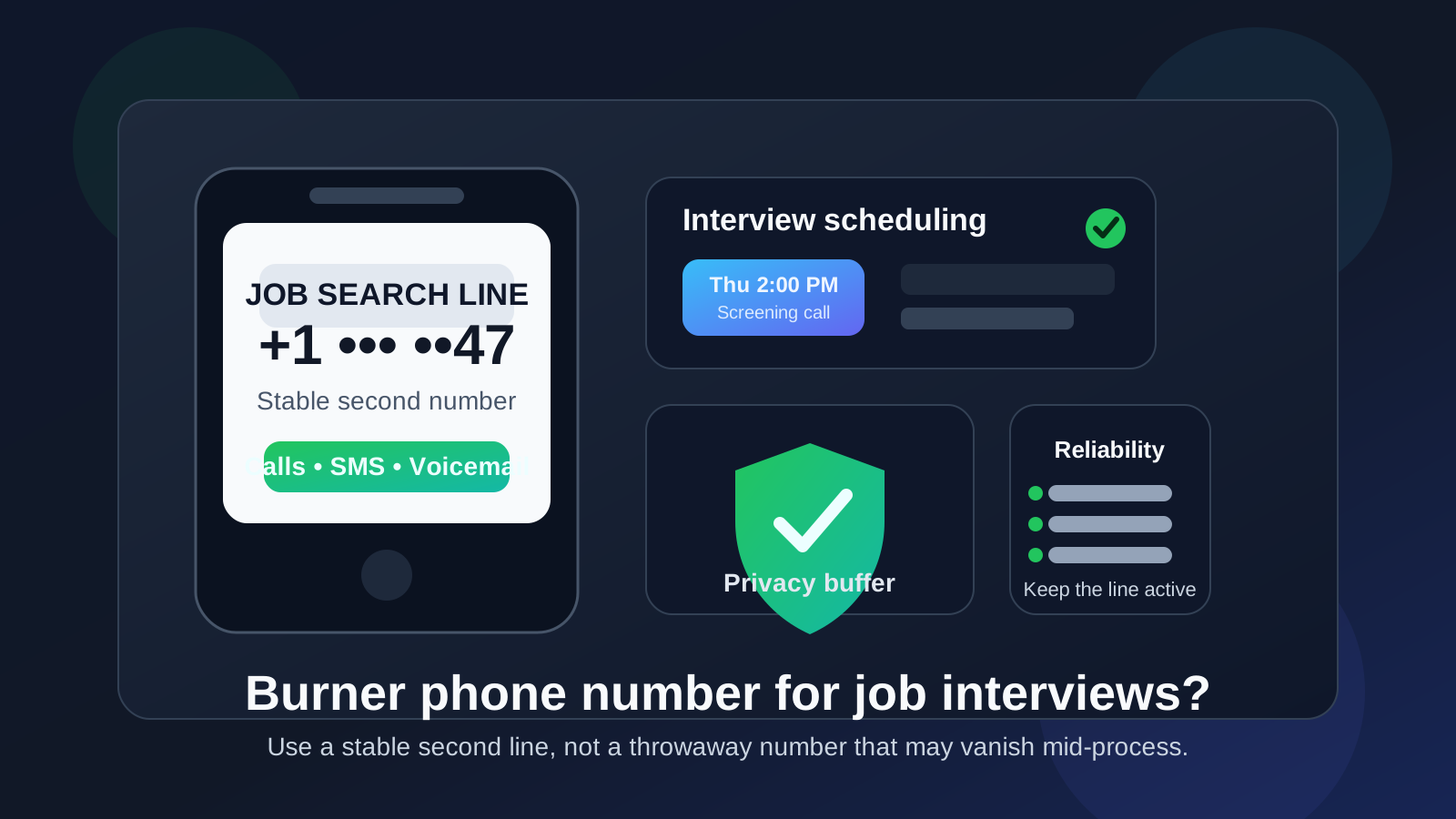
That is the real answer behind this question. The privacy instinct is good. Job boards, recruiter databases, and third-party application portals can spread your contact details farther than you expected. A second number can reduce spam, scam texts, and random recruiter noise on your everyday phone. But the interview stage changes the equation. Once a real employer wants to talk, your number stops being just a form field and becomes an active scheduling tool.
Recruiters call to confirm availability. Coordinators text last-minute meeting updates. Hiring managers leave voicemails when a panel runs late or a link breaks. If the number you gave them is unstable, hard to monitor, or likely to disappear before the process ends, the privacy benefit starts working against you.
The smartest approach is not “never use a burner number” or “always use your personal number.” It is understanding what kind of burner number you mean, how reliable it really is, and when an interview process has become too important for a throwaway setup. If you already use Anonibox or another privacy-first workflow to keep early job-search email separate from your primary inbox, the same thinking applies here: privacy is useful, but reliability matters just as much once the opportunity becomes real.
What people mean by “burner phone number”
One reason this topic gets confusing is that people use the phrase burner phone number to mean different things.
- A truly temporary number: something you expect to discard quickly after a few signups or a short burst of outreach.
- A low-cost secondary number: a prepaid line, forwarding service, or VoIP number you can keep active for as long as you need.
- A dedicated job-search number: a stable second line you use only for recruiter calls, interview scheduling, and job-search texts.
Those are not the same thing. For interviews, the second and third options can work well. The first one is where most of the risk lives. A number you might stop checking next week is not a great match for a process that could last several weeks, multiple interview rounds, and a delayed offer decision.
Why interviews are different from applications
At the application stage, many people are comfortable being more defensive. You may be testing job boards, uploading your resume to recruiter marketplaces, or filling out forms on sites you do not fully trust yet. That is where a privacy buffer is especially appealing.
Interviews are different because timing becomes more sensitive. A recruiter may call from an unfamiliar number while you are at lunch. A coordinator may text you a corrected time zone. A final-round interview may move by thirty minutes because another meeting ran long. These are small details, but they matter. Hiring teams do not always try five different channels if the first one fails.
That is why a burner phone number can be helpful at interview time only if it still behaves like a real professional contact method. It has to ring, accept voicemail, receive texts reliably, and stay yours long enough to support the full conversation.
When a burner phone number can actually help
There are real situations where using a separate or burner-style number for interviews makes sense.
1. You are dealing with broad recruiter exposure
If your search includes staffing agencies, resume databases, and multiple job boards, your number can attract more noise than you want on your main line. A second number keeps that activity more contained.
2. You are running a confidential search
If you are employed and want stronger boundaries, a job-search-only number can help you separate recruiter contact from daily personal life. It can also make it easier to silence or retire the line later if it becomes spam-heavy.
3. You have already had scam or spam issues before
Many people arrive at this question after past searches generated fake recruiter texts, vague “urgent opportunity” calls, or suspicious requests to move to WhatsApp immediately. In that situation, a separate number is a reasonable defensive upgrade.
4. You want cleaner organization
A dedicated number can make it obvious which calls and texts belong to your job search. That can reduce stress when you are talking to several employers at once.
So yes, the idea itself is not bad. What matters is whether your burner setup is stable enough for interview communication.
Where burner numbers start to backfire
This is the part many job seekers underestimate. The interview stage punishes unreliable contact methods faster than the application stage does.
Missed calls and delayed callbacks
If the number lives in an app you barely check, forwards inconsistently, or gets filtered as spam by your own settings, you may miss the exact screening call that would have moved you forward. Recruiters do not always keep chasing unavailable candidates.
Short-lived numbers and expiring access
An interview process can easily outlast your original plan for a disposable line. You might hear back the next day, or three weeks later. You may also move from screening call to panel to reference check to offer. If the number expires in the middle, you create avoidable friction for yourself and the employer.
Voicemail and SMS reliability problems
Interview logistics often happen over lightweight communication: “Can you do 3 PM instead?” “Here is the updated meeting link.” “Please confirm when you arrive.” If your number cannot reliably receive texts, stores voicemail badly, or has no professional greeting, it can cost you more than it saves.
Recycled-number risk
Some temporary numbers do not feel truly personal or permanent. That matters because you do not want a number that changes ownership, gets reused, or behaves unpredictably while active hiring conversations are still attached to it.
Awkward handoff at later stages
Even if a burner line works for the first interview, later stages may involve assessments, background-check communication, onboarding prep, or offer coordination. Changing numbers midstream is possible, but it adds another thing to explain and track.
Stable second number vs. true throwaway number
If you want the benefit without the chaos, aim for a stable second number, not a pure throwaway line.
A stable second number should:
- stay active for the full search and any follow-up period
- receive calls, SMS, and voicemail consistently
- be checked often enough that you can respond quickly
- sound professional if someone reaches voicemail
- be fully under your control rather than tied to an employer device
That setup gives you most of the privacy benefits people want from a burner number without the main downside of disappearing at the wrong time.
When you should probably avoid a burner number for interviews
There are a few situations where a burner-style setup is more risk than reward.
- You are in late-stage interviews: once a process becomes serious, stability matters more than extra privacy distance.
- The number is hard to monitor: if it lives in a neglected app or on a device you rarely open, do not use it.
- You cannot trust SMS delivery: interview reminders, building directions, and quick reschedules often come by text.
- You plan to retire the line quickly: if you already know you will abandon it soon, it is the wrong tool for interview communication.
- Your personal number is already working fine: if you are interviewing with a few legitimate employers and your normal phone is manageable, simplicity may be better.
How to use a burner-style number safely if you choose one
If you do use a burner or dedicated secondary number for interviews, treat it like a real business communication line.
1. Test it before you give it out
Send yourself texts. Leave a voicemail. Call it from another number. Make sure notifications work and missed calls are easy to see.
2. Keep it active longer than you think you need
Do not plan around the fastest possible timeline. Hiring often moves slower than candidates expect. Keep the number alive until the process is clearly over or you have fully switched a legitimate employer to another number.
3. Use a professional voicemail greeting
A simple greeting with your name is enough. An auto-generated default message or a full mailbox makes a bad impression even when the number itself is fine.
4. Check it consistently
A second number is only useful if you actually monitor it. If you want privacy without losing opportunities, discipline matters more than the tool.
5. Keep important interview details elsewhere too
Do not let one phone app become your only record. Save recruiter names, meeting times, and contact details in a calendar or notes system you control.
6. Switch carefully if the process becomes serious
If you decide to move a trusted employer to your main number later, do it clearly and directly. Tell them the best number to use going forward instead of hoping they notice a signature change.
Burner number vs. personal number vs. work number
For most job seekers, the real choice is not burner number versus nothing. It is burner number versus personal number versus work-controlled number.
Work numbers are usually the worst option because they can expose call logs, text notifications, or device-level traces to your current employer.
Personal numbers are often the simplest and safest practical choice if you are interviewing selectively and do not mind some extra recruiter traffic on your main line.
Stable secondary numbers can be the best middle ground when privacy, spam reduction, and organizational clarity matter to you.
The weak option is not “secondary.” The weak option is “disposable and unreliable.”
Red flags where a privacy buffer is especially reasonable
A burner-style number is more understandable when the opportunity itself is not fully trustworthy yet. Be extra cautious if:
- the recruiter contacted you out of nowhere with little context
- the role is vague, oddly urgent, or unrealistically well paid
- the employer pushes you off email and onto chat apps immediately
- you are asked to share sensitive information before the role is clearly legitimate
- the company cannot be verified independently
In those situations, a separate number is part of a broader privacy strategy. The email side matters too. Many people use a separate inbox or a temporary inbox for low-trust job-search exposure so their primary address does not spread everywhere. A stable second phone number fits that same “limit exposure until trust increases” approach.
A quick decision checklist
Before you use a burner phone number for interviews, ask yourself:
- Will this number still be active if the employer contacts me in two weeks?
- Does it handle calls, SMS, and voicemail like a normal dependable line?
- Am I likely to monitor it closely enough during business hours?
- Am I protecting privacy, or just adding communication friction?
- Would a stable second number serve me better than a true throwaway number?
If the honest answer is that the setup is fragile, use something more durable. If the number is stable and you want a cleaner boundary, it can be a smart move.
Final answer
Using a burner phone number for job interviews is sometimes a good idea, but only when “burner” really means a dependable second line you control and can keep active for the entire hiring process.
If it is a truly disposable number, the risk is usually not worth it. Interview-stage communication is too time-sensitive for weak voicemail, unreliable texts, or a line that may vanish before callbacks, reschedules, or offers arrive. In practice, the best setup for most privacy-conscious job seekers is a stable separate number paired with sensible email separation, not a throwaway phone line that creates more uncertainty than protection.