Usually no — a temporary email is not the best address for real job applications because employers often reply days or weeks later, and you need an inbox that will still exist when they do.
If you want more privacy, the better setup is a stable job-search email or alias for real applications, and a temporary inbox such as Anonibox only for low-trust signups, job-board experiments, or one-off downloads.
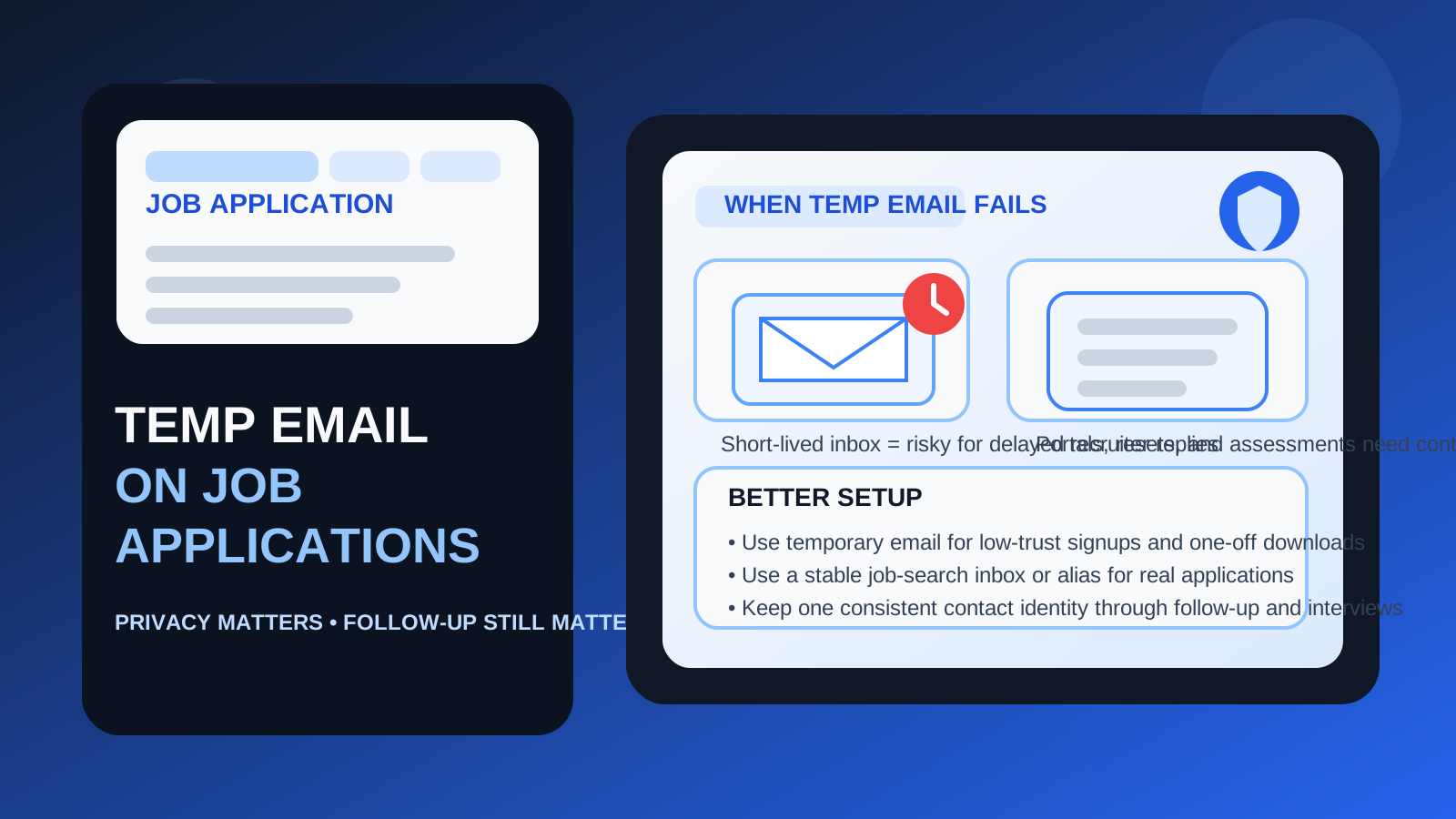
That is the practical answer behind searches for should you use a temporary email on job applications. The temptation makes sense. Job searching can spray your contact details across applicant tracking systems, job boards, recruiter databases, resume tools, and mailing lists you never intended to join for months. If you already use temporary email to cut down on spam elsewhere, it is natural to wonder whether the same trick should protect you during applications too.
The catch is that a job application is not just a one-time signup. It can become the identity attached to interview scheduling, candidate portal logins, assessment links, requests for documents, background-check instructions, and late recruiter follow-up. That changes the decision. A temporary inbox can be smart for low-commitment job-search activity, but it is usually too fragile for the actual employer-facing application itself.
Why this question matters more on applications than on a resume or cover letter
A resume and cover letter are documents. A job application is a workflow. Once you enter an email into an application form, that address often becomes part of several systems at once: the employer’s applicant tracking system, the recruiter’s message history, automated reminders, interview scheduling tools, and any third-party assessments the employer uses later.
That is why the email question changes at the application stage. The address is not just there for one polite reply. It may become the login you need when you check status next week, the place where a hiring manager sends a take-home exercise, or the inbox that receives a request to confirm your availability. If the address is temporary by design, the risk is not theoretical. You can simply become harder to reach at the exact moment a real opportunity becomes real.
This is also why the answer here is a little different from the broader privacy instinct. Privacy still matters. So does spam control. But in a genuine hiring process, continuity matters just as much.
Why people consider temporary email for job applications in the first place
The idea is not irrational. Job seekers usually reach for temporary email because they are trying to solve a real problem:
- they do not want their main inbox flooded by recruiter spam or job-board newsletters
- they are testing a platform they do not fully trust yet
- they are worried about scams and want more separation from their everyday digital identity
- they want to keep a confidential search from blending into a personal or work inbox
- they have had past experiences where one application turned into months of irrelevant follow-up mail
All of those concerns are legitimate. The mistake is not caring about privacy. The mistake is using the same tool for every part of the job-search process. A temporary inbox is excellent when you mainly want access without long-term commitment. It is much weaker when the relationship may continue for weeks and when missing one message can cost you an interview.
Why a temporary email usually backfires on real job applications
1. Recruiters do not always reply quickly
Applicants often assume that if a company is interested, the reply will come right away. Sometimes it does. Often it does not. Roles pause for approvals. Hiring managers go on vacation. recruiters batch applications. Another candidate declines, and suddenly the team returns to the stack two weeks later.
If your contact method was built for short-term use, delayed timing becomes the whole problem. The best application email is the one you can still access, still search, and still monitor when the follow-up arrives later than you hoped.
2. The application email may become your portal login
Many employers and hiring platforms treat your email as the anchor for the rest of the workflow. It may be tied to a candidate account, a password reset, an interview scheduler, or a skills test. That means the address has value beyond receiving one message.
A temporary inbox can create friction here even if it technically still works. If you no longer remember which temporary address you used where, or if you stop checking it regularly because it was meant to be disposable, you make your own application process harder to manage.
3. It can make your contact identity inconsistent
Consistency matters more than people think. If your resume uses one address, your cover letter uses another, and the job application itself uses a temporary inbox, you create unnecessary confusion. Different people in the hiring process may look at different pieces of your application. The easier you are to reach and recognize, the better.
That does not mean every document must be rigidly identical forever. It does mean that mixing a disposable application address into an otherwise stable identity usually adds more friction than protection.
4. You can lose important context later
Real hiring conversations generate history. Maybe the recruiter asks for updated availability. Maybe the employer sends an assessment link. Maybe you need to search back for the exact salary range, application ID, or interview instructions that came in an earlier message. Temporary inboxes are great at receiving mail quickly. They are usually much less pleasant as the long-term record for an active process.
5. A temporary inbox solves the wrong problem once the application is serious
The core goal of a real application is not anonymity. It is controlled reachability. You want legitimate employers to be able to contact you without handing your main inbox to every low-quality platform on the internet. That is a different goal from pure throwaway access, and it usually calls for a different tool.
When temporary email still makes sense during a job search
Temporary email does have a real place in job-search privacy. It is just usually not the right place to put on the application form itself.
A tool like Anonibox can be useful for:
- testing an unfamiliar job board before deciding whether to trust it
- downloading resume templates, salary guides, or gated career resources
- signing up for webinars, newsletters, mailing lists, or event reminders
- trying resume builders or AI career tools that may create aggressive marketing follow-up
- separating one-off research from the contact identity you use for real employers
That is the cleaner privacy workflow for most people: use temporary email at the exploratory or low-trust edge of the search, then switch to a durable inbox for actual applications you care about.
What to use instead of a temporary email on job applications
A dedicated job-search inbox
This is the simplest answer for most applicants. Create a clean, professional email address used only for resumes, applications, recruiter replies, and interviews. It gives you separation from your everyday inbox without risking the fragility of a disposable account.
A dedicated inbox works well because it helps you:
- keep recruiter traffic out of your personal inbox
- find interview requests quickly
- track applications more cleanly
- retire or mute the address later if it becomes noisy
- maintain one stable identity across the whole job search
An email alias
If you want privacy and cleaner filtering without opening a full separate mailbox, a stable alias can be a strong middle ground. The site already covers using an email alias for job applications, and that option usually makes more sense than a temporary inbox when you expect real follow-up.
An alias helps you protect your primary inbox identity while still routing important messages into a mailbox you actually monitor long term. That is usually much safer for applications than relying on an address built to be temporary.
A normal personal email you control
If you do not want extra complexity, a standard personal address can still be completely fine as long as it is professional and you check it regularly. It is still far better than using a work email on job applications, and it avoids the instability that makes temporary inboxes risky for real hiring conversations.
If you want a broader comparison, the site also has guidance on using your personal email on job applications. The short version is that personal beats employer-owned or disposable, but a dedicated job-search address is often even better.
A practical scenario guide
Applying directly on a legitimate company careers page
Use a stable inbox. This is exactly where continuity matters, because the employer may contact you later through the same address for interviews, assessments, or portal activity.
Testing a sketchy or unfamiliar job board
A temporary inbox can make sense for the initial signup if you mainly want to see whether the platform is worth using. But if you later submit a real application through that ecosystem, move to a stable address you can keep monitoring.
Downloading a resource or trying a career tool
This is one of the best use cases for temporary email. If the goal is access to one PDF, webinar, template library, or trial product, the long-term risk of spam often matters more than reply continuity.
Applying through a staffing agency or high-volume recruiting marketplace
You probably still want a stable address, but a dedicated job-search inbox becomes especially useful here. These channels create more follow-up noise, more repeated outreach, and more reason to keep job traffic separate from everyday life.
Signs your email choice is wrong for the application
- you do not expect to monitor the inbox for at least a few months
- you would struggle to recover the account or search old messages later
- the address is likely to expire or fall out of your routine quickly
- you are using different throwaway addresses across resume, application, and follow-up
- the employer is legitimate and the role matters enough that missing one email would hurt
If any of those are true, you probably want a more stable setup.
A simple rule that works for most people
Use temporary email for research, signups, and low-trust experimentation. Use a stable professional inbox for real applications.
That one rule handles most of the confusion. It lets you keep the privacy benefits of temporary email where they genuinely help, without sabotaging the part of the process where delayed follow-up, organized records, and consistent contact information matter most.
Final answer
Usually no — a temporary email is not the best address to use on job applications. It can help reduce spam and limit exposure during the research stage of a job search, but it is usually too fragile for real employer communication, application portals, and delayed recruiter follow-up.
The better choice is a stable email you control, ideally a dedicated job-search inbox or a durable alias. Save temporary email tools like Anonibox for the low-trust edges of the process, not for the applications where you actually want someone to come back and hire you.