Usually no — a college email can work for some student applications, but a stable personal inbox you control is usually the safer choice for job applications. If graduation, forwarding changes, or alumni access limits could interrupt recruiter follow-up, use a long-term address instead.
If you are still in school and applying to campus jobs or internships, a college email is not automatically wrong. But for most job seekers, especially anyone nearing graduation or applying beyond student-only roles, a dedicated personal inbox is the better default.
That answer feels stricter than a lot of generic career advice, but there is a practical reason for it: job applications rarely end the day you submit them. Recruiters may reply weeks later. Hiring managers may reopen your application after a budget delay. Applicant tracking systems may store your profile for future roles. The address you use has to survive that timeline.
A college email can look professional enough on the surface, especially if it uses your real name and comes from a recognizable school domain. The problem is not appearance. The problem is control. Your school controls the account, your school sets the retention rules, and your school may change access right when your job search is still active.
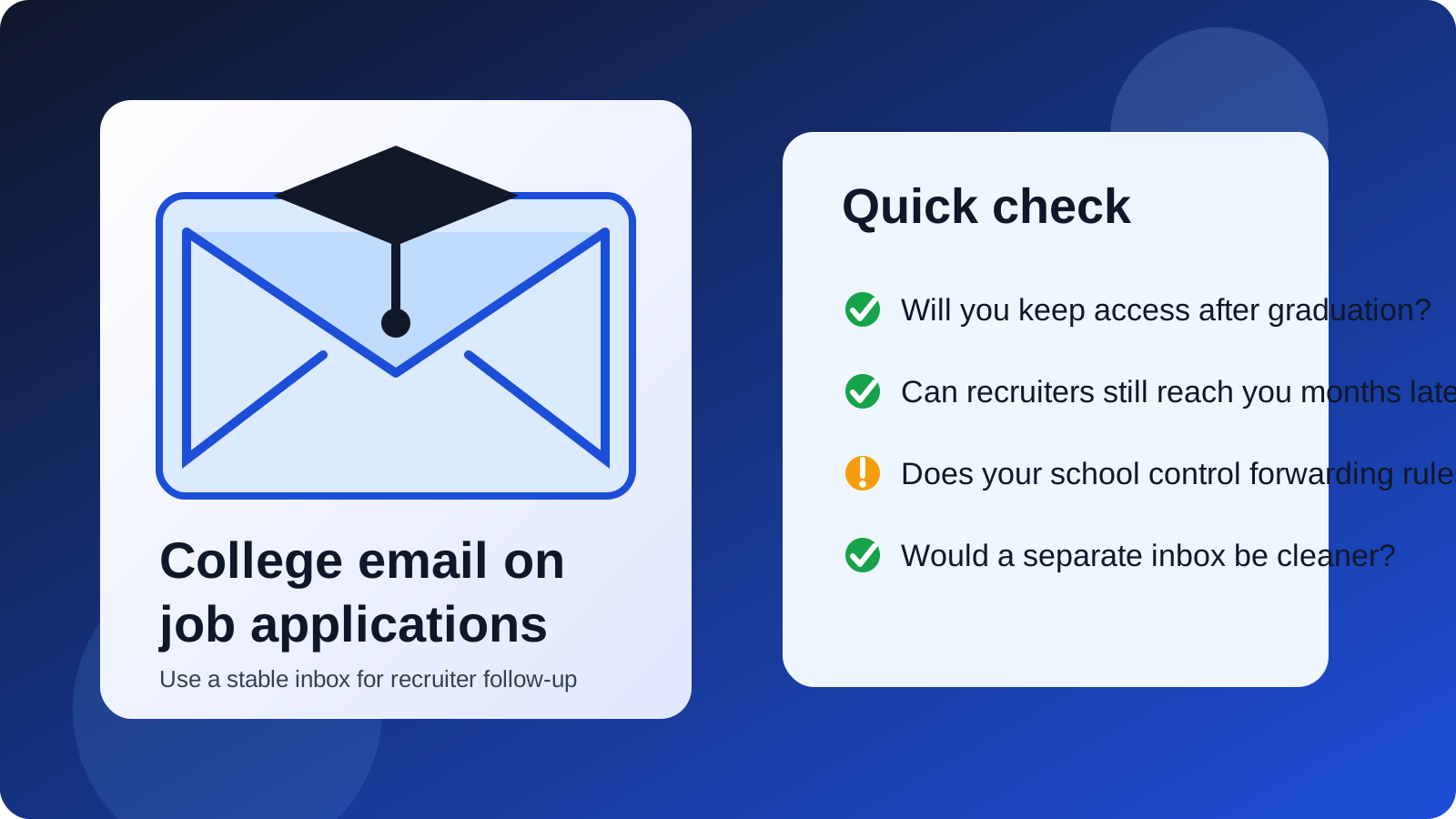
Why this question matters more than people expect
An email address on a job application is not just a contact field. It can become the main thread for interview scheduling, assessment links, follow-up questions, document requests, and even offer-stage communication. That means the best application email is not simply the one that looks acceptable today. It is the one you are most likely to keep, check, and control for the full hiring cycle.
That is where college email becomes tricky. A school account often feels stable while you are enrolled, but job searches often overlap with graduation, summer breaks, alumni transitions, or institutional account-policy changes. A message that arrives after those changes can be easy to miss at exactly the wrong time.
When using your college email on job applications can make sense
There are situations where a college email is perfectly reasonable.
- You are a current student applying for internships, campus jobs, or research roles. In those cases, your student identity is directly relevant.
- Your school guarantees long-term access. Some universities keep alumni email active for years or indefinitely.
- Your address is simple and professional. A clean name-based address looks better than a messy auto-generated username.
- You actively monitor the account. If you check it daily and know its rules, the practical risk is lower.
If all of those conditions are true, using your college email is not automatically a mistake. A lot of student job seekers do it, and many employers will not think twice about it.
But notice how specific those conditions are. The moment one of them stops being true, the college address becomes much less attractive than a personal inbox you own.
Why a college email is often the wrong long-term default
1. Graduation can break the contact channel
This is the biggest risk. Some schools deactivate student email after graduation. Others keep the mailbox but remove forwarding, change authentication requirements, or limit access after inactivity. If your account changes while employers are still reviewing applications, your contact path becomes unreliable.
Hiring does not always move quickly. A recruiter may circle back a month later. A department may reopen a role after internal approvals. A resume may get forwarded to another team long after your initial application. If the email on the application no longer works well, you may never see the message.
2. You do not fully control the account
A college email belongs to an institution, not to you. That affects security, account recovery, forwarding rules, storage limits, and access policies. Even if nothing dramatic happens, it is still not as portable as a personal address that follows you through graduation, job changes, and geographic moves.
3. It can lock you into a student identity longer than you want
For internships and campus recruiting, a student email can feel natural. For full-time roles after graduation, it can keep your application framed around your current status instead of the professional identity you are building. That is not always harmful, but it is rarely an advantage once you have a better long-term contact option.
4. It may not be the cleanest privacy choice
Many students use their school inbox for coursework, campus notifications, clubs, professor messages, billing notices, and platform logins. Adding dozens of job applications to that same account can create noise and make important recruiter messages easier to overlook.
What is usually better than a college email?
For most job seekers, the best option is a professional personal address you control directly. That can be a standard inbox with your name, or better yet, a separate job-search inbox that exists specifically for applications and recruiter follow-up.
A separate personal inbox gives you several advantages:
- Long-term stability: it stays with you after graduation.
- Better organization: recruiter messages do not get buried under school traffic.
- More privacy control: you can decide how widely it is used and where it is shared.
- Less migration stress: you do not have to update applications because a school account policy changed.
If you want even more separation, you can pair that inbox with an alias strategy or a privacy-first workflow. For example, Anonibox can be useful when you want extra separation for low-trust signups, job-board experiments, or early-stage lead forms. But for actual job applications that may require weeks of follow-up, a stable inbox you keep indefinitely is usually the smarter primary channel.
What about using a temporary or disposable email instead?
Usually that is not the best replacement for a college email on real applications. Temporary inboxes help with spam control, but they are often too short-lived for a normal hiring timeline. If an employer responds later with an assessment link, interview invitation, or request for documents, you do not want your contact address to have expired or become inconvenient to monitor.
That is why the practical comparison is not really college email versus temporary email. It is more often college email versus a separate personal job-search inbox. A dedicated personal inbox gives you both stability and cleaner organization, which is the combination most applicants actually need.
When a college email is still reasonable
There are a few common cases where the school address can still be a good fit:
- You are applying only to student-targeted opportunities right now.
- You know your university keeps the account active well beyond graduation.
- You plan to transition carefully and update your contact details if your search extends.
- Your school address is cleaner and more professional than your current personal inbox.
If that sounds like your situation, using the college address is not reckless. It just means you should manage it intentionally instead of assuming it will remain a good default forever.
A quick decision test
Before you use your college email on job applications, ask yourself these questions:
- Will I definitely keep access to this account for the next 6 to 12 months?
- Does my school allow forwarding, recovery, and reliable long-term sign-in?
- Am I applying mainly to student or campus roles, or to broader post-graduation jobs?
- Would a recruiter still be able to reach me easily after graduation or a semester change?
- Do I already have a cleaner personal inbox that would be more durable?
If you hesitate on those answers, that is usually a sign the college email is not your best option.
Best practices if you decide to use it anyway
If you do choose your college address, a few habits reduce the risk:
- Confirm your school’s retention policy. Do not guess about alumni access.
- Turn on reliable forwarding if your school supports it. Test it before you rely on it.
- Check the inbox often. Do not assume important messages will wait.
- Keep the username professional. If your address is cluttered or hard to read, that adds friction.
- Switch to a personal inbox before graduation if your search may continue. It is easier to transition early than to fix missed contact later.
Best practice for most people: use a separate inbox you control
If you want the simplest recommendation, here it is: use a personal email address you control, and if you are actively job hunting, consider making it a dedicated job-search inbox. That gives you the professionalism of a normal address without the stability risk of a school-managed account.
This approach also makes it easier to manage spam, track recruiter messages, and retire the inbox later if it becomes noisy. It is the same basic privacy principle behind using separate channels for sensitive workflows: keep important communication reachable, but do not tie it to an account you might lose.
Final answer
Should you use your college email on job applications? Usually no — not as your default. It can be fine for current students in limited cases, especially for internships or campus roles, but a long-term personal inbox is usually safer, more stable, and easier to manage.
If you want the safest setup, use a professional personal address you control for real applications, and keep your college inbox as a temporary supporting channel rather than the foundation of your job-search identity.