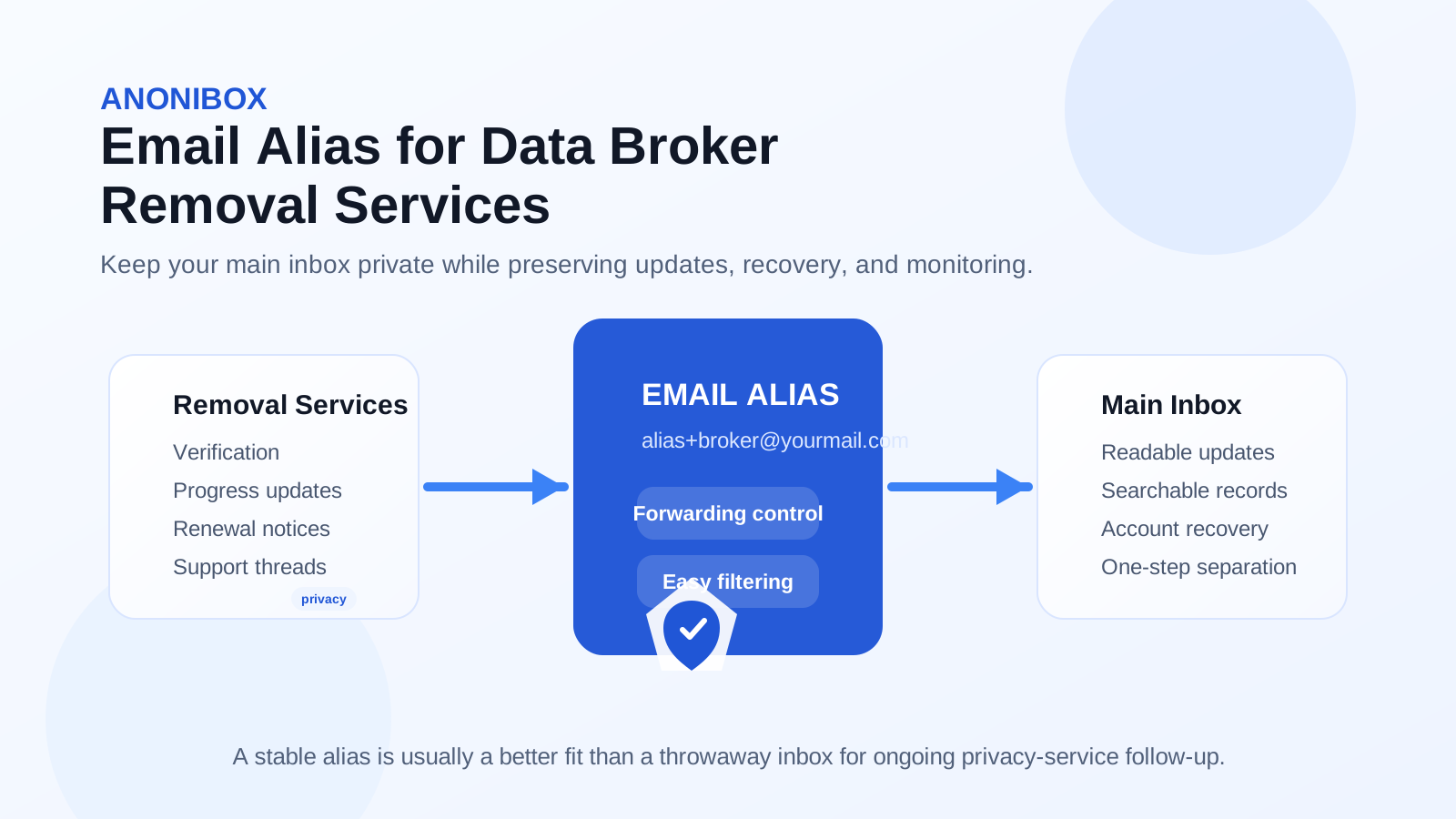
Usually yes. An email alias is often one of the best options for data broker removal services because it keeps your main inbox private while still giving you a stable place for verification links, progress updates, and renewal notices.
In practice, an alias works best as a middle ground: more durable than a temporary email, but less exposing than handing every privacy service your long-term personal address.
Why this question matters
People sign up for data broker removal services because they want less exposure, not more. They are trying to reduce how easily strangers, spammy lead brokers, people-search sites, and opportunistic marketers can connect names, addresses, phone numbers, and email accounts. That makes the signup email choice more important than it first appears.
The problem is that data broker removal is rarely a one-click event. Even if the service is useful, you may still need account verification, scan results, support replies, billing reminders, renewal decisions, re-check alerts, or evidence that an opt-out request was processed. If you use your everyday personal inbox, those messages get mixed into everything else. If you use a truly disposable address, you may cut yourself off from updates you actually need later.
That is why an email alias is such a practical option for this use case. It creates separation without sacrificing continuity.
What an email alias actually does
An email alias is a secondary address that forwards mail to an inbox you already control. To the removal service, it looks like a normal email address. On your side, it acts like a privacy buffer. You can filter it, label it, disable it later, or use a unique alias for one specific provider.
That is different from a temporary inbox. A temporary inbox is often disposable by design. An alias is meant to stay reachable for as long as you need it. It is also different from opening a completely separate mailbox, which can be useful but requires more setup and more account management.
Why an email alias can be a strong fit for data broker removal services
1. It limits exposure of your primary address
Your oldest personal email address tends to become a central identifier over time. It is attached to shopping accounts, household bills, school logins, travel confirmations, banking alerts, and personal conversations. The more places you hand it out, the harder it becomes to control where it travels next.
An alias reduces that spread. You are still reachable, but the service never needs your core inbox identity directly. If the provider becomes noisy, gets acquired, changes its marketing behavior, or simply stops being useful, you have a cleaner exit path.
2. It keeps privacy-management mail organized
Data broker removal messages are easy to lose in a busy mailbox because they do not always arrive in one burst. You may get a welcome message today, a support response next week, and a renewal prompt months later. If those messages come through an alias, you can automatically route them into a label or folder, which makes later searches much easier.
That matters when you need to answer questions like:
- When did I sign up?
- Which service handled which request?
- Did they confirm removals or only promise to review them?
- When does the plan renew?
- Which company sent the last progress report?
3. It gives you better leak detection and control
If you use a distinct alias for one removal service, you learn something useful later: if that alias starts receiving unrelated promotions, you know exactly which relationship produced the noise. That does not prove bad intent on its own, but it gives you much better visibility than using the same personal inbox everywhere.
It also lets you take action without uprooting your entire email life. You can mute the alias, filter it harder, or retire it if needed. That is a meaningful advantage over exposing your primary address directly.
4. It preserves account recovery and long-term follow-up
This is where an alias usually beats a throwaway inbox. Data broker removal services may involve password resets, account confirmations, support tickets, cancellation questions, reactivation decisions, or periodic monitoring alerts. A stable alias keeps those workflows alive. A short-lived inbox often does not.
If the service is something you actually plan to use for a while, continuity matters more than one extra layer of disposability.
Why a temporary email is often weaker for this specific job
Temporary inboxes are great for low-commitment testing. They can be useful if you just want to compare landing pages, download a guide, see whether a provider blocks disposable domains, or avoid immediate sales follow-up during early research. But once you create a real account, temporary email starts to show its limits.
You may lose access to:
- verification messages you need to activate the account,
- progress reports that explain what was actually removed,
- support replies about edge cases or manual requests,
- subscription and renewal reminders,
- password-reset links if you need to log back in later.
That is why the best workflow is often staged. Use a temporary inbox for very early browsing if you want to stay cautious, but move to a stable alias before you rely on a service for ongoing privacy work. If you use Anonibox or another disposable-email tool during research, that can help you avoid early funnel spam; it just should not automatically become the permanent address for a service you expect to revisit over time.
When a full separate mailbox may be better than a simple alias
An alias is a strong default, but it is not the only good option. A completely separate mailbox may be better if:
- you want privacy-management accounts kept away from your main login entirely,
- you manage removals for multiple family members or business identities,
- you expect a high volume of monitoring messages and support threads,
- you want dedicated recovery settings, storage, and audit history for this category of accounts.
Think of it this way: a temporary inbox is best for low-trust testing, an alias is best for lightweight ongoing use, and a separate mailbox is best when privacy management becomes a durable system rather than a one-off task.
How to set up an email alias for this use case
- Create an alias that is specific enough to recognize later. Something like privacy-removals@, broker-scan@, or a provider-specific alias is easier to track than a random string.
- Route it into a dedicated label or folder. That keeps progress updates and billing notices from disappearing under unrelated email.
- Store the login and alias details somewhere safe. If you need the account months later, you should not be reconstructing which alias you used.
- Keep recovery options under your control. The alias should forward to an inbox you actually monitor, not to a mailbox you rarely check.
- Review the alias periodically. If it starts attracting unrelated mail, you will know the address is circulating more broadly than you intended.
Common mistakes to avoid
- Using your oldest personal inbox by default. That is usually the easiest choice, not the safest one.
- Using a disposable inbox for a paid or ongoing account. It feels private at first, but it can create support and recovery headaches later.
- Reusing one alias for too many unrelated privacy tools. That makes it harder to tell where future noise came from.
- Assuming an alias makes you anonymous. It does not. It reduces exposure of one identifier; it does not erase all traceability or make a service risk-free.
- Ignoring forwarding and filtering setup. The value of an alias is not just the address itself. It is the control you build around it.
A quick decision checklist
Before you sign up, ask yourself:
- Am I only testing this provider, or do I expect to use it for months?
- Will I need later access to confirmations, reports, or account recovery?
- Do I want to know exactly which provider used this address?
- Would a full separate mailbox be better for my privacy workflow than a forwarding alias?
- Can I still monitor this alias reliably if an important message arrives weeks later?
If the answer to those questions points toward continuity and control, an alias is usually the best fit.
Final answer
Yes — for most people, an email alias is a smart choice for data broker removal services. It gives you more privacy than using your main inbox directly, but it stays stable enough for verification, monitoring, support, and future account access.
It is not a magic shield, and it will not solve every privacy concern by itself. But as a practical day-to-day workflow, it is one of the cleanest options available: safer than exposing your core inbox everywhere, and much more reliable than depending on a temporary address for an ongoing service. If your goal is to reduce inbox exposure without losing control of important updates, an email alias is usually the right middle ground.