Discord can work for quick interview coordination after you verify the employer, but it is usually a poor primary channel for full job interviews.
If a recruiter wants to run the whole interview only through Discord, especially before you can confirm who they are, slow down and verify the opportunity independently.
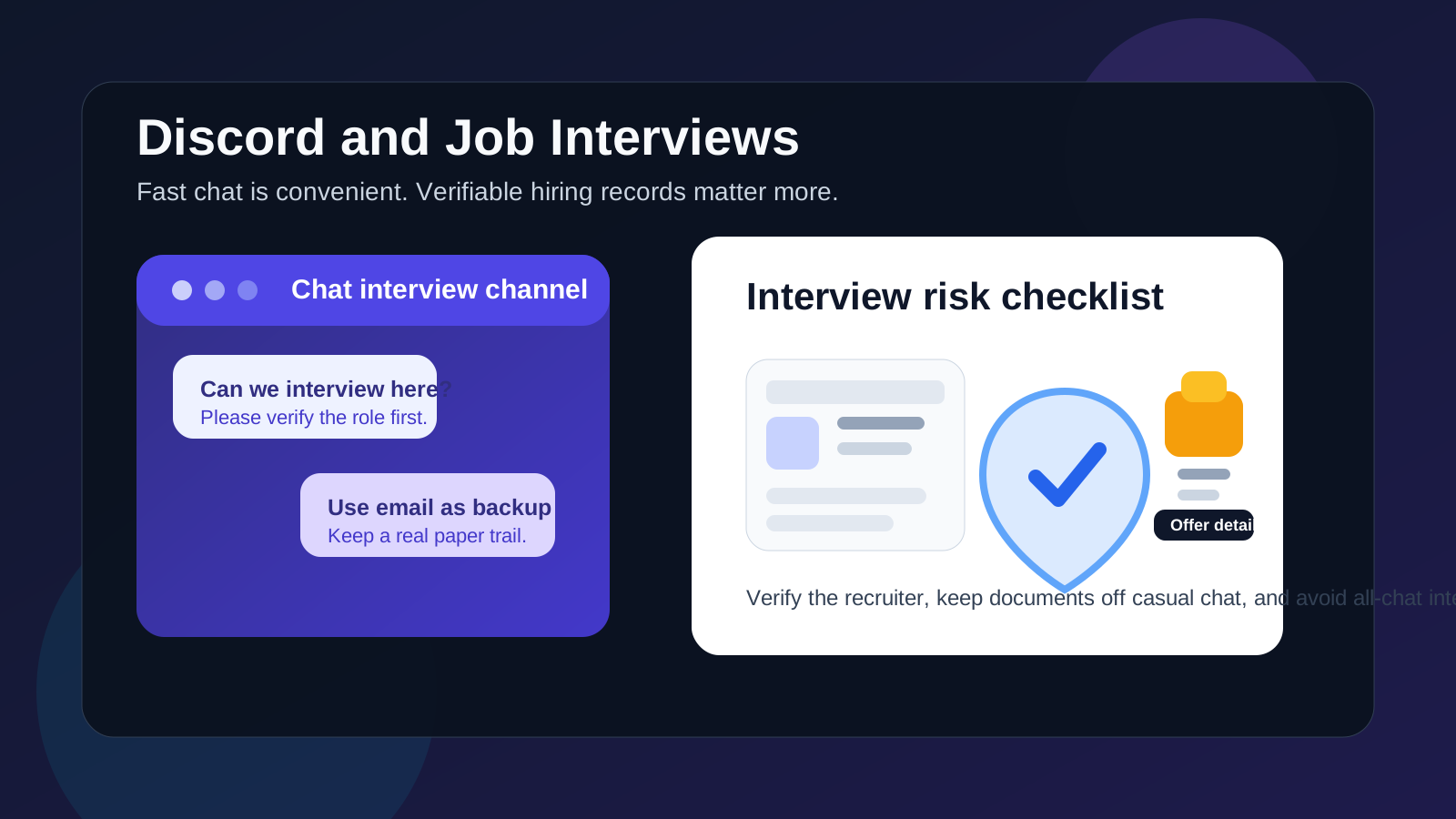
That does not mean Discord is automatically fake or unusable. In some corners of gaming, creator work, community operations, modding, indie development, and startup-heavy online communities, Discord really is part of how people meet, network, and share opportunities. A hiring manager may answer questions in a server. A community lead may suggest a time for a quick call. A founder may move fast and prefer chat over long email threads.
The issue is not whether Discord exists in professional life. The issue is whether it is being used in a way that still preserves identity checks, clear records, and reasonable boundaries. Job interviews are higher-stakes than casual networking. You are sharing time, sometimes documents, sometimes a portfolio, and often personal context that can be abused if the process is sloppy or fake.
Short answer: Discord is fine as a side channel, weak as the main interview channel
If you already know the company is real and the interviewer is real, Discord can be acceptable for low-friction coordination. That might mean confirming a time, asking which server or call link to join, or sending a quick “I’m here” message before the interview starts.
What Discord should usually not replace is the formal backbone of the interview process. If the job, the scheduling, the meeting details, and the follow-up all live only inside a Discord thread, you lose some of the structure that protects both sides. That makes misunderstandings easier and scams harder to spot.
Why Discord comes up in interviews at all
People usually ask this question for understandable reasons. Discord feels faster than email, less stiff than a corporate calendar invite, and more natural in internet-native industries. If you are interviewing for a gaming studio, creator community, moderation role, developer advocate job, or startup that lives in online communities, a Discord touchpoint may not feel strange at all.
There are also a few practical reasons employers or recruiters may suggest it:
- Fast scheduling: chat messages are easy for quick reschedules or call reminders.
- Community-native hiring: some teams recruit from communities that already use Discord daily.
- Low-friction follow-up: candidates and hiring managers can clarify small details without a formal email chain.
- Voice and screen sharing: Discord can technically handle a live conversation.
Those are real conveniences. They explain why Discord is tempting. They do not, by themselves, make it the best place to run an interview process.
What Discord does reasonably well
1. Warm introductions in community-based roles
If you already participate in a credible professional server, Discord can help you meet the right person faster. A community manager, founder, or moderator may point you to an open role or tell you which official page to use. That kind of warm introduction can be useful.
2. Last-minute logistics
For simple coordination, Discord can be fine. “We’re running ten minutes late” or “here’s the updated voice channel” is very different from “send us your ID, tax forms, and full portfolio here.” The first is low-stakes logistics. The second is where the risk rises.
3. Familiarity in certain industries
If the job itself revolves around Discord communities, creator support, esports, moderation, or community-building, some Discord usage may be completely normal. Even then, normal does not mean ideal for every stage of hiring.
Where Discord becomes risky for job interviews
1. It is harder to verify identity cleanly
This is the biggest problem. A Discord display name, role badge, or polished profile is not the same as a verifiable company-domain email or a public role listing on the employer’s site. Someone can sound convincing in chat while still being difficult to confirm independently.
That matters because interviews often become the moment where scammers push harder. Once you are invested, it becomes easier for someone to pressure you into downloading files, moving to another channel, or sharing more personal information than the stage should require.
2. Your records get weaker
Real interview processes generate important details: time zones, interviewer names, meeting formats, take-home instructions, next steps, and promises about when you will hear back. If too much of that lives only in a chat app, it is easier to lose the thread, search the wrong server, or miss a key detail buried under notifications.
3. Personal and professional boundaries blur fast
Many people use Discord for hobbies, gaming, fandom, friends, or side communities. If you use the same account for interviews, your avatar, username style, bio, visible activity, or server memberships may reveal more than you intended. That may not matter with a verified employer, but it is still a boundary issue worth noticing.
4. Discord can make scam behavior feel casual
Casual tone lowers defenses. A fake recruiter can sound friendly, move quickly, and make the whole interaction feel normal because it is happening in a familiar chat environment. That is especially dangerous when they try to create urgency, skip formal confirmation, or keep everything out of email.
5. Files and links need extra caution
If someone sends attachments, invite links, app installers, or “assessment tools” through Discord before you have fully verified the role, be careful. Discord itself is not the problem; unverified downloads are. A convenient chat channel can become the delivery path for malware, credential harvesting, or fake interview tasks.
When Discord may be reasonable
Discord becomes much easier to justify when several green flags are already in place:
- You found the role through a real company site, public posting, or verified employee.
- You already have matching confirmation from a company-domain email.
- The interviewer’s identity can be cross-checked on the company site or LinkedIn.
- Discord is being used for convenience, not for the entire hiring process.
- The role itself is close to online communities where Discord use is expected.
In that setup, Discord is a supporting tool. The interview can still be legitimate because the trust did not come only from the app.
Red flags that mean you should pause
- No company-domain email at all: everything stays inside Discord from the first message onward.
- Vague role details: no clear public job posting, unclear company information, or shifting answers.
- Pressure to move fast: urgency appears before basic verification is complete.
- Sensitive requests too early: ID documents, payment details, tax information, or software installs before a normal interview process exists.
- Server or DM-only hiring: the recruiter acts as if a formal paper trail is unnecessary.
- Links or downloads feel off: shortened links, suspicious files, or odd “skills tests” that require local installs.
If several of those signs show up together, the problem is not just that the channel is Discord. The bigger issue is that the hiring process may not be trustworthy at all.
Best practices if someone wants to interview on Discord
Ask for an official email confirmation
A legitimate employer should be able to confirm the interview by email from the company domain, even if they prefer Discord for fast coordination. That single step gives you a stronger record and an easier way to verify the opportunity.
Keep important documents off casual chat
Resumes, portfolios, assessments, contracts, onboarding documents, and anything identity-sensitive are usually better handled through email or a formal hiring portal. Discord is better for coordination than for document custody.
Review what your profile reveals
If you use Discord professionally, it is worth checking your display name, avatar, status, bio, and what a stranger can infer at a glance. Small profile decisions can protect your privacy without making you look evasive.
Save the real details somewhere else
Do not rely on memory or one app. Put the interview time, role title, interviewer name, and next-step promises in your own notes or calendar. If you lose the server, lose access to the DM, or simply miss a notification, you still have a clean record.
Use a separate email strategy for early exposure
If your broader job search already involves public communities, job boards, or low-trust signups, separating your inbox can help. Some people use a service like Anonibox for the earliest, noisiest stage of outreach, then move serious interview communication onto a stable address they monitor closely. That keeps your exposure lower without weakening your paper trail once the role becomes real.
A practical decision checklist
Before agreeing to use Discord for an interview, ask yourself:
- Did I verify the company and the role outside Discord?
- Do I know who this person is beyond a username or server role?
- Is Discord only being used for coordination, or for the entire process?
- Would I be comfortable if I needed to search or prove this conversation later?
- Am I being asked to share more information than this stage should require?
If those answers feel solid, Discord may be fine as a convenience channel. If they feel shaky, trust that discomfort. Interview friction is annoying, but fake interviews are worse.
Final answer
Discord can be acceptable for job interviews in narrow situations, especially after the employer is verified and the app is being used only for quick coordination or a community-native role. But it is usually not the best place to run the full interview process from start to finish.
The safest approach is to verify the recruiter independently, keep official email involved, avoid sending sensitive material in casual chat, and treat any Discord-only interview workflow with extra caution. Used as a side channel, Discord can be convenient. Used as the entire system of trust, it is much weaker.