Yes — you can use DuckDuckGo Email Protection for employment verification if the alias forwards into an inbox you monitor closely and you keep it active until the process is fully finished.
It is a reasonable privacy buffer, but it is usually not the best choice if HR or a screening vendor needs the simplest possible long-term contact path for urgent forms, corrections, and follow-up questions.
That distinction matters because employment verification happens late enough in the hiring process that reliability starts to matter more than clever setup. A disposable inbox may be fine for a low-trust signup or a one-off download. Employment verification is different. You may receive consent forms, portal links, deadline reminders, identity questions, and follow-up messages from more than one party over several days.
So the right question is not just whether DuckDuckGo Email Protection is private enough. The real question is whether it gives you enough continuity for a stage of hiring where one missed email can slow down an offer or delay a start date.
What DuckDuckGo Email Protection is really doing here
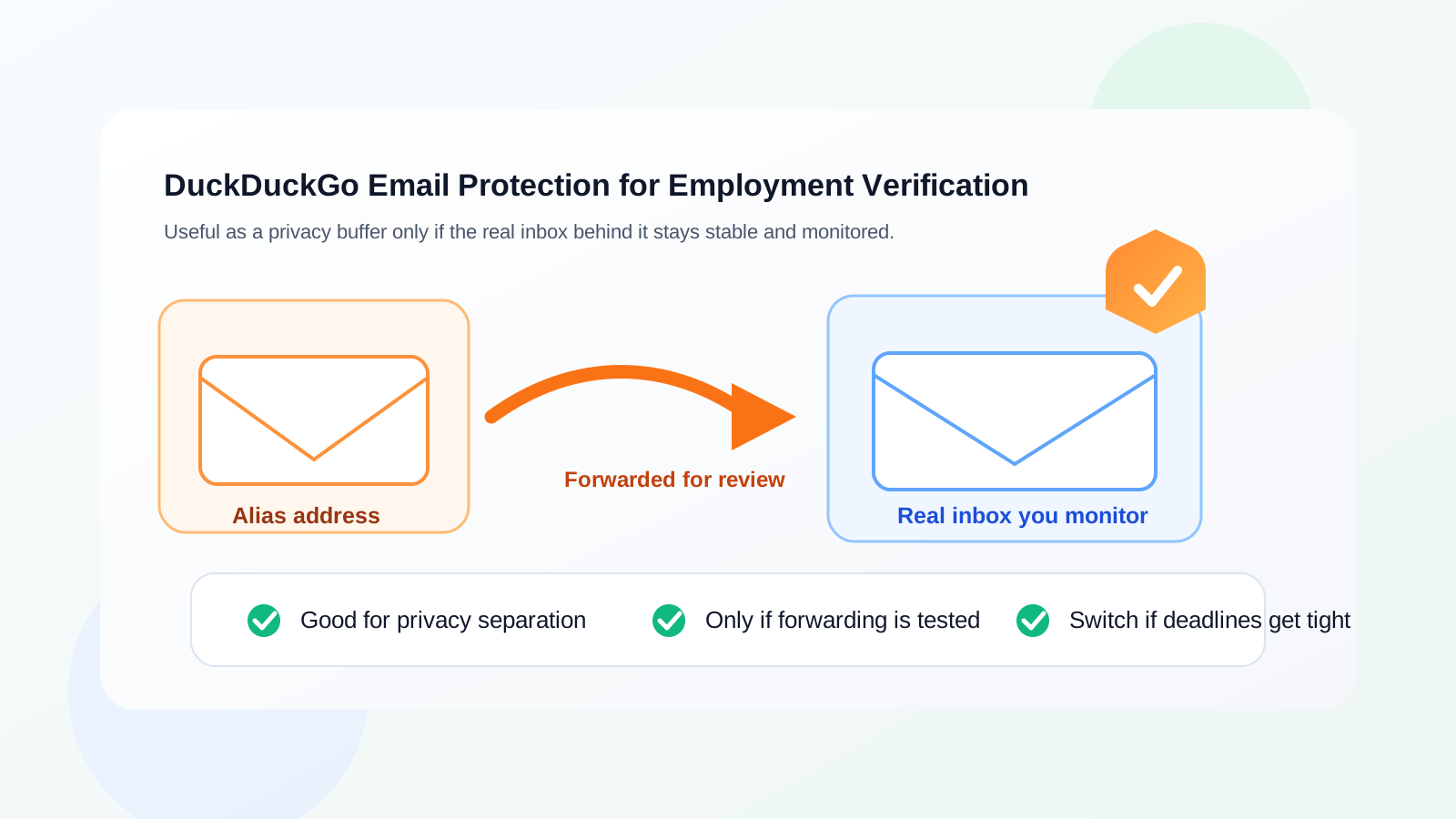
DuckDuckGo Email Protection is closer to an alias or forwarding layer than a classic temporary inbox. Instead of living inside a standalone mailbox you abandon later, it sits in front of a real inbox you already control. That means you get some privacy separation without forcing the sender to know your underlying address.
For employment verification, that can be useful. It lets you keep your oldest personal inbox less exposed while still receiving the messages in a place you already know how to manage. If you are privacy-conscious, that is a real advantage.
But the forwarding layer also adds one more moving part. During early job-search activity, that is often acceptable. During employment verification, where the messages can become urgent and document-heavy, the extra layer only makes sense if it stays boringly reliable.
Why employment verification is a tougher test than early applications
People often treat all hiring email as the same. It is not. The email setup that works for job-board signups or recruiter outreach is not automatically the best setup for final-stage verification.
- The stakes are higher: this stage often happens after interviews, when the company is actively trying to close the process.
- The timeline can tighten fast: you may get same-day requests for forms or corrections.
- More parties may be involved: recruiter, HR, employer, and third-party screening vendor.
- The content is more sensitive: prior employment dates, job titles, legal names, consent steps, and identity details can all show up here.
That means employment verification rewards the fewest moving parts possible. Privacy still matters, but continuity matters more than it did earlier in the funnel.
When DuckDuckGo Email Protection is a good fit
1. You want a privacy buffer without using a throwaway inbox
If you do not want every employer, recruiter, and screening vendor to have your long-term personal address, an alias can be a good middle ground. You still receive the mail in a real inbox you own, but you do not expose that inbox as widely.
2. You already have a clean destination inbox behind it
The alias only works as well as the mailbox it forwards into. If the destination inbox is stable, checked daily, and not buried under newsletters or low-priority clutter, the setup can work fine. If the destination inbox is chaotic, the alias is not solving the real problem.
3. You expect moderate follow-up, not a fragile multi-week process
DuckDuckGo Email Protection is most comfortable when the employment-verification process is real but still straightforward: a few emails, maybe a portal link, maybe a consent form, and a manageable amount of back-and-forth. If you expect prolonged document exchange or repeated resends, a direct dedicated inbox becomes more attractive.
4. You understand your own workflow
If you already know how your forwarded messages arrive, how quickly they show up, and how you prefer to reply, you are in much better shape than someone testing an alias setup for the first time in the middle of a deadline.
Where DuckDuckGo Email Protection can create friction
Reply consistency can matter more than receiving the first message
Many people focus on whether the initial email will arrive. That is important, but it is only half the story. Employment verification often turns into a thread: a screener asks for a correction, HR resends a form, or a recruiter follows up on a missing step. If replying through the setup feels confusing, you have added friction at the exact stage where speed matters.
It can encourage “temporary mode” thinking
Alias tools are useful, but they sometimes keep people in the mindset of treating every hiring interaction as disposable. Employment verification is not disposable. Once a company is verifying your history, you are in the part of the process where stable records and reliable communication matter more than aggressive inbox minimization.
Late-stage hiring is less forgiving of missed messages
If a vendor sends a consent request at noon and the deadline is 5 PM, a forwarding setup that you only check casually can become a problem very quickly. The risk is not that the alias looks suspicious. The risk is simply missing something important because there were too many layers between the sender and your attention.
DuckDuckGo Email Protection vs a true temporary email
This is one of the most useful comparisons because people often put them in the same bucket.
A true temporary inbox is best for low-trust or low-stakes moments: one sign-up, one code, one gated resource, then you are done. That is where a tool like Anonibox can be useful. It is a clean way to protect your main inbox during early-stage testing, job-board experiments, and spam-prone forms.
Employment verification is later-stage and continuity-heavy. You are no longer optimizing for one incoming message. You are optimizing for complete follow-through. DuckDuckGo Email Protection is better suited than a disposable inbox because the messages still land in a real mailbox you control. Even so, it is still one step less direct than using a dedicated long-term inbox from the start.
DuckDuckGo Email Protection vs a dedicated job-search inbox
For many people, the strongest alternative is not their oldest personal inbox and not a disposable one. It is a dedicated job-search inbox that exists specifically for recruiter messages, interviews, offers, and verification.
A dedicated inbox often wins on:
- Simplicity: one direct address across recruiter threads, forms, and vendor portals.
- Searchability: full history in one place, including sent mail and attachments.
- Lower confusion: no need to remember which alias belongs to which employer.
- Continuity: easier to keep active through offer, onboarding, and start-date changes.
If your main goal is to reduce exposure while staying fully dependable, a dedicated inbox is often the best long-term answer. DuckDuckGo Email Protection can still make sense if you prefer an alias layer, but it should not come at the cost of clarity or responsiveness.
Practical signs the alias is probably fine
- You already use the underlying inbox daily.
- You have tested that forwarded messages arrive promptly.
- You can reply without uncertainty or thread weirdness.
- The employer or screening vendor is sending a modest amount of communication.
- You plan to keep the alias active well past the first email.
In those cases, DuckDuckGo Email Protection can be a sensible privacy layer rather than a risky gimmick.
Practical signs you should switch to a direct inbox
- The process has become document-heavy or deadline-heavy.
- You are juggling several aliases and starting to lose track.
- You are not completely sure how replies present to the other side.
- You expect onboarding, payroll, or HR follow-up to continue using the same address.
- You already feel anxious about missing something important.
At that point, the best move is usually to reduce complexity. There is nothing wrong with deciding that the last stage of hiring deserves the most direct possible communication channel.
Best practices if you decide to use DuckDuckGo Email Protection for employment verification
Forward into an inbox you trust, not one you barely monitor
This sounds obvious, but it is the most important rule. The alias is only the front door. Your actual reliability depends on the inbox behind it.
Keep notifications on during active verification windows
If you are waiting on consent forms, identity checks, or corrections, this is not the moment for a once-a-day email habit. Turn on alerts or create a label or folder rule so the messages stand out.
Do not disable the alias early
Employment verification may feel done before it is actually done. Leave the path open until the employer confirms everything is complete and you are confident no more follow-up is coming.
Save the important details outside the thread
Keep a small note with the company name, recruiter, screening vendor, deadlines, and any portal URLs. That way you are not relying entirely on your inbox to remember the state of the process.
Use one consistent identity once the process is underway
If you applied with one email, interviewed with another, and verify employment with a third, you can create avoidable confusion. An alias can still work, but consistency makes life easier for everyone involved.
A simple example of the right and wrong way to use it
Good use: You created a job-search-only inbox months ago, your DuckDuckGo alias forwards into it, you check it constantly, and the company’s verification vendor has only sent a few straightforward requests. In that case, the alias is a reasonable privacy buffer.
Bad use: You are using an alias that forwards into a crowded personal inbox you rarely check, you are not totally sure how replies behave, and the employer has already started sending time-sensitive portal reminders. In that case, the alias is adding risk instead of reducing it.
Final answer
Yes, you can use DuckDuckGo Email Protection for employment verification, and it can be a smart option when you want some privacy separation without relying on a fully disposable inbox.
But employment verification is one of the least forgiving parts of the hiring process. If the setup adds even a little uncertainty around forwarded mail, replies, or long-term continuity, a dedicated direct inbox is usually the better choice. Use the alias when it improves control without increasing friction, and choose boring reliability the moment the process becomes serious.