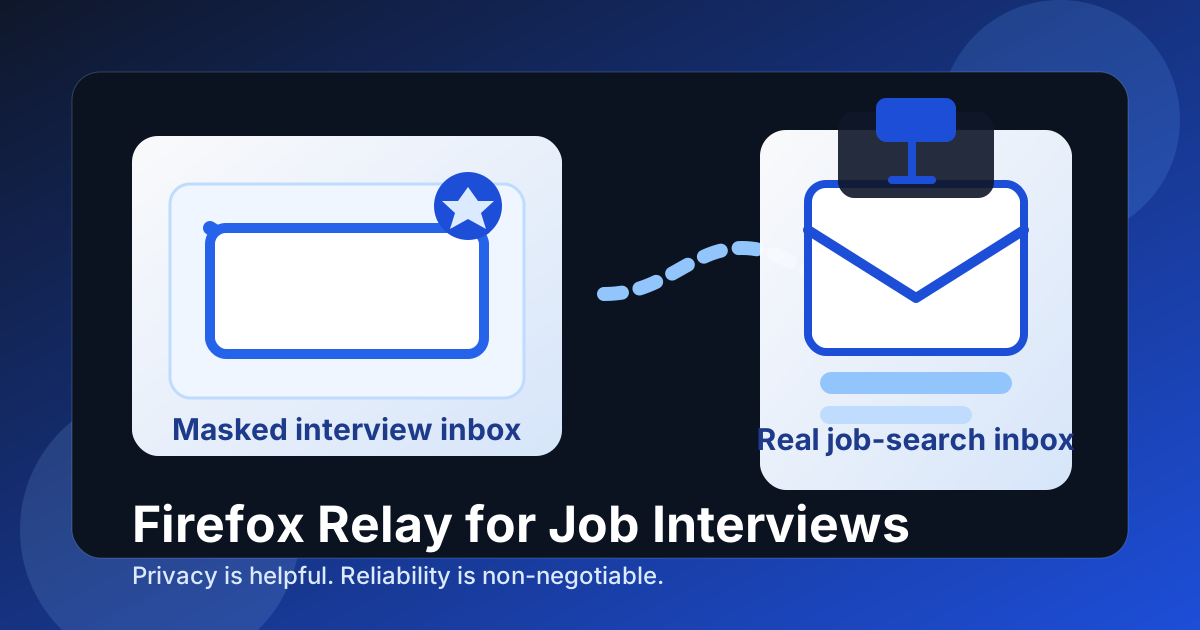
Yes, you can use Firefox Relay for job interviews if the mask forwards into an inbox you check constantly and you keep that mask active for the entire hiring process.
It is usually a better choice than a disposable inbox once interviews begin, but it is still not as simple or as future-proof as using a dedicated long-term email account for a serious job search.
Why people consider Firefox Relay for interviews in the first place
Firefox Relay appeals to job seekers for an obvious reason: it lets you hide your real address behind a masked one. That can be genuinely useful when you are dealing with recruiter databases, staffing firms, multiple hiring platforms, or employers you do not fully trust yet. Instead of handing your oldest personal inbox to every application form, you can give out a mask and keep more control over where interview traffic starts.
That matters because interview-stage communication often begins before you feel sure the opportunity is real or worth deeper investment. A recruiter might ask for availability, a coordinator might send a calendar link, or a founder might follow up from a personal domain you have never seen before. Privacy-conscious candidates do not want every one of those contacts tied permanently to the same personal inbox they use for banking, friends, travel, and years of accumulated account recovery.
So the question behind this keyword is sensible. The issue is not whether Firefox Relay is private enough. The issue is whether it is dependable enough when interview communication becomes time-sensitive and messy in real life.
What Firefox Relay does well during a job search
For early and mid-stage interview activity, Firefox Relay has several practical advantages.
- It keeps your real address out of more databases. That reduces the chance that one signup becomes long-term recruiter spam or marketing clutter.
- It creates cleaner separation. You can keep interview traffic distinct from your personal inbox identity, especially if you are applying broadly or talking to several recruiters at once.
- It is more stable than a throwaway temp inbox. A forwarding mask tied to a real mailbox is usually much safer for live scheduling than a disposable address that may disappear or become hard to manage later.
- It can help you spot where messages came from. If you use a thoughtful alias strategy, you can tell which employer, recruiter, or platform originally received that address.
Those benefits are real. For people who already use masked email for privacy, Firefox Relay can feel like a natural middle ground between exposing your main address everywhere and relying on a true temporary inbox that is too fragile for interviews.
Why interview-stage email is different from application-stage email
The biggest mistake people make here is treating interviews like ordinary signups. Early applications are often low stakes. If one job board newsletter gets noisy or one lead goes nowhere, that is annoying but manageable. Interviews are different.
Once a company is actively speaking with you, email becomes operational. It may carry same-day scheduling changes, video meeting links, panel details, take-home instructions, calendar invites, feedback requests, travel notes, or next-step confirmations. Sometimes several people from the same company write from different domains or tools. Sometimes the recruiter, coordinator, and hiring manager all appear in the same thread within 24 hours.
That is why reliability matters more than cleverness. If your privacy setup adds confusion, delays, or avoidable message loss, it is no longer helping you.
When Firefox Relay is a good fit for job interviews
Firefox Relay can work well when the interview process is active but still relatively lightweight. Good examples include:
- initial recruiter screens
- first-round interview scheduling
- conversations with third-party recruiters you do not know yet
- job searches where you want to avoid exposing your long-term personal address too early
- situations where you already have a dependable inbox receiving the forwarded mail
If the underlying mailbox is one you monitor carefully and the mask stays stable, many employers will never care that you used an alias. In practice, recruiters mainly care that messages land, replies arrive on time, and the address looks consistent from one stage to the next.
Where Firefox Relay can create friction
Firefox Relay is not automatically risky, but it does introduce a few failure points you should think through before relying on it.
1. Your real inbox still does the real work
A mask is only the front door. The actual delivery still depends on the inbox behind it. If that mailbox is messy, rarely checked, overfiltered, or already overloaded, Firefox Relay does not fix the core problem. It just hides your address.
2. Alias management can get confusing
If you create too many masks too quickly, you may forget which company has which address. That becomes awkward when you need to search old threads, identify the source of a follow-up, or decide which contact should keep working long term.
3. You may outgrow the privacy layer mid-process
Interview workflows sometimes turn into offer workflows faster than expected. What starts as a simple recruiter screen can become a take-home assignment, reference request, or paperwork chain. If you are already thinking, “I might need this thread in three months,” you are no longer in disposable-email territory. You are managing a long-lived professional relationship.
4. Fast-moving communication punishes any weak link
If an interview gets rescheduled at short notice, or a coordinator sends the meeting link 15 minutes before start time, you want the path from sender to inbox to feel boring and dependable. Anything you might disable, misroute, or stop monitoring becomes a liability.
When you should switch to a more permanent address
Even if Firefox Relay works at first, there are points where switching to a dedicated long-term inbox is the safer play.
- Late-stage interviews: several rounds, multiple stakeholders, or detailed coordination.
- Take-home assignments and threaded feedback: you want clean history and easy search later.
- Offer-stage communication: salary discussions, written offers, benefits notes, and onboarding logistics should go somewhere stable.
- Background checks or identity-sensitive steps: reliability matters more than one more layer of masking.
- Any process you may revisit later: some employers come back weeks later with updates, reopened roles, or second opportunities.
A good rule is simple: use privacy layers early, use stable infrastructure when stakes rise. That is usually the most practical balance.
Firefox Relay versus a disposable inbox
This is where Firefox Relay often makes more sense than a true temporary email tool. A disposable inbox is useful for low-trust signups, one-off downloads, salary reports, trial accounts, or noisy job-board experiments. It is great when your main goal is avoiding spam and you do not need an ongoing relationship.
Job interviews are different because the communication is supposed to continue. Firefox Relay forwards into a real inbox you control, so it is generally more appropriate than a temporary inbox once an employer is actively engaging with you.
That does not make it perfect. It just means it sits in a different category. If you are still at the stage of testing alerts, browsing low-trust job boards, or signing up for career resources you are not sure you will keep, a disposable option like Anonibox may be the cleaner tool. If a real person is trying to schedule an interview with you, a forwarding alias or dedicated inbox is usually the safer move.
Best practices if you want to use Firefox Relay for interviews
- Forward into a serious mailbox. Use an inbox you already trust for important communication, not one you barely open.
- Test the flow before you apply. Send yourself messages from another account and make sure delivery is quick and easy to notice.
- Keep the mask active for the full process. Do not rotate addresses mid-interview unless there is a real problem.
- Use a professional display name. Your visible sender identity should still look normal and recruiter-friendly.
- Track which mask belongs to which employer. A simple note is enough. Confusion grows fast when several companies are in motion.
- Whitelist or star important contacts in your real inbox. Privacy does not help if the forwarded message lands in clutter or promotions.
- Switch deliberately if the process becomes serious. If you move to a permanent address, do it once, explain it briefly, and keep the handoff clean.
What recruiters are likely to notice
Most recruiters will not care that deeply about Firefox Relay as a product. They usually care about simpler signals:
- Did the message bounce?
- Did you reply promptly?
- Does the address look stable enough for ongoing conversation?
- Can they send attachments, invites, and follow-ups without confusion?
That means you do not need a perfect or prestigious email setup. You need a reliable one. If Firefox Relay helps you stay organized and private without making you harder to reach, it can work. If it makes you second-guess whether an important email arrived, it is the wrong tool for that stage.
A quick decision checklist
- Do I have a real inbox behind the mask that I check constantly?
- Will I keep this alias active until the process is fully over?
- Am I still in early interview coordination, or am I getting close to offers and paperwork?
- Would a dedicated job-search inbox be simpler than managing masks for this role?
- Am I using Firefox Relay for privacy, or am I using it because I do not trust my own inbox habits?
If your answers point to stability and intentional use, Firefox Relay is reasonable. If they point to uncertainty, clutter, or frequent switching, a plain dedicated inbox is safer.
Final answer
So, should you use Firefox Relay for job interviews? Yes, you can — if you treat it as a stable forwarding layer rather than as a throwaway trick. It is a sensible privacy tool for early and mid-stage interview communication, especially when you want to protect your real address from recruiter databases and low-trust platforms.
But the closer you get to high-stakes scheduling, offer letters, background checks, and long-term follow-up, the more valuable a straightforward dedicated inbox becomes. Privacy is useful. Missing a recruiter reply is expensive. The best setup is the one that protects your identity without making you harder to hire.