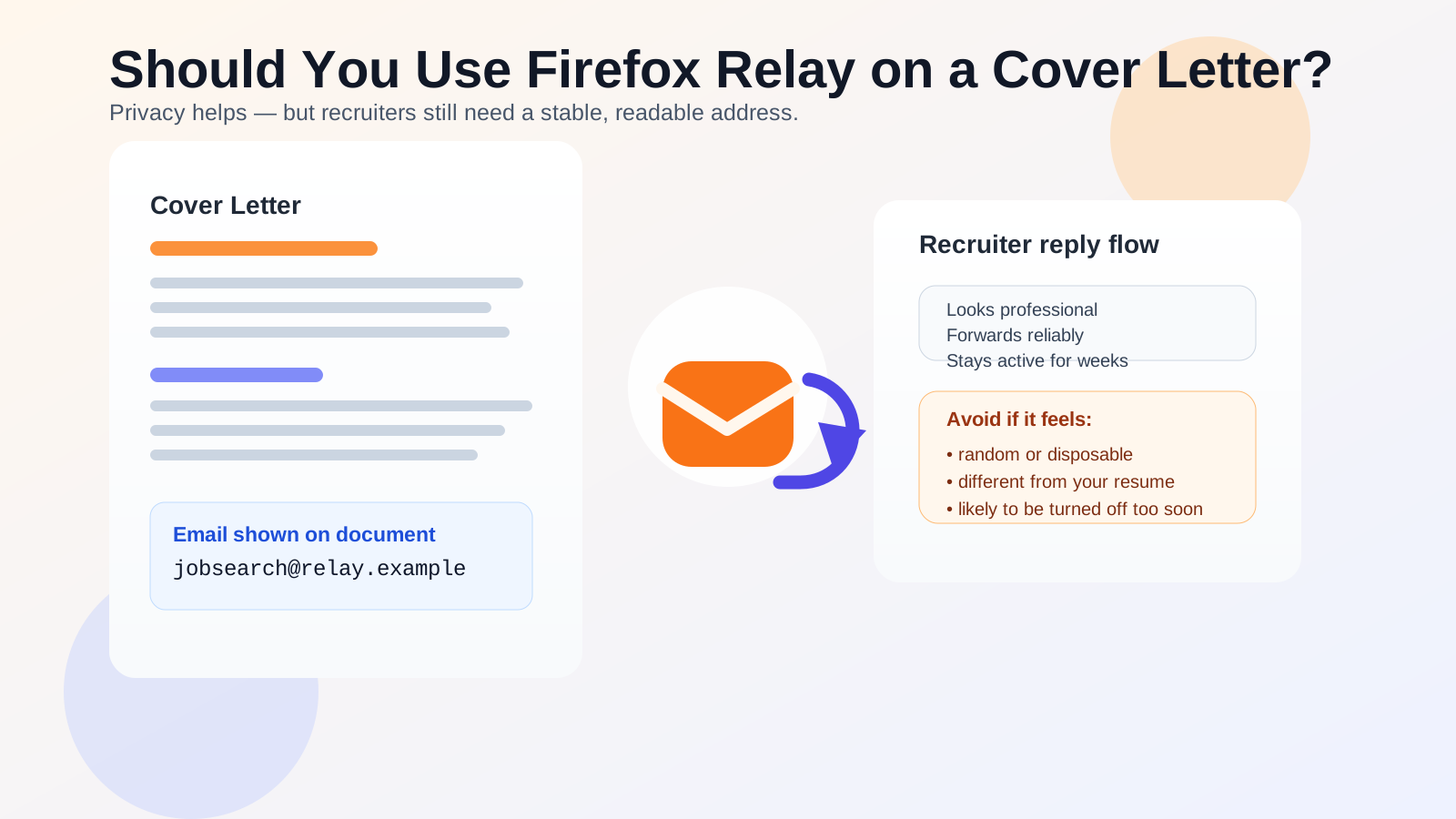
Yes — Firefox Relay can work on a cover letter if the alias looks professional, forwards reliably, and stays active through the whole hiring process.
It is a poor choice if the address looks random, if you may disable it later, or if you want a throwaway contact instead of a dependable one that a recruiter can still use weeks from now.
A cover letter sits in an awkward middle ground between privacy and professionalism. You want employers to reach you easily, but you may not want your main inbox printed on a document that can be forwarded through applicant tracking systems, recruiter tools, staffing firms, and internal hiring threads. That is why tools like Firefox Relay start to look attractive.
Firefox Relay gives you an email alias that forwards messages to your real inbox. That can be genuinely useful during a job search, especially if you want inbox separation and less long-term exposure. But a cover letter is not the same thing as a newsletter signup, coupon form, or random free trial. The address on that page may be used for interview scheduling, follow-up questions, portfolio requests, and offer-stage communication. Privacy helps only if it does not get in the way of being reachable.
Why this question matters
People rarely worry about email privacy until they start applying for jobs at scale. Then the problem becomes obvious. One resume upload can lead to recruiter outreach, job-board digests, staffing emails, screening invites, and unexpected follow-up from roles you barely remember applying to. A cover letter usually carries the same email address as the rest of your application, so the contact route you choose matters more than it seems.
Firefox Relay appeals to privacy-conscious applicants because it adds a buffer between the outside world and the inbox they actually use every day. That buffer can make job-search mail easier to track and, in some cases, easier to shut down later if the address starts attracting noise. The question is not whether that privacy layer is useful. The question is whether the alias still feels steady and professional enough for a formal hiring document.
Short answer: acceptable for some applicants, not ideal for everyone
Firefox Relay is usually acceptable on a cover letter if you already use it confidently, the alias is easy to read, and you expect to keep it active until the hiring process is truly over. It can be a sensible way to separate recruiter mail from your main inbox without exposing your oldest personal address everywhere.
It is not ideal if you are experimenting with aliases for the first time, rotating them aggressively, or relying on a string that looks obviously temporary. Cover letters reward boring reliability. If the address creates even a little uncertainty, the privacy benefit may not be worth the trade.
What Firefox Relay does well on a cover letter
It protects your underlying inbox
That is the clearest advantage. A cover letter may be saved, forwarded, or copied into internal systems you never see. Using an alias means your core inbox is not printed directly on the document itself. If one employer, one recruiter, or one platform becomes noisy later, you have more control than you would with a permanently exposed personal address.
It keeps job-search communication easier to spot
Alias-based workflows help with organization. When a message arrives through a Firefox Relay address, you immediately know it is tied to your job search. That can be useful when you are juggling applications, networking conversations, portfolio submissions, and your regular personal or work email at the same time.
It can lower long-term spam risk
Even legitimate hiring channels can lead to extra email over time. Recruiter databases get reused, applicant pools get revisited, and old submissions sometimes trigger unrelated outreach later. A relay address can reduce how much direct exposure your primary inbox gets from all of that.
It fits a broader privacy-first workflow
Some people use one clean inbox for trusted communication, another for job searching, and disposable tools for low-trust signups. Firefox Relay can fit into that middle layer well. It is more durable than a throwaway inbox, but still more private than printing your long-standing personal email on every document.
Where Firefox Relay can go wrong
The alias may look too random
This is the biggest practical issue. Recruiters do not need a lesson on alias technology, but they do react to what is in front of them. If the address looks cluttered, auto-generated, or hard to read aloud on a phone screen, it can create small but unnecessary friction. A cover letter is not the place to look clever. It is the place to look easy to contact.
You may treat it like a temporary address
Firefox Relay is more stable than a disposable inbox, but some applicants still approach it with a throwaway mindset. That is where trouble starts. A company may respond in two days or in three weeks. If you disable the alias, stop watching the destination inbox, or forget how the forwarding was set up, you can miss real opportunities for reasons that have nothing to do with your qualifications.
Forwarding adds one more layer to manage
Extra layers are fine when you manage them carefully. They are less fine when you are applying to ten roles at once and cannot remember which alias is attached to which document. A direct inbox is simpler. A relay inbox is only better if the extra control is worth the extra complexity for you.
It may not match the rest of your application
Consistency matters. If your resume shows one address, the application form shows another, and your cover letter shows a Firefox Relay alias, you create a chance for confusion. Even if every address forwards to you correctly, the hiring team may not know that. A privacy setup works best when the same professional contact address appears across the whole application package.
When Firefox Relay makes sense on a cover letter
- You already use Firefox Relay comfortably and understand how your forwarding setup works.
- The alias is clean, readable, and not obviously random-looking.
- You plan to keep it active through the full interview and offer timeline.
- You use the same address on the resume, application form, and cover letter for that role.
- You want privacy and inbox separation, but you still need a dependable long-term contact path.
In that situation, Firefox Relay can be a reasonable middle ground. It is not the most conventional option, but it can still be professional enough if handled carefully.
When it is better to use something else
- You are only using the alias because you do not trust yourself to manage spam later.
- The address format looks awkward or hard to remember.
- You are likely to turn the alias off after submitting the application.
- You want the simplest possible contact method for a high-value application.
- You are applying for a role where conventional presentation matters a lot and you do not want any extra variables.
In those cases, a normal long-term inbox is safer. Gmail, Outlook, iCloud Mail, Proton Mail, Fastmail, and a clean custom-domain address can all work well if they are professional-looking and monitored consistently.
Firefox Relay versus a temporary inbox
This distinction matters. Firefox Relay is not the same as using a one-time disposable inbox. A disposable inbox is often perfect for low-trust signups, free downloads, gated tools, or early research when you only need a confirmation link and do not care about future continuity. A cover letter is different.
If you use Anonibox or another temporary email workflow for job boards, resume tools, or sketchier signup steps, that can make sense. But the email printed on the cover letter itself usually needs more stability than a true throwaway address. Firefox Relay sits in the middle: more private than a direct inbox, but only appropriate if you treat it like a durable contact channel rather than a disposable one.
Best practices if you do use Firefox Relay on a cover letter
Use one clear address everywhere for that application
Your cover letter, resume, and form submission should point to the same contact route. That reduces confusion and makes the whole application feel more polished.
Choose readability over cleverness
If you can control the alias format, keep it simple. If you cannot, think carefully about whether the result still looks professional enough for a formal document.
Test the forwarding before you apply
Send yourself a message, reply to it, and make sure the full path behaves the way you expect. Do not discover a forwarding issue after a recruiter has already tried to reach you.
Keep the alias active for longer than you think you need
Hiring processes drag. Leave the address in place until the process is clearly over, not just until you send the application.
Monitor the destination inbox daily
An alias is only as reliable as the inbox behind it. If replies land in an account you rarely check, the privacy setup is hurting you more than it is helping.
A simple decision rule
If Firefox Relay helps you stay organized without making your contact details look temporary, it can be fine on a cover letter. If the alias looks odd, feels experimental, or adds enough complexity that you might miss an important reply, use a regular long-term inbox instead.
That rule is more useful than debating whether aliases are “professional” in the abstract. Employers care far less about the technology than about whether your email works, looks clear, and stays available.
Final answer
Firefox Relay can be a reasonable cover-letter email for privacy-conscious job seekers, but only when reliability comes first. The alias should be readable, stable, and consistent across your application materials. If you are treating it like a semi-disposable layer, it is the wrong tool for the job.
For low-trust signups and early job-search experiments, temporary email tools can be useful. For the actual contact address on a cover letter, though, the best option is usually the most dependable one you can monitor every day. If Firefox Relay meets that standard for you, it can work. If not, a straightforward long-term inbox is the safer move.