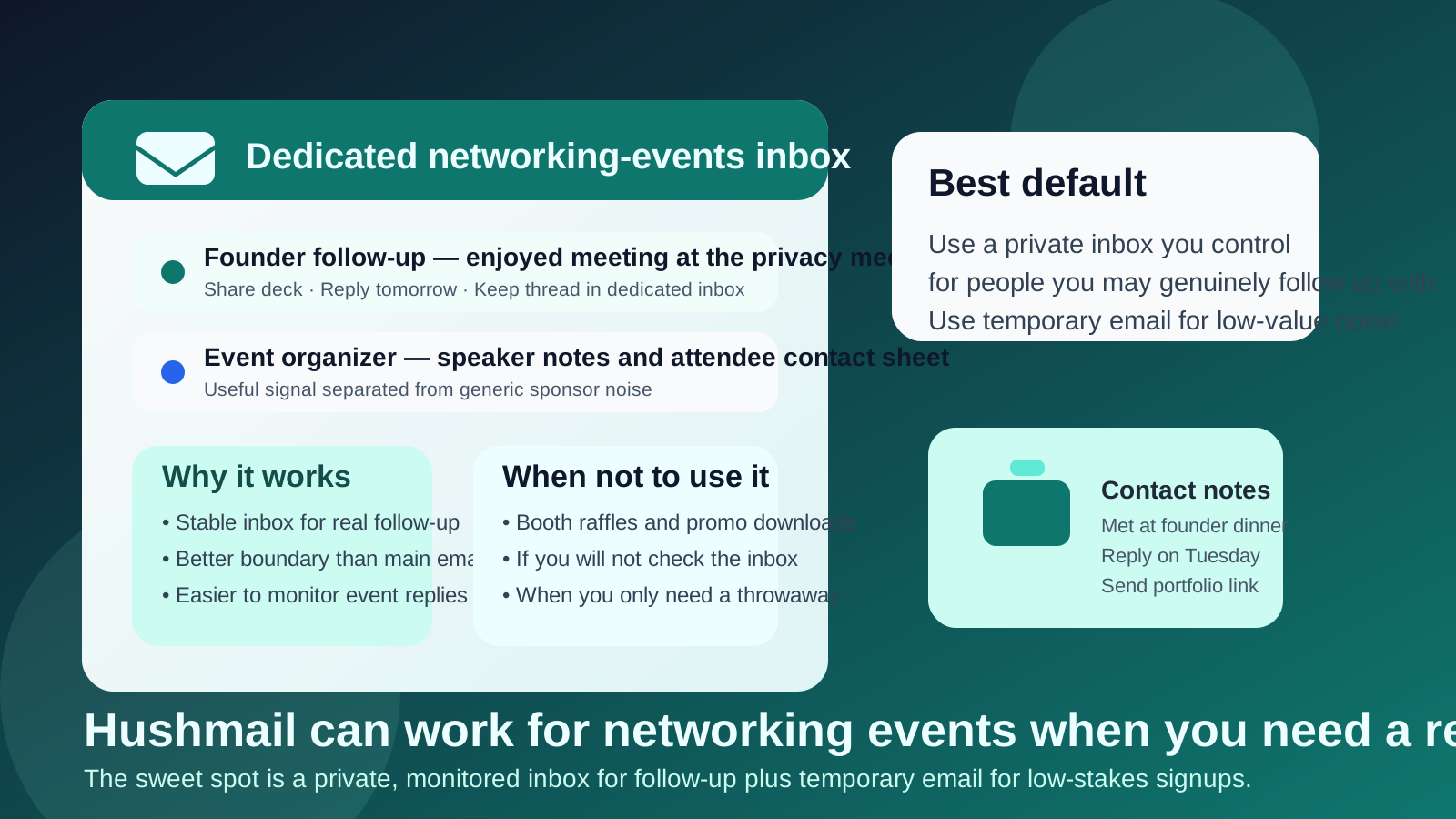
Yes — Hushmail can be a good choice for networking events if you want a separate, stable inbox for real follow-up without exposing your oldest personal email everywhere.
No — it is not the best option when you only need a throwaway address for giveaways, sponsor downloads, or low-trust event forms you do not plan to revisit.
Why this question matters at networking events
Networking events create a messy mix of communication. In one evening, you might swap contact details with a founder, scan a QR code for a panel handout, sign up for a community mailing list, and hand your email to an event platform that will keep promoting future sessions. Some of those messages are genuinely useful. Some become long-term inbox clutter within a day.
That is why the question is not just whether Hushmail is “good” or “bad.” The real question is what kind of relationship you expect the email address to support. If the goal is ongoing conversation, a stable inbox matters. If the goal is simply getting one download or one confirmation email, a temporary inbox often makes more sense.
For most people, networking is not a one-message activity. A good event connection can turn into a coffee chat, a referral, a job lead, a collaboration, or an introduction weeks later. That long tail changes the email decision.
Short answer: Hushmail works best as a dedicated networking inbox, not as a disposable shield
Hushmail can be a strong fit when you want a separate inbox for networking that feels more controlled than your everyday personal email. It helps when you are trying to keep event follow-up organized, reduce spillover into your main inbox, and maintain a stable address for people you may actually hear from again.
It is a weak fit when you are treating every event interaction as disposable. If you know you do not want ongoing contact, or the form looks more like sponsor marketing than human follow-up, a temporary email workflow is usually better than any long-term mailbox.
What Hushmail does well for networking events
It gives you separation without making you unreachable
The biggest practical advantage is separation. A dedicated networking inbox keeps event conversations away from shopping receipts, family messages, newsletters, and the other digital clutter that builds up in a main personal account. That separation makes it easier to notice the messages that actually matter.
Just as important, it still leaves you reachable. Unlike a throwaway inbox, a dedicated Hushmail address can stay active long enough for someone to reply after the event, follow up later, or remember you a month down the line.
It supports a more intentional networking workflow
Networking feels less chaotic when it has its own lane. If every panel RSVP, follow-up thank-you, founder reply, and recruiter intro lands in one dedicated place, you can process it more deliberately. That makes it easier to decide which conversations deserve a quick reply, which ones belong on your calendar, and which event emails are just noise.
It can be a better boundary than your oldest personal email
A lot of people use the same personal inbox they have had for years. That is simple, but it also means every new event adds more traffic to the address already tied to shopping sites, random signups, legacy accounts, and old mailing lists. A separate inbox gives you more control over how much of your digital life an event really gets to touch.
When Hushmail is a smart choice
Hushmail is usually a sensible option for networking events when most of these are true:
- You expect real follow-up: not just one confirmation email, but actual conversations.
- You want one repeatable address: something you can share across multiple events and keep using.
- Your main inbox is crowded: meaningful replies could easily get buried there.
- You care about boundaries: you do not want every event organizer, sponsor, or booth form tied to your oldest personal address.
- You will monitor the inbox: a separate address only helps if you actually check it.
In other words, Hushmail works well when you are trying to create a cleaner professional contact lane, not when you simply want to hide from all follow-up.
When Hushmail is the wrong tool
When the interaction is low-value or spam-heavy
Not every event signup deserves a stable inbox. Some QR codes lead to generic newsletters. Some booth forms exist mostly to feed a marketing sequence. Some “download the deck” links are useful once and never again. In those cases, a long-term inbox is more access than the interaction deserves.
That is where a temporary email workflow fits better. If your goal is to protect your real inbox from predictable noise, a disposable option such as Anonibox is often more practical than handing over a permanent address.
When you will not keep up with the inbox
A private dedicated inbox sounds smart in theory, but it fails fast if you forget to check it during the critical follow-up window. Networking messages often arrive within a day or two, but not always immediately. If you create a separate address and then ignore it, you have solved the privacy problem by creating a missed-opportunity problem.
When you need the absolute easiest workflow
Sometimes the right answer is the inbox you already use best. If your current setup is clean, professional, and reliably monitored, switching providers does not automatically improve anything. The provider matters less than the system around it.
Will people judge a Hushmail address at a networking event?
Usually not in any meaningful way. Most people care far more about whether your address looks readable, whether your message is thoughtful, and whether you reply like a normal professional. A clean address based on your name matters much more than whether the domain is the same one they personally use.
What creates friction is usually one of these things instead:
- a hard-to-type username full of numbers or old nicknames
- slow replies after someone takes time to write back
- different email addresses showing up across your resume, event profile, and follow-up messages
- sending one-off networking notes from an inbox you do not really monitor
If your Hushmail address is simple and you use it consistently, it is unlikely to be the thing that hurts your networking.
Hushmail vs your main personal inbox
Your main inbox can absolutely work for networking events if it is tidy and you are comfortable using it everywhere. But many people are not starting from a tidy inbox. They are starting from an account filled with years of receipts, subscriptions, alerts, newsletters, and ignored folders.
That is the real case for a separate networking inbox: not that your current email is somehow unusable, but that a cleaner lane makes follow-up easier. If a panel speaker sends you a thoughtful reply or a recruiter asks for a resume, you want that message to stand out instead of competing with unrelated noise.
Hushmail vs temporary email
This is the comparison Anonibox readers usually care about most. Both approaches can help with privacy, but they solve different problems.
Use Hushmail when:
- you may want to build a real relationship after the event
- someone could reasonably reply days or weeks later
- you want one stable address for introductions, follow-up, and referrals
- you need continuity more than short-term shielding
Use temporary email when:
- the signup looks broad, promotional, or low-trust
- you only want a resource download or confirmation link
- you do not want sponsor follow-up tied to a long-term inbox
- the interaction is transactional, not relationship-based
For many people, the smartest setup is layered. Share one stable address for people you would genuinely like to hear from again. Use temporary email for everything that feels more like marketing intake than human follow-up.
Best practices if you use Hushmail for networking events
1. Decide before the event which address goes where
Do not make the decision at every booth in the moment. Decide in advance that Hushmail is your serious networking inbox, and decide when you will use a temporary address instead. That small bit of planning prevents a lot of messy improvisation.
2. Keep the address simple and professional
Use something easy to read and easy to repeat out loud. Event settings are noisy, fast, and full of manual entry. A clean address reduces mistakes.
3. Check the inbox heavily for a few days after the event
The first seventy-two hours matter. That is when many real replies show up: introductions, calendar links, role suggestions, resource shares, and short “great to meet you” notes that deserve a response.
4. Capture context while it is fresh
If someone writes back, note where you met them and what you discussed. Networking falls apart when every message thread becomes “nice meeting you” with no memory attached. A simple note can save you from awkward follow-up later.
5. Separate signal from noise quickly
Archive the generic event blasts, keep the real conversations visible, and move fast on replies that could lead somewhere. The point of a dedicated inbox is not just privacy; it is cleaner decision-making.
Common mistakes to avoid
- Using one permanent address for every booth, sponsor, and raffle: this creates avoidable long-term clutter.
- Using temporary email for people you genuinely want to hear from again: that is the wrong level of permanence.
- Creating a dedicated inbox and then neglecting it: privacy without follow-up is not a win.
- Switching addresses mid-conversation: consistency matters once a real thread starts.
- Treating all event signups as equally important: they are not, and your email strategy should reflect that.
A practical setup that works for most people
- Use one stable inbox for serious networking and job-related follow-up.
- Keep that inbox clean enough that important replies are easy to spot.
- Use temporary email for low-value event forms, promo downloads, and sponsor noise.
- Check the stable inbox consistently after every event.
- Reply quickly to the messages that could lead to real conversations.
If Hushmail is the inbox that helps you do that, it can be a very good fit. The real goal is not to choose the “perfect” provider in the abstract. The goal is to match the permanence of the inbox to the value of the relationship you are creating.
Final answer
So, should you use Hushmail for networking events? Yes, if you want a separate, monitored inbox for genuine follow-up and you expect at least some event contacts to become real conversations.
No, if your real need is a disposable shield against generic event marketing. In that case, temporary email is usually the better tool. The best setup is often a combination: one stable inbox for people, one temporary workflow for noise, and a clear boundary between the two.