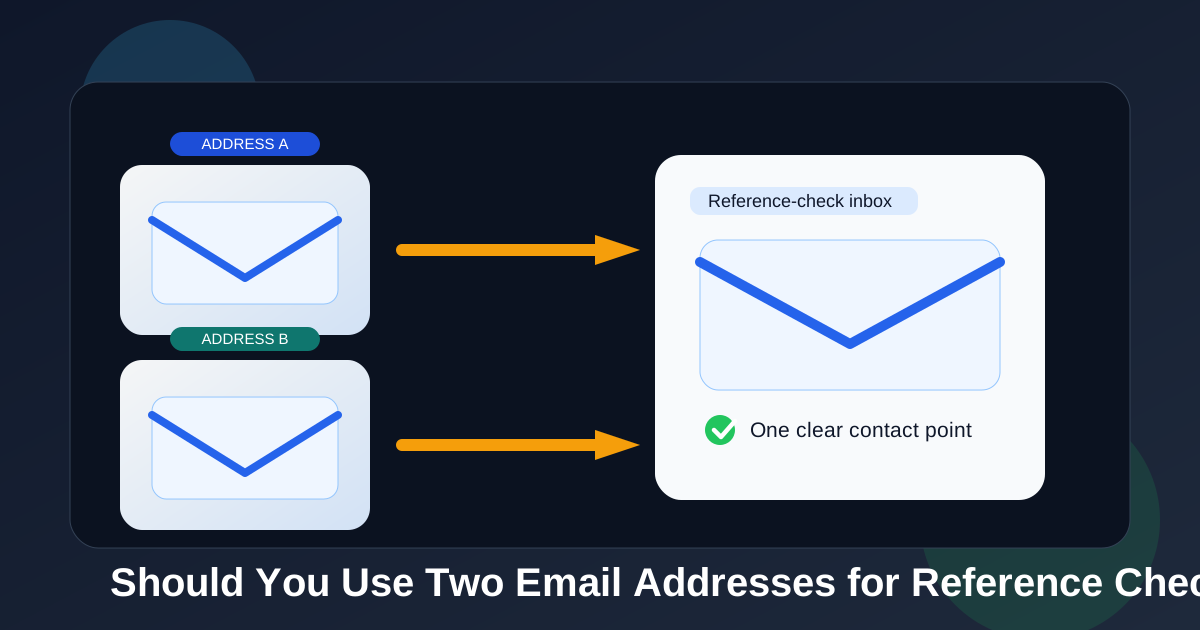
Usually no. For reference checks, one stable inbox you monitor closely is usually better than splitting communication across two email addresses.
If you use two addresses at all, use them only in a controlled way, such as moving from an early privacy buffer to a long-term inbox before the real reference-check workflow starts.
Should You Use Two Email Addresses for Reference Checks? sounds like a small detail, but late-stage hiring often turns small details into real friction. A reference check may involve a recruiter, a hiring manager, an HR generalist, and sometimes a screening vendor or portal. When messages are already moving across multiple people, adding two email addresses can make the process less organized instead of more protected.
That does not mean two addresses are always wrong. It means the default should be simple: give employers one dependable inbox that you control, check often, and expect to keep active through the rest of the hiring process. If you want extra privacy, structure that carefully rather than casually scattering different addresses across the same workflow.
Why people think about using two email addresses
The instinct is understandable. Job seekers often want one address for privacy and another for reliability. Maybe you used a separate inbox or a temporary workflow during early applications and now you are wondering whether you should also provide a more permanent address for references. Maybe you want one address for recruiter outreach and another for formal HR steps. Maybe you are trying to avoid spam while still looking responsive.
All of that makes sense in principle. The problem is that reference checks are not an early-stage browsing phase anymore. By the time an employer asks for references, the communication usually needs to be boringly reliable. Splitting that communication between two addresses can create confusion faster than it creates safety.
Short answer: one stable inbox is usually better
In most cases, the best setup is one professional, long-term inbox dedicated to your job search or at least stable enough to use through offers, background checks, and onboarding follow-up.
A second address only helps if it solves a specific problem without introducing a new one. If you give two addresses just because you are unsure which one is best, you may accidentally create duplicate threads, missed reminders, portal mismatches, or slower follow-up when timing matters most.
Why reference checks are especially sensitive to mixed contact details
Reference checks often look simple from the outside, but the actual workflow can be messy. Depending on the employer, you might receive:
- emails asking you to confirm reference names and contact details
- links to a third-party screening or questionnaire portal
- follow-up reminders if a form is incomplete
- requests to clarify dates, titles, or previous supervisors
- status updates from HR after a reference replies late
- notes that connect the reference check to later hiring steps
That means continuity matters. If one email lands at Address A and the next lands at Address B, you can end up searching two inboxes for one process. That is annoying at best and risky at worst.
What can go wrong when you use two email addresses?
1. Messages get split across multiple threads
One person on the hiring team may reply to the address you used on your application. Another may use the address you added later in a signature. A vendor may send the portal invite to only one of them. You now have a fragmented audit trail for a process that already has enough moving parts.
2. You can miss time-sensitive reminders
Reference checks sometimes stall because someone needs a small correction or because a third-party screening service needs a quick confirmation. If those reminders go to an inbox you are checking less often, the delay can look like unresponsiveness even when you were simply looking in the wrong place.
3. Employers may use the wrong address later
Hiring teams do not always remember which email was “for now” and which one was “for later.” Once both exist in the thread, either one can become the default. That gets especially messy if you meant one address to be temporary.
4. Portal and consent links can become hard to track
Some screening systems are very literal about matching the email attached to the candidate record. If your portal invite is tied to one address but you keep replying from another, you can create unnecessary friction for yourself when you need to search, reset access, or confirm identity.
5. Two addresses can look less organized, not more professional
A single clean inbox usually signals clarity. Two addresses can be perfectly legitimate, but if there is no obvious reason for them, it may create the impression that your contact setup is improvised.
When two email addresses can make sense
There are cases where a second address is reasonable. The key is that it should serve a specific transition or backup purpose, not exist as random extra complexity.
You are moving from an early privacy inbox to a stable long-term inbox
This is the best use case. Some people start a job search with a privacy buffer so unknown recruiters, job boards, or low-trust signups do not hit their main inbox immediately. A tool like Anonibox can fit naturally there. Once a real employer reaches the reference-check stage, though, it is usually time to consolidate onto one long-term inbox you fully control.
In that case, two addresses may briefly appear in the process, but only during the handoff. The goal should be to switch cleanly, not to keep both active forever for the same workflow.
You are about to lose access to the first address
If you originally used a school address, contract address, or older inbox that may stop being reliable soon, providing a replacement before reference-check emails begin is sensible. Again, this is a migration problem, not a permanent two-address strategy.
An employer specifically asks for a secondary contact address
If an employer or vendor explicitly requests a backup email, then giving one is fine. That is different from volunteering two addresses without context. If you do provide a backup, make clear which address should be used as the primary one.
When using two addresses is usually a bad idea
- you are giving both because you cannot decide which inbox you actually trust
- one of the addresses is temporary, expiring, or lightly monitored
- you already lose track of important hiring messages in normal circumstances
- the employer is using a screening portal tied to one candidate email record
- you are trying to solve a spam problem that is better solved earlier in the funnel
If any of those feel familiar, simplifying to one address is usually the smarter move.
What is usually better than giving two email addresses?
Use one dedicated job-search inbox
This is the cleanest answer for most people. A dedicated inbox keeps references, interviews, background checks, and offer-stage communication separate from your everyday personal inbox without splitting the hiring process across multiple channels.
Use one primary inbox plus an internal forwarding or alias setup
If you like flexibility, an alias or forwarding rule can give you some of the convenience of multiple addresses without making the employer manage multiple contacts. The important part is that you experience the flexibility while the employer sees one clear address.
Move off temporary tools before the process gets serious
Temporary or privacy-first sign-up workflows are most useful earlier, when you are screening opportunities and reducing inbox clutter. Reference checks usually need continuity more than insulation. That is why the handoff point matters so much.
A practical handoff plan if you started with another email
- Choose the inbox you want to use through the rest of the process. It should be professional enough, easy to search, and something you expect to keep active.
- Save important older messages. Keep application confirmations, recruiter names, and any portal or scheduling notes from the earlier inbox.
- Tell the employer before the reference-check step begins. A simple note works: “Please use this address for the rest of the hiring process so I do not miss any follow-up.”
- Check both inboxes briefly during the transition. Do this only for a few days, not forever.
- Stop advertising both addresses once the switch is made. One clear primary inbox should remain.
That approach gives you the privacy benefits of an early buffer without the chaos of a permanent dual-address setup.
How this differs from using a separate email
People sometimes mix up these ideas. A separate email means one dedicated inbox for job-search communication. Two email addresses means two different contact points inside the same late-stage workflow.
The first idea is often useful. The second idea is often unnecessary. In other words, a separate email can reduce confusion; two active reference-check addresses can create it.
Examples that make the difference clearer
Good setup: You use one dedicated personal inbox for interviews, references, and later hiring steps. It stays stable, and everything lands in one place.
Acceptable transition: You used a privacy-focused address earlier, then switched to one long-term inbox before the employer sent reference-check or screening links.
Bad setup: Your résumé has one address, your recruiter replies go to another, and the screening vendor portal invite lands in whichever inbox someone happened to copy. Now you are hunting across threads when an employer needs a fast answer.
Best practices if you decide to mention a second address anyway
- state clearly which address is primary
- explain the second address only if there is a real reason
- avoid using two addresses with nearly identical names that are easy to confuse
- keep both inboxes monitored during any short transition window
- do not leave a temporary address in circulation once a permanent one is set
Quick checklist before you share two addresses
- Do I actually need two addresses, or would one stable inbox solve this better?
- Am I giving a second email for a specific reason, or just out of uncertainty?
- Could this split reminders, portal links, or replies across inboxes?
- Will both addresses still be monitored if the process stretches longer than expected?
- Would an alias or forwarding rule give me the same benefit with less confusion?
If those questions make you hesitate, that is useful. It usually means the cleaner answer is one dependable address.
Final answer
Usually no. For reference checks, two email addresses usually create more coordination risk than practical benefit. One stable inbox is simpler for you, clearer for the employer, and less likely to scatter important messages across threads, portals, and follow-up notes.
If you started with a privacy buffer, switch cleanly before the reference-check process gets real. That lets you keep the privacy benefits of tools like Anonibox earlier in the search while still giving late-stage hiring the continuity it needs.