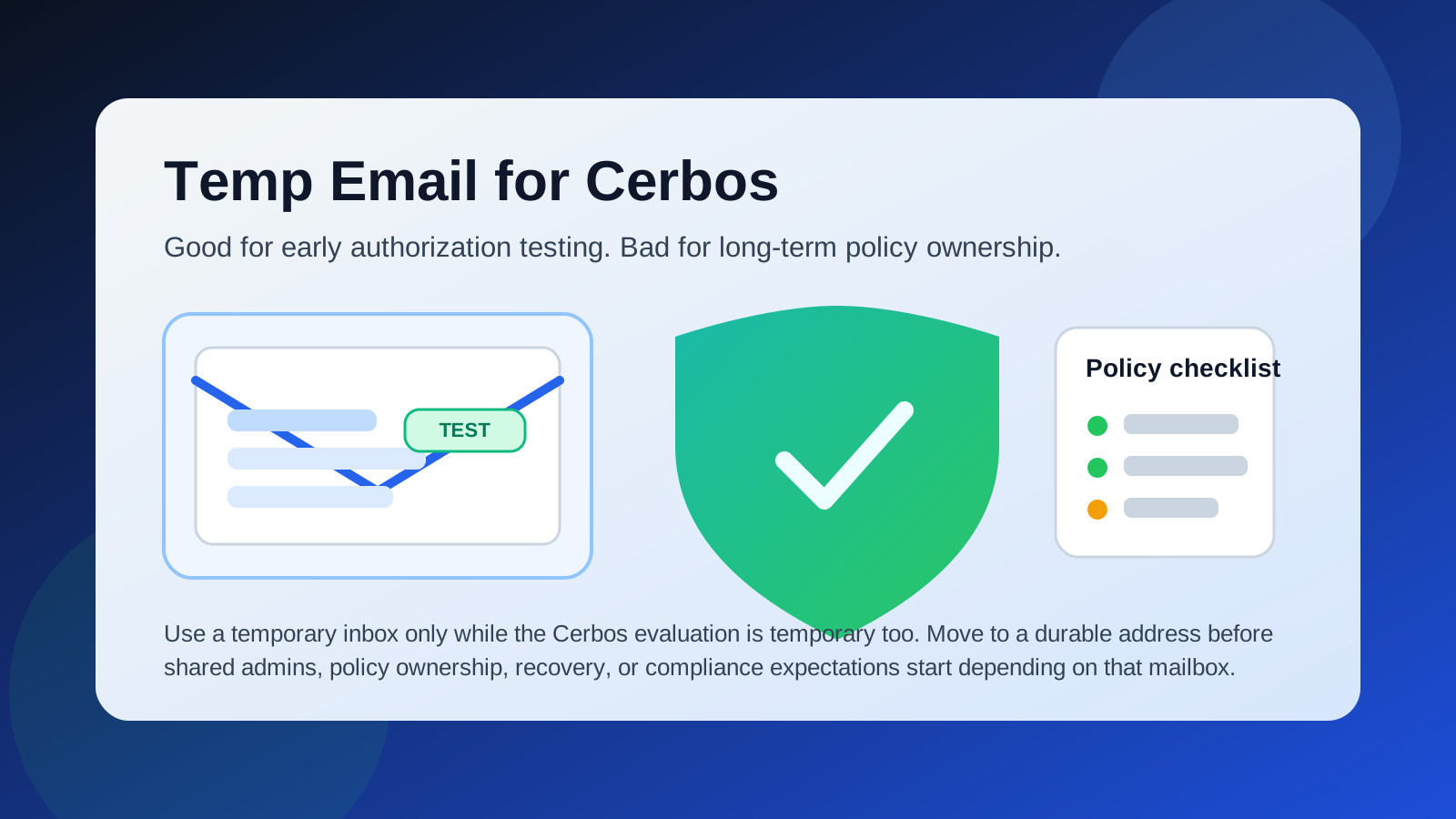
A temp email for Cerbos can be useful for early authorization testing, demo requests, and short-lived proof-of-concept work. It becomes a bad idea once policy ownership, shared admin access, security notices, or account recovery depend on that inbox.
If you are only exploring Cerbos with disposable test projects, a temporary address keeps your main inbox cleaner. If the environment might survive beyond a quick evaluation, switch to a durable inbox before teammates, production policies, or operational responsibility attach to it.
Why someone would use a temp email for Cerbos in the first place
Cerbos sits in a part of the stack where teams often want to evaluate quickly before they commit. Depending on how you approach that evaluation, you may run into email-gated demos, documentation updates, community signups, hosted components, or internal shared testing workflows that still ask for an address even if the core policy engine runs elsewhere.
That makes the inbox question surprisingly practical. During early research, you may not want another product sequence, demo follow-up, or verification message landing in your everyday work inbox before you even know whether the tool belongs in your architecture. A temporary inbox gives you a cleaner boundary for that early exploration.
It also helps when you are comparing several identity or authorization tools at once. If you are looking at Cerbos alongside other access-control products, using a throwaway inbox for first-touch evaluation can keep those tests organized instead of blending them into your permanent mailbox.
When a temp email for Cerbos makes sense
A disposable address usually makes sense when both the inbox and the account behind it are genuinely temporary.
1. First-look evaluation
If the goal is simply to inspect onboarding, request a demo, unlock a proof-of-concept resource, or validate whether Cerbos deserves deeper time, a temp inbox is reasonable. At that stage the email address is just a door into the evaluation, not the long-term owner of anything important.
2. Side-by-side authorization tool comparisons
Architecture work often creates inbox clutter fast. If you are comparing Cerbos with neighboring authorization options, using a temporary mailbox can stop every early-stage message from piling into your normal inbox. That is especially useful when you are still narrowing the shortlist.
3. Short-lived test environments
Some teams create disposable sandboxes or internal demos that are expected to disappear after a week. In that case a temp inbox can fit, as long as the environment itself is truly disposable and no one mistakes it for a long-term system.
4. Inbox hygiene for solo experiments
If you are the only person involved and the work is exploratory, a temporary address can be a simple filter. Tools like Anonibox are useful exactly here: you receive the one message you need without offering every experiment a permanent path into your daily inbox.
Why Cerbos is different from a casual app signup
The risk profile here is not the same as signing up for a random newsletter or one-off design tool. Authorization systems affect how people gain access, what actions they can take, and how policies are understood over time. Even when the initial evaluation feels small, the project can turn into infrastructure before anyone fully notices.
That means the real danger is not just inbox spam. The bigger danger is hidden operational dependency. A throwaway address that felt harmless on day one can become the account everyone silently assumes will always be reachable for policy reviews, owner changes, security notices, or recovery steps later.
Where a temporary inbox starts becoming risky
1. Policy ownership
If a Cerbos-related account is connected to real policy design, approval, or long-term governance, the owner email matters. You do not want important authorization work anchored to an inbox you may never reliably revisit.
2. Shared team access
The moment teammates, platform engineers, or security stakeholders depend on the same workspace or admin path, the inbox stops being personal convenience and starts becoming shared operational glue. A temporary address is weak glue for something multiple people rely on.
3. Security notices and recovery
If verification steps, suspicious-login alerts, ownership changes, or recovery messages route through a disposable mailbox, future troubleshooting becomes harder than it needs to be. Even if nothing goes wrong immediately, you are building fragility into the account.
4. Long-lived staging environments
Teams constantly say an environment is “just staging” and then keep it around for months. Once that happens, the original disposable signup becomes technical debt. If the environment might survive, the email should too.
5. Procurement, compliance, or audit expectations
As soon as a tool moves from experiment to candidate for serious use, email ownership gets less casual. Durable inboxes are easier to document, hand over, and defend in internal reviews than a temporary mailbox that vanished with the original test.
A safer workflow for evaluating Cerbos
If you want the privacy benefit of a temporary inbox without creating long-term pain, the safest path is simple.
- Use the temp email only for the earliest evaluation edge. Think demo requests, one-person testing, short-lived signup flows, or low-stakes proof-of-concept work.
- Keep the project clearly marked as temporary. Name the workspace or notes in a way that makes the test status obvious so nobody mistakes it for a durable production path.
- Move to a stable inbox before the account becomes important. Do not wait until more people are involved. Switch while ownership is still easy.
- Store critical setup notes outside the mailbox. Policy decisions, environment notes, and admin steps belong in version control or internal documentation, not in a disposable inbox.
- Review the mailbox choice before invites or approvals expand. If the account is about to touch real people or real governance, temporary is over.
This is the clean middle ground. You get the low-friction start of a disposable address while avoiding the classic mistake of leaving an increasingly important account attached to an increasingly unreliable inbox.
What about testing your own Cerbos-related email flows?
A temp inbox can also help when you are testing the email flows around your own integration, such as invitation links, onboarding paths, or account setup journeys that sit next to Cerbos-backed authorization logic. It gives you a fast way to confirm that messages arrive and that the user journey basically works.
Just remember what that test can and cannot prove. A disposable inbox is great for functional verification. It is not a full deliverability guarantee, and it should not become the permanent address for a real owner account simply because it worked during QA.
A practical rule of thumb
Use a temp email only while the Cerbos evaluation is disposable too. If you would be comfortable deleting the whole environment tomorrow, a temporary inbox can fit. If losing access would create genuine pain, confusion, or policy risk, you should already be on a durable address.
That rule keeps the decision simple and honest. Match the durability of the inbox to the durability of the system behind it.
Quick checklist before you decide
- Is this only a first-look evaluation or demo request?
- Will anyone besides you need reliable access?
- Could the account become tied to real policy ownership or governance?
- Would recovery matter if you lost the inbox next month?
- Are you trying to reduce spam, or are you actually setting up something that may last?
If most answers point to short-lived solo testing, a temp address is fine. If they point toward shared ownership, real environments, or long-term operational value, use a stable inbox instead.
Bottom line
A temp email for Cerbos is a smart choice for early authorization testing, quick comparisons, and disposable proof-of-concept work. It is the wrong long-term home for policy ownership, team access, security notices, and recovery.
The safest approach is simple: use a temporary inbox only while the account itself is temporary. Once the Cerbos evaluation starts becoming real infrastructure, move to a durable address before the shortcut turns into operational debt.