If you are only testing Consensus to see how the experience feels, a temp email can be fine for the first round of signup and evaluation. If you plan to share workspaces, send prospect-facing links, or rely on the account later, switch to a permanent inbox you control.
That is the practical answer to temp email for Consensus: useful for early interactive demo testing, risky for anything that becomes collaborative, customer-facing, or tied to long-term ownership.
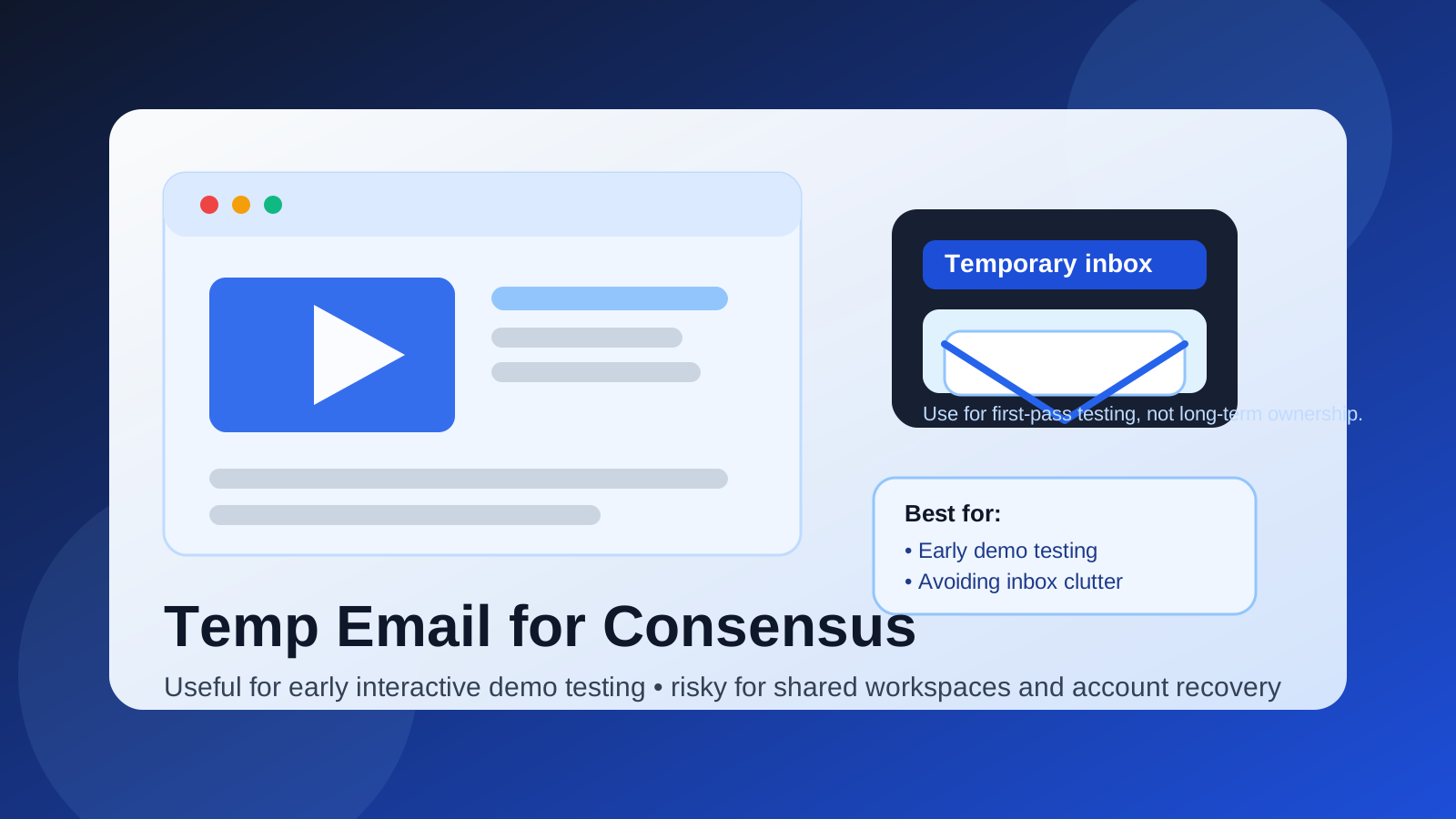
People usually look for a temporary email when they want to try a product without turning one quick test into months of sales follow-ups. That is a reasonable instinct. Demo and buyer-enablement tools often ask for a work email before you can explore templates, onboarding flows, or account setup. A disposable inbox can keep that first-pass research separate from your main work account, which is especially useful if you are comparing several tools at once.
Still, not every stage of evaluation has the same privacy trade-off. Using a throwaway inbox for the first login is very different from using one for a real workspace that teammates depend on, or for links you may share with prospects later. The safest approach is to treat a temp inbox as a short-term evaluation tool, not as the permanent home of an account that may become important.
When a temp email makes sense for Consensus
A temporary address is usually most reasonable when your goal is narrow and low-stakes. You want to look around, understand the product category, and decide whether the platform deserves deeper attention.
- Early vendor comparison: You are looking at several interactive demo or buyer-enablement tools and do not want every test to land in your main inbox.
- Initial product exploration: You only need the verification email, welcome message, and first-run onboarding to judge whether the tool is worth more time.
- Spam reduction: You want to avoid stacking promotional sequences, webinar invites, and “just checking in” outreach from every product trial.
- Clean research workflow: You prefer to keep evaluation separate from your real sales, product, or operations inbox until you know a tool is serious.
That is where a service like Anonibox fits naturally. It gives you a simple way to receive the first confirmation email and review the early setup messages without handing your primary address to every platform you test.
Why people use temp email for Consensus in the first place
There is nothing strange about wanting distance during software evaluation. If you are exploring Consensus, you may be doing one of a few very normal things: comparing demo software, checking whether the product feels polished enough for your team, or figuring out whether the workflow matches your current sales motion. In that stage, your main goal is learning, not commitment.
A temp inbox helps because it reduces friction in three ways:
- It keeps your real inbox quieter. Early-stage testing often creates a trail of welcome emails, reminders, meeting prompts, and nurture sequences.
- It creates mental separation. Trial messages stay in their own lane instead of blending into your day-to-day work mail.
- It lets you evaluate honestly. You can focus on the product itself instead of immediately stepping into a long vendor conversation.
That can be genuinely useful if you are still deciding whether Consensus belongs on your shortlist at all.
Where a disposable address starts to become risky
The problem is not the first hour of testing. The problem is what happens when the account stops being disposable in practice.
1. Shared workspaces create real ownership problems
Once teammates are involved, the email on the account matters more. If the login belongs to a temporary inbox that expires or becomes inaccessible, your team can end up with a workspace no one can reliably recover, administer, or cleanly transfer later.
2. Prospect-facing links raise the stakes
If you create assets, links, or demo experiences that could be shown outside your team, you no longer want the account tied to an address you might lose. Even if the trial started casually, external-facing use changes the risk profile immediately.
3. Account recovery gets fragile fast
Password resets, verification prompts, ownership changes, and security notifications all depend on having a stable inbox. A temp email is great until the day you actually need it again.
4. Internal continuity matters more than inbox privacy
At some point the bigger risk is not spam. It is losing continuity. If Consensus becomes part of a real evaluation process, pilot, or team workflow, a recoverable company-controlled email is simply the safer choice.
A smart workflow: temp first, permanent later
You do not need to choose between full exposure and zero privacy. The best workflow is usually a staged one.
Step 1: Use a temp email for the first pass
Use the temporary inbox only for the initial signup, verification email, and first-product look. This is the right stage for quick curiosity, surface-level testing, and shortlist building.
Step 2: Decide whether the tool is worth deeper evaluation
Ask the practical questions early:
- Does the product feel relevant to your team’s actual workflow?
- Is the setup clear enough to justify more time?
- Would you realistically want colleagues involved?
- Could this become something customer-facing or sales-critical?
If the answer is no, you avoided unnecessary inbox clutter. Mission accomplished.
Step 3: Move to a permanent inbox before collaboration starts
If the answer is yes, move the account to a stable address before you invite teammates, store meaningful work, or share anything externally. That transition point is the difference between safe convenience and avoidable account mess.
Step 4: Document who owns the account
For any business-facing software, the real issue is not only the address itself but also who controls it. Use an inbox that your team can access and recover appropriately if the tool becomes part of a real process.
Common mistakes to avoid
- Leaving the temp email in place too long: what starts as a harmless test can quietly become the account everyone depends on.
- Using a disposable inbox for shared evaluation: once multiple people touch the account, recoverability matters.
- Forgetting about follow-up actions: password resets, confirmation prompts, and billing or ownership notices may arrive later.
- Treating every signup the same: a throwaway inbox is smarter for low-stakes research than for tools that may become prospect-facing quickly.
- Assuming privacy and continuity are the same thing: they are not. You may protect your inbox today while creating access risk for next month.
How to decide if a temp email is appropriate
If you are unsure, use this quick checklist before signing up:
- Am I only testing the product for a short time?
- Will I be the only person touching this account?
- Would it be fine if I never needed this inbox again after today?
- Am I avoiding spam, rather than building something important?
- Am I still in the “maybe” stage instead of the “real pilot” stage?
If most of those answers are yes, a temp inbox is probably reasonable. If several answers are no, you are likely better off using a permanent address from the start.
What to do if you already signed up with a temp email
If you already created the account with a disposable address and now realize the evaluation is becoming more serious, do not panic. The simplest move is to update the account email as early as possible while you still have access. Do that before inviting coworkers, saving important assets, or depending on the account for anything external.
Also make sure any important onboarding emails, setup instructions, or confirmation links are saved somewhere stable before the temporary inbox disappears. That alone can prevent a lot of avoidable cleanup later.
The bottom line on temp email for Consensus
A temp email for Consensus is useful when you are doing early interactive demo testing and want to protect your primary inbox from unnecessary follow-up. It is not the right long-term choice once shared workspaces, prospect links, account recovery, or real team ownership enter the picture.
Use the temp inbox to answer the first question — “Is this worth my time?” — then switch to a permanent address if the tool becomes part of real evaluation or collaboration. That keeps the privacy benefit without creating a fragile account that becomes hard to manage later.