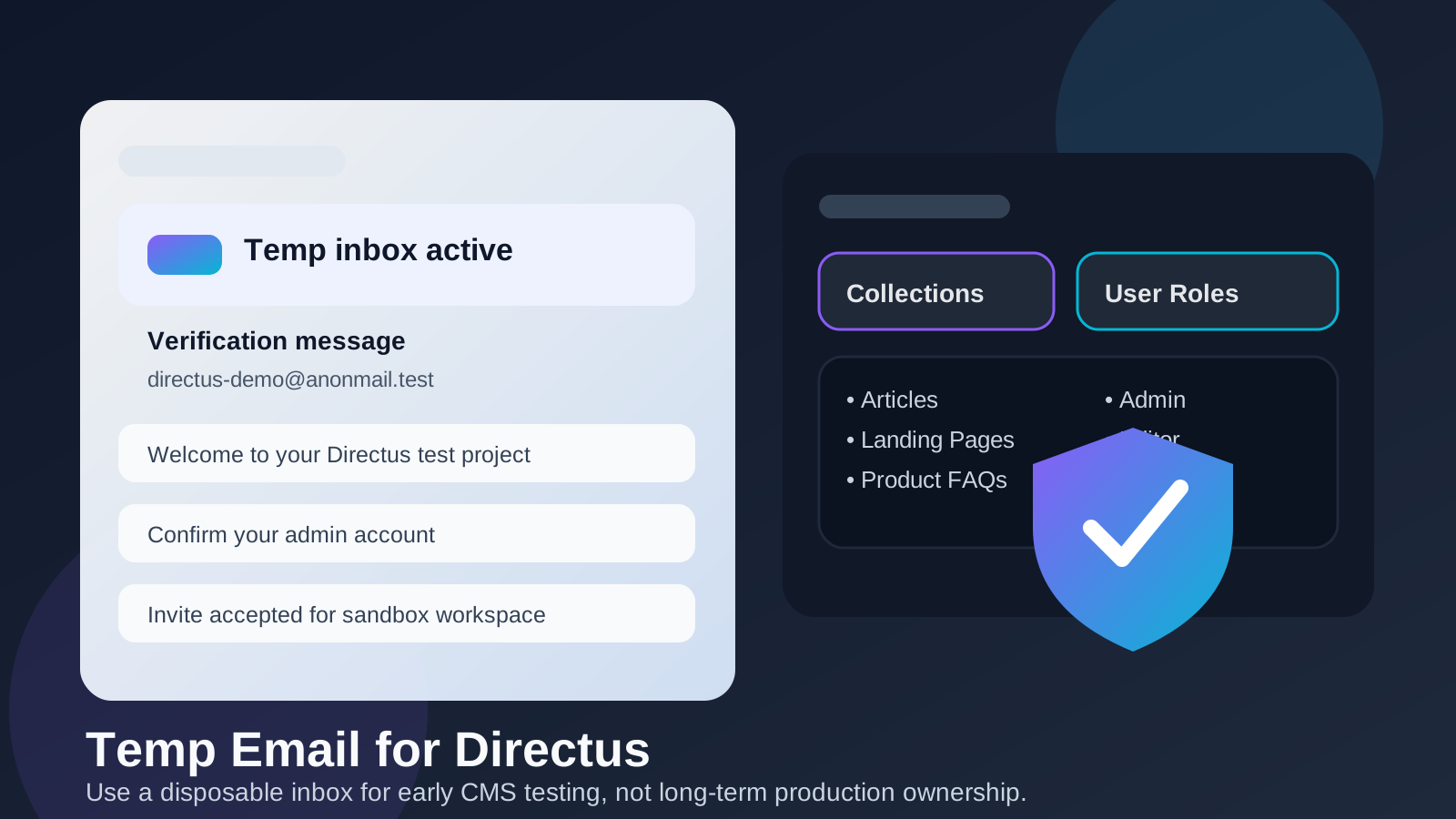
A temp email for Directus is useful for early CMS testing, sandbox projects, and low-stakes setup work, but it is a bad long-term choice once production admins, team invites, or recovery access matter. If you only need to verify an account, inspect the admin experience, or test a proof of concept without feeding your main inbox more noise, a disposable address can make sense.
The safe rule is simple: use a temporary inbox for experiments, then switch to a stable address before the project becomes real. That way you get the privacy and convenience benefits without locking an important system behind an email account you may lose later.
Directus is often evaluated in exactly that messy early stage where people are spinning up internal tools, content models, portals, demos, and small app backends. A founder wants to test a headless CMS. A developer wants to compare Directus with Strapi, Supabase, or Appwrite. A team wants to see how the admin UI feels before committing. In that phase, people want speed, not another month of onboarding emails and low-value follow-ups in their main inbox.
That is where a temporary inbox can help. It gives you a quick way to receive the verification message, finish signup, and inspect the product without tying every early trial to your permanent work or personal email. If you use Anonibox or a similar throwaway inbox for early account checks, the goal is not secrecy theater. The goal is reducing inbox clutter and limiting unnecessary exposure until you know the platform deserves real ownership.
When a temp email for Directus makes sense
A temporary email address is most useful when the Directus project is clearly experimental. In those cases, you are not making a long-term account decision. You are just trying to answer practical questions like: Does the setup feel smooth? Can the admin panel do what I need? Is this worth deeper evaluation?
Good examples include:
- testing Directus for a proof of concept or hackathon build,
- checking the admin experience before inviting a real team,
- trying user roles, collections, and content modeling in a throwaway project,
- verifying email-based auth or onboarding flows in a safe sandbox,
- comparing Directus against other backend or CMS tools before choosing a platform.
In all of those cases, the account is temporary because the project itself is temporary. If you end up deleting the environment a day later, there is not much downside to using a disposable address for the first pass.
Why people use temporary email during platform evaluation
Most software trials do not stop at one verification email. Once you sign up, you may get welcome sequences, feature prompts, webinar invites, upgrade nudges, onboarding checklists, and account reminders. That is normal business behavior, but it is still inbox overhead.
When you are comparing multiple tools in the same week, the friction adds up fast. A temporary inbox helps in a few ways:
- It keeps early experiments separate. Your real inbox stays reserved for the projects and vendors that actually matter.
- It reduces noise. You still get the confirmation link, but you do not automatically commit your main address to every trial.
- It makes comparisons cleaner. If you are testing several platforms, you can isolate their setup messages instead of mixing them together.
- It gives you a privacy buffer. You delay sharing your long-term email identity until you know the product is serious for you.
That is especially useful with developer tools and CMS platforms, where curiosity-driven signups are common. Plenty of projects never make it past evaluation, and your inbox does not need to carry the residue from all of them.
When using a temp email for Directus is a bad idea
The danger is that Directus projects can stop being temporary much faster than people expect. A small test can become the first version of a client portal. An internal content tool can become a shared team workflow. A demo can become the starting point for production infrastructure. Once that happens, the email behind the account matters a lot more.
A disposable address is the wrong choice when the Directus setup is tied to:
- production content or live customer-facing data,
- admin ownership for a real business system,
- team invites and shared responsibility,
- password resets or security notifications you may need later,
- billing, subscription changes, or vendor communication,
- anything that would be painful to lose access to next month.
In other words, a temp inbox is fine for exploration. It is not fine for operational ownership. If the Directus instance matters to your work, the account should live behind a stable email address controlled by a real person or team process.
A practical way to use a temp email for Directus safely
1. Decide whether the project is truly disposable
Before signup, ask the blunt question: if this setup goes well, will I keep it? If the honest answer is “maybe,” you may be better off using a secondary permanent inbox or alias instead of a fully disposable one. Temporary email is best when the project is genuinely low-stakes.
2. Use the temporary inbox only for signup and first-pass checks
The cleanest workflow is to use the throwaway address for verification, first login, initial admin exploration, and maybe one or two email-flow tests. That keeps the early stage private without pretending the entire lifecycle should stay tied to a temporary account.
3. Save any important setup details somewhere permanent
If the first session gives you anything useful, such as project notes, invite settings, collection structure ideas, or integration reminders, store those outside the inbox. A temporary mailbox is good for fast access, not long-term memory.
4. Switch early if the project survives first contact
The moment the Directus environment looks likely to stick around, promote it to a real address. Do not wait until you have production content, shared ownership, or a client depending on it. Changing the account posture early is less messy than trying to repair ownership after the project grows roots.
Specific Directus situations where temp email can be useful
Not every Directus workflow needs the same level of permanence. A disposable inbox is more defensible in some situations than others.
Trying the admin UI
If you mainly want to see how Directus feels as an admin experience, a temporary inbox is reasonable. You are evaluating usability, not establishing long-term governance.
Testing auth and invite flows
If you want to inspect how email verification, user creation, or invite handling works in a demo environment, a temp inbox can be helpful. It lets you receive the email messages you need without exposing your primary account too early.
Comparing CMS and backend options
Many teams compare Directus with other platforms in a short research cycle. When the goal is simply to learn whether the product fits your stack, using a temporary inbox can keep that evaluation lightweight and reversible.
Running one-off classroom or hackathon experiments
Short-lived learning projects are exactly the kind of environment where temporary email can make sense. The risk stays low because the project itself has a clear shelf life.
What to evaluate in Directus besides the email question
The inbox choice is only the first tiny decision. What matters more is whether Directus actually works for your use case.
During the trial, focus on questions like:
- Is content modeling intuitive for the people who will maintain it?
- Are permissions and roles clear enough for real team use?
- Does the admin interface feel efficient or frustrating?
- How well does it fit your existing frontend, data, and deployment plans?
- Will the project need stable operational ownership soon?
If the answers look promising, that is your signal to stop treating the setup as disposable. The more useful the platform becomes, the less appropriate a temporary inbox becomes.
Better alternatives once the project becomes important
If you like the privacy benefit of a temp email but you already know the Directus project may last, a separate permanent address is often the smarter middle ground. That can mean a dedicated work alias, a role-based mailbox, or another inbox you control long term.
This approach gives you the same organizational benefits without the recovery risk. You still keep experimental platform signups out of your personal inbox, but you preserve access to notifications, recovery messages, and ownership changes later.
For individual builders, that might be a secondary email just for software evaluations and dev tools. For teams, it may be an internal alias tied to admin ownership rather than a single person’s personal inbox. Either way, it is much safer than letting a project mature while its key account remains attached to a throwaway mailbox.
Red flags to watch for before you rely on any disposable inbox
A temporary email address helps with privacy, but it does not remove the need for common sense. Before you sign up anywhere, pay attention to what the platform is actually asking for and how quickly the account may become important.
- If you expect to invite teammates soon, use a stable address sooner rather than later.
- If the setup will control live content, treat account ownership as a real operational decision.
- If billing or contract communication may follow, do not bury it in a disposable inbox.
- If the project is for a client, avoid casual ownership choices from day one.
Temporary email is a workflow convenience, not a substitute for account hygiene.
Final answer
Yes, a temp email for Directus can be a smart choice for early CMS testing, demo backends, and one-off evaluation. It gives you a fast way to verify the account, explore the admin side, and protect your main inbox from unnecessary noise while the project is still disposable.
No, it is not the right choice once Directus becomes tied to production content, admin responsibility, team invites, billing, or account recovery. Use temporary email for the trial phase, then move to a stable address as soon as the project starts to matter. That is the balance that protects your privacy without creating a future account headache.