Yes, you can use a temp email for Discourse when you are testing a new community, checking invite flows, or reviewing how signup and notification emails behave. It is useful for early setup and QA, but it is a bad choice for production admins, real member access, password recovery, and long-term community ownership.
That makes temporary email a practical tool for early Discourse experiments, not a safe long-term inbox for anything your moderators, members, or team will depend on once the forum becomes real.
Why people look for a temp email for Discourse
Discourse is usually not a one-person throwaway app. It is often set up for a product community, support forum, internal knowledge hub, course cohort, private membership area, or customer discussion space. Even in the first hour of testing, that can trigger a lot of mail: account verification, invite emails, digest settings, admin notices, password resets, staged test-user signups, and trial follow-up if a hosted plan or related service is involved.
If you are evaluating several community platforms at once, or spinning up a short-lived sandbox to test permissions and user journeys, dropping every one of those messages into your main inbox gets annoying fast. A disposable inbox gives you a simple way to catch the messages you need without committing your long-term address to every experiment.
That is where a tool like Anonibox fits naturally. It helps isolate the early testing phase so you can inspect email-dependent behavior, compare workflow quality, and keep your personal inbox cleaner until the community is worth keeping.
When a temp email makes sense for Discourse
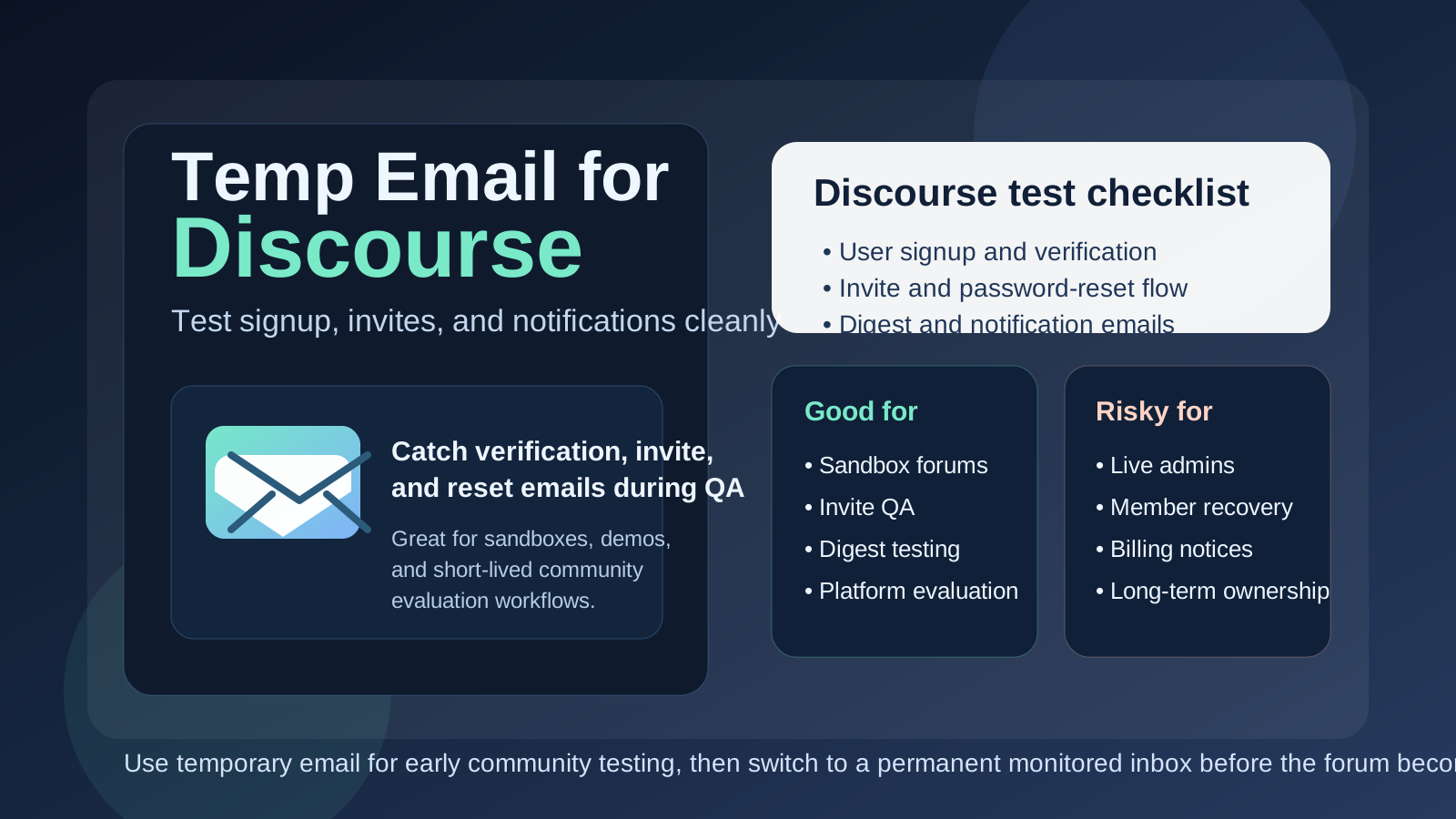
Temporary email works best when the Discourse environment is clearly short-term, low-stakes, or experimental. Good examples include:
- Evaluating Discourse against other community platforms before your team picks one
- Testing member signup, account confirmation, and password-reset flows on a staging forum
- Checking invitation emails for trial moderators, staff, or fake test members
- Reviewing category permissions, notification settings, and digest behavior in a sandbox
- Running QA on hosted-community setup without tying every experiment to your permanent inbox
- Keeping early proof-of-concept work separate before a client or internal owner takes over
In those situations, the inbox is helping you test something rather than permanently own something. That is exactly where a temp inbox is helpful.
When a temp email is a bad idea
The trouble starts when a disposable inbox stays attached after the community stops being disposable. A small Discourse pilot can turn into the real forum surprisingly quickly, especially when signups, moderation, and onboarding are already working. If no one revisits the original contact email, you can end up with a fragile control point sitting behind an important community.
A temp email is the wrong tool if it controls or receives messages for:
- The main admin or owner account for the forum
- Real member access that people need to recover later
- Moderator invites and ongoing staff permissions
- Security notices, password resets, and account-change alerts
- Billing contacts, hosting notices, or vendor communication
- Any community that already matters to customers, members, or your internal team
Once the forum is live, inbox stability matters. If the address can expire, disappear, or become hard to access later, it should not control anything operational.
A simple rule that prevents most problems
If the account exists to help you test the community, a temp email can be fine. If the account exists to own the community, recover the community, or receive important notices for the community, use a permanent inbox you control.
That rule sounds basic, but it saves a lot of avoidable pain. Community software often begins as a harmless test, then slowly becomes the real thing. Make the inbox switch before that happens, not after.
How to use a temp email for Discourse safely
1. Decide whether the forum is truly temporary before signup
Do not default to a disposable inbox just because it is convenient. Ask first whether this is a sandbox, a short evaluation, a demo for stakeholders, or a community that might become permanent. If there is a serious chance the same forum will survive into real use, start with a permanent address instead.
2. Use separate inboxes for separate environments
If you are testing more than one community setup, one inbox per environment makes life much easier. Verification links, invites, and notification tests are easier to interpret when they are not mixed together.
3. Save the messages you actually need
During early testing, you usually only need a few emails: the verification message, one or two invite emails, a password reset, and maybe a digest or notification sample. Capture those while you have them. Temporary inboxes are useful because they are lightweight, but that also means you should not treat them like a permanent archive.
4. Switch before you invite real people
The best time to migrate away from a disposable inbox is before real members, moderators, customers, or clients start depending on the forum. It is much easier to fix ownership while the environment is still quiet than after the community is active.
What to test while you still have the disposable inbox
If you are going to use a temp email during evaluation, use that phase well. The point is not merely to prove that an email arrives. The point is to see whether Discourse handles the email-dependent parts of the community the way your team expects.
Signup and account confirmation
Create a test user and walk through the full signup flow. Is the verification email easy to find? Does the confirmation process feel smooth? If your community depends on member onboarding, that first impression matters.
Password resets
Do not stop after the first login. Trigger the reset flow on purpose. Password recovery is one of the most important email-dependent paths in any forum, and it is often where rough edges show up first.
Invites and staff onboarding
If your setup involves moderators, editors, private groups, or invited members, test those invitation paths early. This is exactly the kind of workflow where a disposable inbox is still useful during QA but clearly risky for long-term ownership.
Notification and digest behavior
Discourse communities can generate regular notification email, mention alerts, reply alerts, and digest messages. In a staging environment, a temp inbox lets you check whether the wording, timing, and usefulness feel right without cluttering your main mailbox.
Admin and trust-path reality checks
The broader question is whether the community is easy to run. Are account flows understandable? Are email-driven actions dependable? Does the forum feel manageable for the people who will operate it later? A temp inbox helps you test those questions cleanly, but it should not hide the fact that long-term community ownership needs a durable inbox behind it.
Common mistakes people make
- Leaving the temp email attached too long: the test forum quietly becomes the real forum.
- Using one inbox across several pilots: verification and reset messages get mixed together.
- Forgetting who controls the original admin account: later, no one remembers which inbox owns the setup.
- Testing signup but not recovery: password resets often matter more than first login.
- Using a disposable inbox for staff ownership: member testing and moderator operations are not the same thing.
Temp email vs separate permanent community inbox
It helps to separate two different privacy tools:
- Temp email: good for early testing, throwaway signups, invite QA, and low-stakes experiments
- Separate permanent project inbox: good for real forum ownership, team continuity, security notices, and account recovery
People sometimes treat them as interchangeable, but they solve different problems. A temp inbox reduces short-term clutter and exposure. A permanent project inbox creates long-term control. For serious Discourse use, you often want both at different stages rather than forcing one to do every job.
A practical workflow that works well
- Create a temporary inbox for the proof of concept, staging forum, or short evaluation period.
- Use it to test signup confirmation, password resets, invites, and notification behavior.
- Decide whether the forum is disposable, ongoing, or likely to become production.
- If the project survives the test phase, move ownership to a permanent monitored inbox.
- Only then attach real admins, real moderation workflows, billing, or long-term community responsibility to that account.
This gives you a cleaner evaluation without turning convenience into an admin-recovery problem later.
Where Anonibox fits in the process
Anonibox is most useful at the front of the workflow. It helps when you are comparing community platforms, testing invite flows, or checking how email behaves inside a Discourse sandbox without pouring all of that activity into your everyday inbox.
What it should not become is the permanent control point for a live forum that already matters to your team or members. If the community is important, the inbox behind it should be stable, monitored, and chosen on purpose.
Final takeaway
A temp email for Discourse is a smart move when you are evaluating the platform, testing member flows, or running short-lived QA in a non-production environment. It keeps your main inbox cleaner and gives you an easy way to inspect the email-dependent parts of the forum.
But once Discourse becomes a real community, switch to a permanent inbox immediately. Temporary email is great for early community testing. It is the wrong foundation for production admin control, real member recovery, and long-term forum ownership.