A temp email for Hanko is useful when you are only testing passkey flows, signup screens, verification steps, or short-lived demo accounts, but a permanent inbox is safer once production users, shared team access, or account recovery depend on that address.
Use a disposable inbox for quick auth testing and inbox privacy, then switch to a durable mailbox before the account becomes part of your real identity stack.
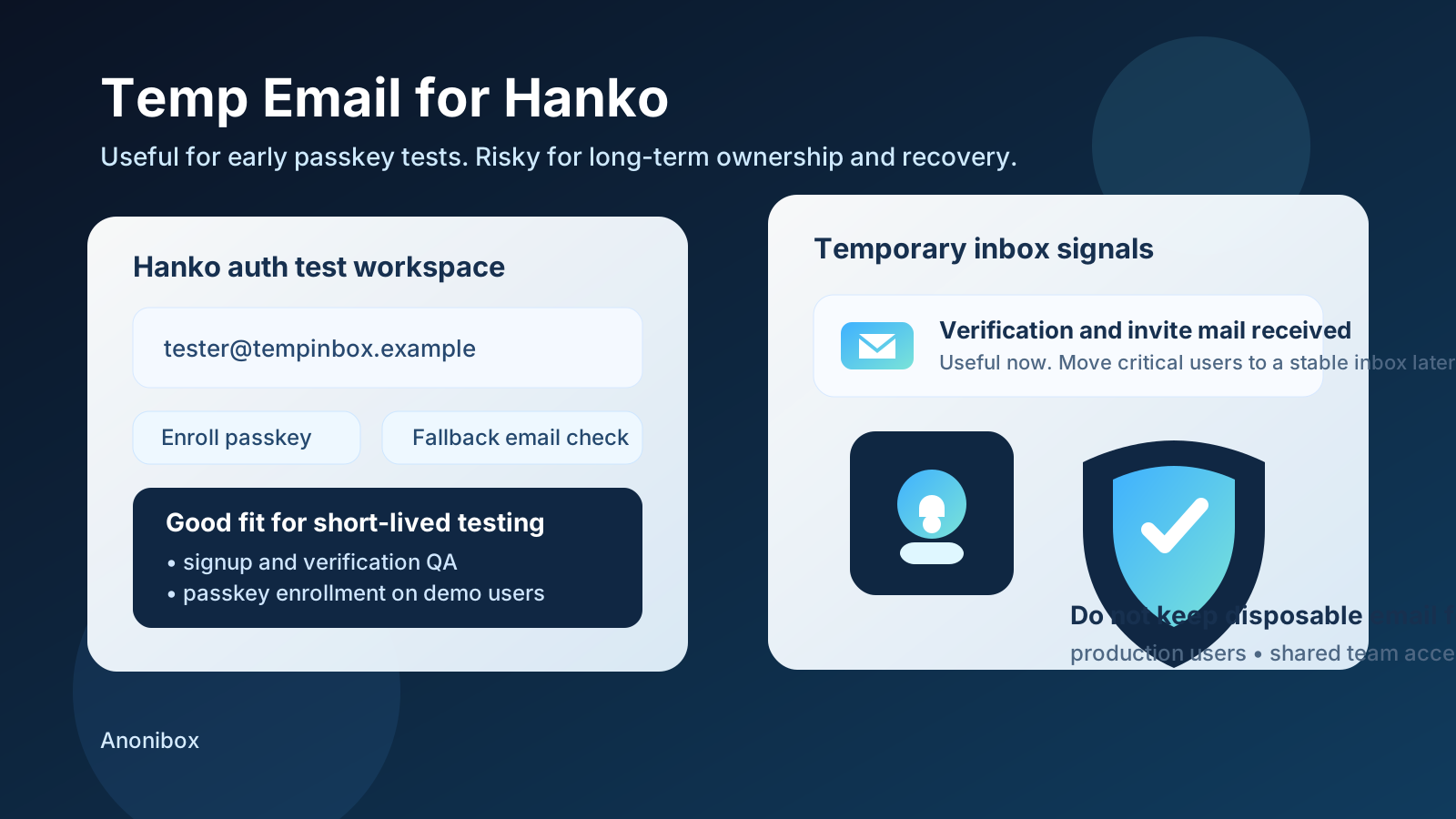
That distinction matters more with Hanko than some teams expect. Hanko is often evaluated because people want modern authentication, passkeys, passwordless flows, cleaner developer ergonomics, or a simpler path to user sign-in. Even so, email still shows up in practical ways during testing: account setup, verification, invite acceptance, fallback login, recovery checks, and long-term account ownership. That is why people search for a temp email for Hanko in the first place. They want to experiment quickly without tying every test account to a permanent inbox too early.
The right answer is not to use a disposable inbox for everything and it is not to ban temporary email entirely. The smarter approach is to match the inbox to the risk level of the account. A throwaway staging user is one thing. The address that controls a production auth tenant, shared admin access, or future recovery is something else entirely.
Why people use a temp email for Hanko
Most Hanko evaluations begin in a low-stakes environment. A developer wants to test passkey registration on a demo app. A product team wants to compare the sign-in experience against another identity vendor. A QA lead wants to make sure verification mail, invite flows, or fallback email actions behave the way users would expect. In that stage, a temporary inbox is genuinely practical.
It keeps noisy test messages out of your main mailbox, separates one auth experiment from another, and reduces the chance that a quick trial quietly turns into months of follow-up mail. That is where a tool like Anonibox fits naturally. You get the message you need, validate the flow, and move on without permanently attaching every lab account to your real work address.
When a temp email for Hanko makes sense
1. Early signup and passkey enrollment tests
If your goal is to confirm that Hanko can create a user, send the right email, and support a first passkey registration flow, a temporary inbox is usually fine. This is especially true when you are only testing the basic user journey and you know the account will not survive beyond the evaluation.
2. Sandbox, staging, and QA identities
Teams often need multiple users for QA: fresh accounts, different browsers, different devices, and multiple rounds of passkey enrollment or recovery testing. Disposable inboxes make that easier because you do not have to clutter a permanent mailbox with every test user you create and discard.
3. Email-action checks around auth flows
Even in a passkey-oriented product, email can still matter. You may want to test verification links, fallback sign-in flows, invite emails, account-change messages, or recovery prompts. When the purpose is simply to inspect that message path, temporary email is an efficient choice.
4. Comparing Hanko with other identity tools
If Hanko is one of several options on your shortlist, a temporary inbox helps isolate each trial. That makes it easier to compare the actual product experience instead of mixing every vendor signup, invite, and onboarding sequence into the same mailbox.
When it becomes a bad idea
The danger is not that a temporary inbox fails during the first test. The danger is that a supposedly short-lived account stops being temporary while the inbox behind it still is. That is how convenience turns into avoidable recovery pain.
1. Production users and real account ownership
If the account will be tied to a live app, a real customer environment, or long-lived user access, switch to a stable inbox. Production identity systems need reliable ownership, especially when authentication issues happen at the worst possible time.
2. Shared team access
Temporary email is a poor foundation for accounts that more than one person depends on. Team members change, projects get handed off, and responsibilities move around. If the original inbox disappears, access recovery becomes much harder than it needs to be.
3. Admin or security-sensitive roles
If a user can manage auth settings, invites, recovery rules, or anything that affects other users, use a durable mailbox from the beginning. The risk is not just losing one account. It is losing access to the identity layer other people depend on.
4. Recovery, incident response, and long-term maintenance
Email often matters most when something goes wrong: a device is lost, a passkey is removed, a login flow breaks, or an admin needs to prove account ownership. If you may need that message path months later, a disposable inbox is the wrong place to anchor it.
A safer workflow for using temp email with Hanko
You do not need an all-or-nothing rule. The best setup is usually phased.
- Start with a temporary inbox for low-stakes evaluation, sign-up testing, and first-pass auth checks.
- Create clearly disposable test users so everyone on the team knows those accounts are not meant for long-term ownership.
- Test the email-dependent parts deliberately, including verification, fallback flows, invite behavior, and whatever recovery path Hanko exposes in your setup.
- Document what you learn right away because temporary inboxes are not meant to be permanent archives.
- Move promising environments to a stable inbox early if the project is becoming real, shared, or customer-facing.
That gives you the speed advantage of temporary email without letting a demo setup become hidden infrastructure.
What to check during a Hanko trial
If you are going to use a temporary inbox, make the test count. Do not stop at “the email arrived.” Use the trial to answer practical questions that matter later.
- How fast do email-based actions arrive? Verification, invite, or fallback messages should not feel unreliable.
- How smooth is passkey enrollment? Check registration on the devices and browsers your team actually cares about.
- What happens when passkeys are unavailable? Some real-world users still need fallback logic, and that path is often where email matters most.
- How clear are the messages? Verification and recovery emails should be understandable, trustworthy, and easy to act on.
- Can you separate lab testing from real ownership? If the answer is getting blurry, it is time to move to a durable address.
Those checks turn a throwaway signup into useful product evidence instead of just another inbox experiment.
Common mistakes to avoid
Treating passkey products as if email no longer matters
Passkeys reduce friction in important ways, but they do not eliminate operational realities around account ownership, invites, or recovery. Teams sometimes assume that because the primary login experience is modern, the underlying inbox can stay temporary forever. That is a risky shortcut.
Building a shared environment on a disposable address
A setup that starts as one engineer’s quick test can become the de facto team environment surprisingly fast. If more than one person is using it, stop pretending the account is disposable and move it to a real inbox.
Skipping fallback and recovery testing
It is easy to focus only on the happy path: create account, enroll passkey, sign in, done. But the email-related edge cases often matter more in production than the first successful login. Test them while the project is still cheap to change.
Keeping temporary email attached for too long
The safest time to switch to a permanent address is earlier than most teams think. Once the account begins to carry any real business value, delaying the change only increases the chance that recovery becomes messy later.
Should you use a temp email for Hanko?
Yes, if the account is truly temporary. A disposable inbox is a practical way to test signup flows, passkey enrollment, email verification, fallback messages, and short-lived demo users without cluttering your main mailbox.
No, if the account is becoming important. The moment Hanko is tied to production users, team ownership, security-sensitive settings, or long-term recovery, the safer move is a stable inbox you control and can keep available for the life of the project.
Final takeaway
A temp email for Hanko is a smart tool for early auth evaluation because it keeps experiments lightweight, private, and easy to discard. It is especially helpful when you are comparing identity tools, testing passkey enrollment, or validating email-driven edge cases around sign-in and recovery.
The important part is knowing where to draw the line. If the account will matter to real users, teammates, or future incident recovery, graduate it to a permanent inbox before the temporary setup becomes technical debt. Used with that discipline, temporary email is not reckless at all. It is simply a cleaner way to separate experimentation from production responsibility.