Yes — a temp email can make sense for Hightouch if you are only testing signup, warehouse connection flow, audience setup, or the first reverse ETL syncs in a disposable evaluation workspace. It keeps trial mail out of your main inbox while you figure out whether the product deserves deeper implementation time.
No — it is usually the wrong choice once the workspace may control real customer data syncs, production destinations, shared ownership, or account recovery. If the test survives the first pass, move it to a durable inbox your team actually controls.
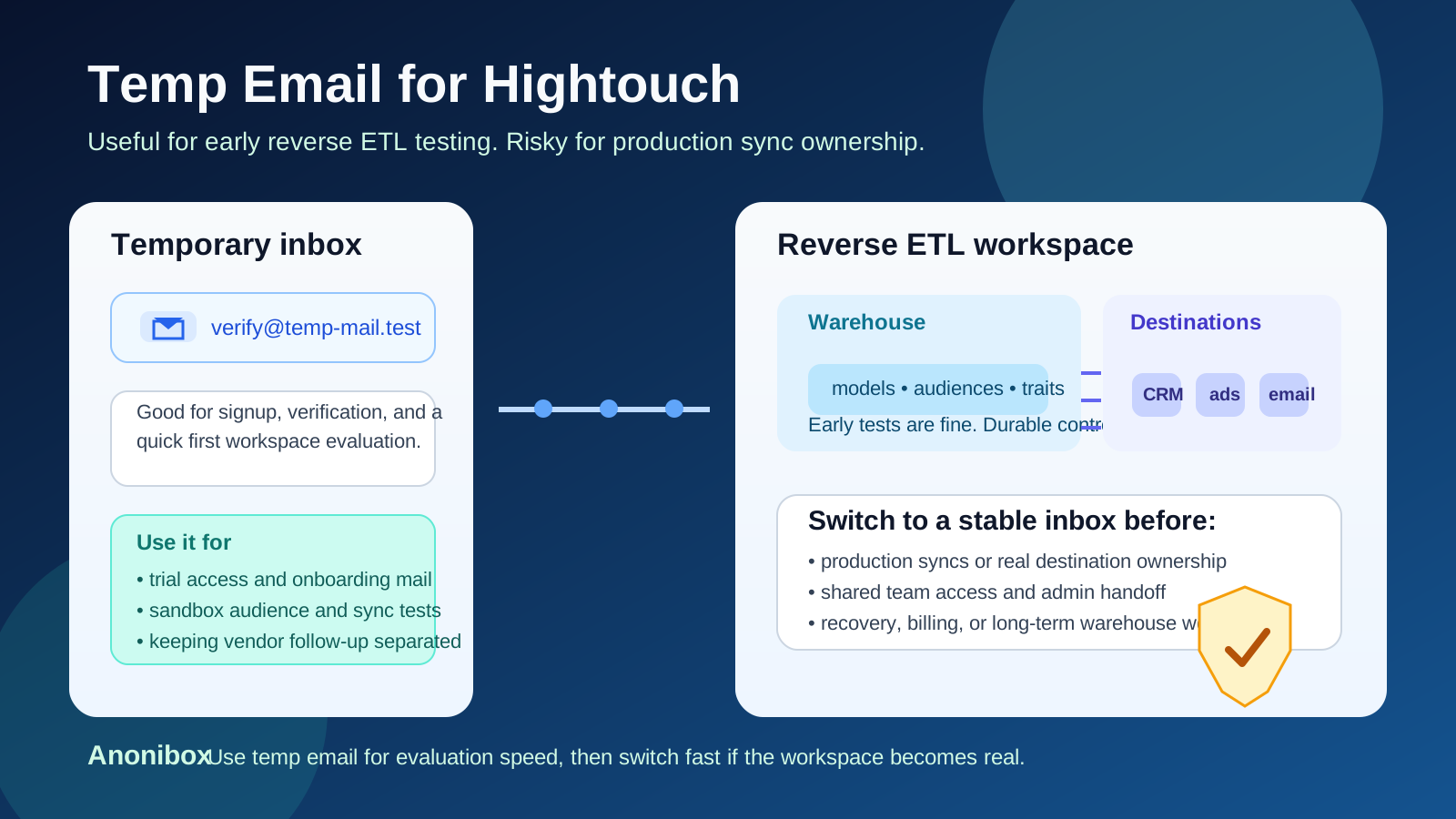
If you are evaluating warehouse activation tools, a temp email for Hightouch can be a practical way to keep the first round of vendor email contained. You sign up, verify the address, poke around the workspace, maybe inspect destination setup or audience workflows, and suddenly your normal inbox has welcome sequences, product tours, follow-up nudges, demo requests, and “need help getting started?” messages mixed into the rest of your actual work.
A temporary inbox gives you cleaner separation during that early stage. You still receive the messages you need to access the trial and test the basics, but you do not have to commit your long-term work identity before you know whether Hightouch even belongs on the shortlist. That can be especially useful when you are comparing adjacent tools in the broader customer-data stack such as Segment, RudderStack, Braze, Customer.io, Mixpanel, or Amplitude.
The catch is that Hightouch is not just another low-stakes newsletter signup. Reverse ETL and composable CDP workflows can go from “quick look” to “operationally important” very fast. The moment a workspace starts to matter for real data syncs, destination ownership, or team continuity, a temp inbox stops being smart and starts being fragile.
Why people use a temp email for Hightouch in the first place
Most people are not reaching for a temporary inbox because they want to hide. They are reaching for it because software evaluation creates clutter, and customer-data tools create more clutter than average.
- They want to isolate evaluation mail. Verification links, setup prompts, trial reminders, and sales follow-ups do not need to live in the same inbox as product, engineering, and customer conversations.
- They are comparing several tools at once. If you are evaluating Hightouch alongside other activation or CDP products, separate inboxes make the comparison easier to manage.
- They are not ready to commit their long-term address. At the earliest stage, the goal may just be to see whether the workflow feels promising at all.
- They want a cleaner sandbox mindset. A disposable inbox reinforces the idea that this is a trial workspace, not automatically the future production account.
Used that way, temp email is not a trick. It is basic inbox hygiene during a short experiment.
When a temporary inbox is a reasonable fit
1. You are doing a real first-pass evaluation
If your goal is simply to understand how Hightouch feels, a temp inbox is often fine. Maybe you want to verify signup, inspect the workspace, review how destinations are presented, or see how audience and sync concepts are introduced before you spend real implementation energy. That is exactly the kind of short test where a disposable inbox can help.
2. You only need the inbox for verification and initial access
Early evaluations often require very little from email itself. You click a verification link, maybe receive a welcome note or a getting-started sequence, and then most of the real judgment happens inside the product. When that is the case, a temp inbox can be enough to get you through the front door.
3. The workspace is truly disposable
Sometimes a trial is just a scratch environment. You are not wiring in meaningful data. You are not inviting a team. You are not treating the account as strategic infrastructure. If the workspace can be thrown away without consequences, a throwaway inbox is a natural match.
4. You are screening the product before involving the wider team
Many evaluations start with one operator doing the first pass before analytics, lifecycle, growth, or engineering colleagues join later. In that narrow, solo stage, using a temporary inbox to filter out noise can make sense.
Where temp email starts becoming risky
The big risk is not using a temp inbox for thirty minutes. The big risk is forgetting that the account stopped being temporary in practice.
1. Real production syncs are getting close
The second a workspace is likely to push data into real destinations, the owner inbox should stop being disposable. Production syncs create operational consequences. If something breaks, pauses, or needs review, the account must be tied to an address that still exists and is actually monitored.
2. Team access matters
Hightouch workflows rarely stay personal for long. Growth, CRM, lifecycle, product, or data teammates may all need context. If the workspace is becoming shared, a temporary inbox is the wrong place for the primary owner account.
3. Warehouse credentials and destination setup are becoming meaningful
Even if you are still technically “testing,” the account becomes more important once you start connecting real systems or documenting sync behavior that people might rely on later. At that point, continuity matters more than inbox tidiness.
4. Recovery and security notices could matter
Password resets, access challenges, billing notices, and ownership confirmations are easy to ignore when you think the workspace is disposable. They are much less easy to ignore when the account becomes useful six weeks later and nobody remembers the original mailbox.
5. The team simply never migrates the account
This is the most common failure mode. The trial goes well, people get busy, and a temporary setup quietly becomes the real setup. That creates avoidable mess around ownership, access, and handoff later.
A better workflow: temporary first, durable fast
You do not need a rigid rule like “never use temp email for SaaS trials.” You just need a better rule about timing.
Step 1: Use temp email only for the first evaluation pass
If you just want to inspect the product, verify signup, and assess the initial setup flow, a temporary inbox can do that job well.
Step 2: Save the useful details outside the inbox immediately
Temporary inboxes are good for access and bad for recordkeeping. If you learn something useful during the trial, save it somewhere durable. That might include:
- workspace URLs or IDs
- notes on connection setup friction
- which destinations seem easiest or hardest to test
- questions about sync reliability, audience logic, or permissions
- which teammates would need access if the trial continues
Step 3: Move to a durable owner inbox the moment the trial survives the first filter
If Hightouch becomes a serious candidate, do not wait. Switch the primary ownership path early, while the account is still easy to reorganize.
Step 4: Clean up team access before the workspace becomes important
Do not let a production-adjacent tool stay anchored to a mailbox that only one person created for convenience. Shared tools need shared visibility and clear administration.
Step 5: Keep temp email for experiments, not for lasting operations
That is the real dividing line. Temporary inboxes are useful for curiosity. Durable inboxes are necessary for continuity.
What to evaluate while testing Hightouch
If you are going to use a temp email for Hightouch, the inbox itself should not be the story. The story should be what you learn once you are inside.
Warehouse connection clarity
Does the product make the first connection steps understandable, or does it assume too much context too early? Even a quick test can reveal whether the implementation path feels crisp or overly brittle.
Destination setup and sync logic
Pay attention to how clearly the tool explains what is being synced, when it is being synced, and where it is going. Good activation software should reduce ambiguity, not add to it.
Audience and model usability
Can you tell how business users, marketers, lifecycle operators, or data teammates would work together inside the platform? A polished homepage matters less than whether the actual product helps people reason about data movement cleanly.
Error visibility and trust
Even in a trial, you can often see whether a tool appears to care about observability. If a sync fails, is the feedback understandable? If something is incomplete, does the product explain why? Those signals matter before you ever connect anything critical.
Ownership and handoff readiness
Imagine that the evaluation succeeds and a second or third teammate joins. Would ownership feel obvious? Would the setup be easy to explain? If not, that is a meaningful signal about long-term fit.
Common mistakes to avoid
Letting the trial account become the permanent account by accident
This is the classic mistake. A temporary setup survives because nobody stops to formalize it. If the workspace becomes useful, promote the ownership model immediately.
Inviting teammates before the inbox is stable
Team invites are usually a sign the trial is becoming real. If the account is still hanging off a disposable inbox, fix that before collaboration deepens.
Confusing inbox privacy with account governance
A temp inbox reduces clutter and exposure. It does not solve governance, continuity, or operational ownership. Those require deliberate account management.
Keeping important trial context trapped inside the inbox
Verification messages, setup notes, and first impressions should be documented somewhere durable if they matter. Disposable inboxes are not archives.
Testing with more real data than the setup deserves
Even during evaluation, be careful about how quickly a trial workspace starts touching anything meaningful. A temporary inbox should usually correspond to a low-stakes environment, not to a quietly critical one.
Where Anonibox fits naturally
Anonibox is useful at the point where you want to test Hightouch without turning that curiosity into long-term inbox baggage. If you need the verification email, the first-run setup messages, and a clean way to separate vendor follow-up from your normal work, a temporary inbox can be a tidy solution.
Just keep the scope honest. If Hightouch turns into a serious activation or reverse ETL candidate, move the account to a stable address before production syncs, shared ownership, or recovery workflows depend on it. That way you get the convenience of temp email without letting a disposable choice turn into a durable liability.
Final takeaway
A temp email for Hightouch is useful for early reverse ETL testing, quick workspace evaluation, and keeping trial follow-up out of your main inbox. It works well when the account is genuinely disposable and the goal is simply to learn whether the product deserves more time.
It becomes a poor choice once the workspace may control production syncs, team access, warehouse-connected workflows, or account recovery. Use temp email to evaluate quickly, then switch to a durable owner inbox as soon as the test becomes real.