Yes — a temp email can make sense for Segment if you are opening a short-lived workspace to test source connections, event routing, or the first-run setup. It keeps trial mail out of your main inbox while you decide whether the platform deserves deeper evaluation.
No — it is usually the wrong choice for any Segment account that will touch real production sources, shared destinations, team ownership, or account recovery. Once the workspace starts to matter, move it to a durable address you or your team actually control.
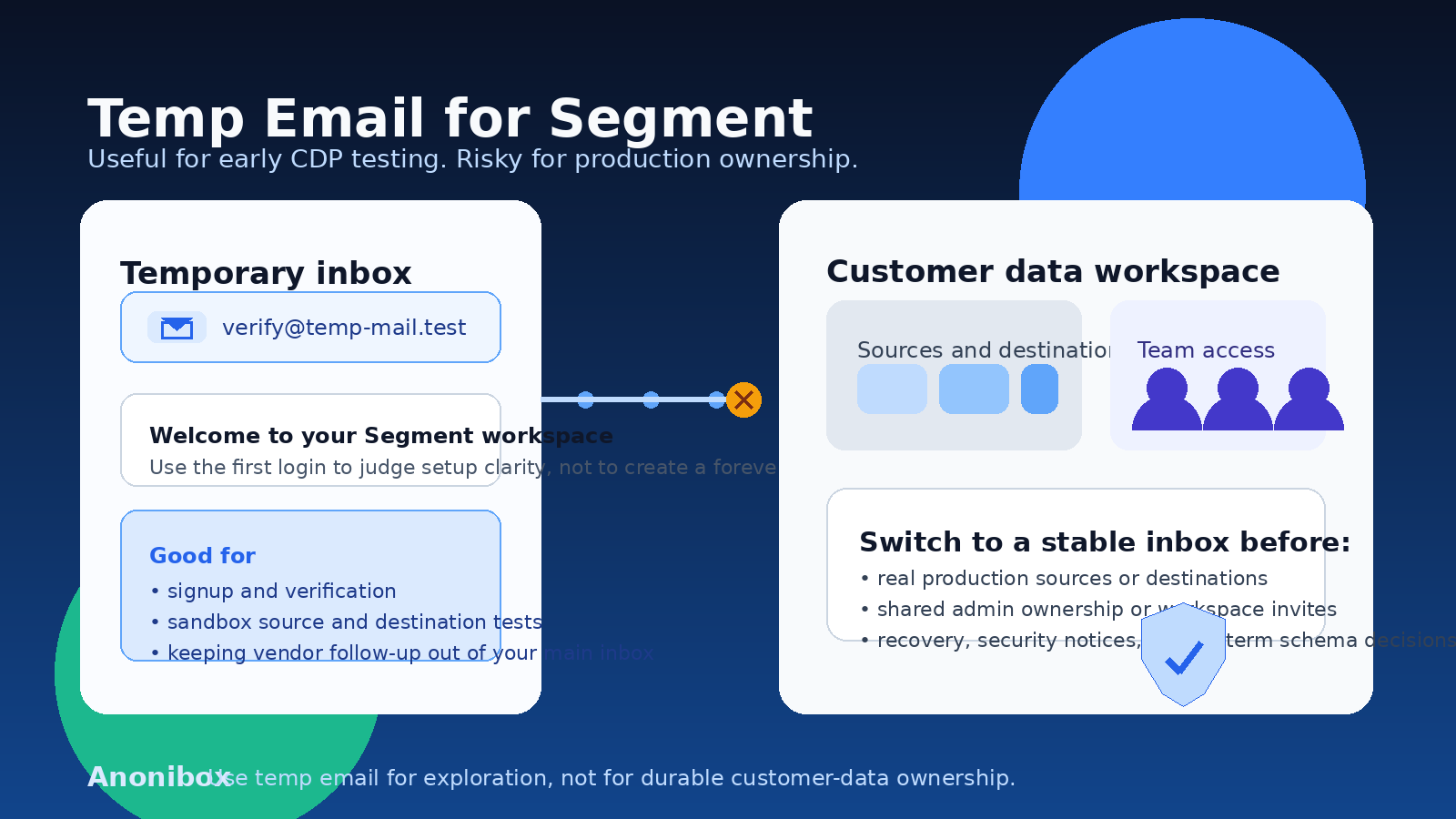
If you are comparing customer data tools, a temp email for Segment is attractive for a simple reason: early vendor evaluation creates more email than most people want. You sign up to inspect the workspace, verify the account, maybe connect a test source, and suddenly you also have welcome messages, onboarding prompts, product tours, follow-ups, and invite notices landing in your regular mailbox.
A temporary inbox gives you a way to keep that first phase contained. You still receive the verification link and the first setup messages you need, but you do not have to attach your long-term address to every exploratory trial. That is especially practical when Segment is being compared with tools like RudderStack, PostHog, Mixpanel, Amplitude, or warehouse-first analytics setups during the same decision window.
The important part is knowing where the convenience stops. Segment is not just another newsletter signup. Even a small workspace can quickly become the place where event schemas, source connections, destinations, and team decisions start to accumulate. A temp inbox is helpful for the first look. It becomes risky the moment the workspace turns into something your team may keep.
Why people consider a temp email for Segment
Segment often sits near the top of the stack when teams are evaluating data collection and routing tools. That means a trial account can lead to a surprisingly busy inbox even before anything meaningful is in production. A temporary inbox helps for a few practical reasons.
- It keeps evaluation mail separate. Verification emails, setup nudges, invite notices, and follow-up sequences do not need to land in the same mailbox you use for real customer, product, or engineering work.
- It makes product comparisons cleaner. If you are reviewing several CDP or analytics tools in the same week, separate inboxes make it easier to keep each trial in its own lane.
- It protects your primary address during early research. Not every vendor you evaluate needs your long-term work identity on day one.
- It lowers the friction of curiosity. You can inspect the workspace, test the first-run experience, and walk away if the product is not a fit.
Used that way, temp email is not about secrecy. It is about keeping a narrow experiment narrow.
When a temporary inbox is actually a good fit
1. You are doing a true first-pass evaluation
If your goal is simply to see how Segment feels, a temporary inbox is usually reasonable. You might want to confirm that signup works smoothly, look around the workspace, review how sources and destinations are presented, and decide whether the product deserves serious time. That is exactly the kind of short-lived trial where a disposable inbox helps.
2. You only need email for verification and initial access
Many early evaluations boil down to one short chain: sign up, click the verification link, receive a welcome message, and get into the dashboard. If that is all you need at the start, a temp inbox can do the job without committing your main address to an ongoing vendor relationship.
3. You are comparing multiple data tools at once
Segment is often evaluated alongside adjacent products. If you are opening test workspaces across several analytics, feature, or event-pipeline platforms, a temporary inbox can help you avoid mixing every trial into one crowded mailbox. That makes it easier to judge the tools on their actual workflows instead of on the amount of follow-up email they generate.
4. The workspace is genuinely disposable
Sometimes the trial is exactly what it sounds like: a sandbox, a proof of concept, or a one-person test you may delete in an hour. In that situation, a throwaway inbox is a sensible fit because the account itself has no long-term value if the test fails.
Where a temp email starts becoming risky
The biggest mistake is not using a temporary inbox for the first thirty minutes. The biggest mistake is leaving the account on that inbox after the workspace stops being temporary in practice.
1. Production sources or destinations are coming into scope
Once the workspace starts touching real data, even in a limited way, the account stops being a casual experiment. If your next step involves a real source, a meaningful destination, or a configuration your team may depend on later, the controlling inbox should already be stable.
2. Team ownership matters
Customer data platforms rarely stay personal for long. Product, engineering, growth, analytics, or operations people may all need visibility. If other people will rely on the workspace, a temp inbox becomes the wrong place for the primary owner account.
3. Recovery and security notices could matter later
Recovery feels theoretical until it is not. If a password reset, access challenge, or account notice ever becomes important, you do not want the workspace tied to an inbox that was created only for convenience during an early trial.
4. Tracking plans and schema decisions are being kept
Even before a workspace is fully operational, teams can begin making real decisions inside it. If the account becomes the place where naming conventions, event structure, or implementation notes are discussed and reused, it deserves durable ownership.
5. Nobody remembers to switch later
This is the most common failure mode. The trial goes well, people get busy, and the supposedly disposable account quietly becomes the real one. That creates avoidable cleanup later around ownership, access, and recovery.
A safer workflow: temporary first, controlled later
You do not need an extreme rule like “never use temp email” or “always use temp email.” The better approach is to match the inbox to the stage of the work.
Step 1: Use temp email only for the first evaluation pass
If all you need is access, verification, and a quick tour, a disposable inbox is fine. Treat that phase as a contained experiment.
Step 2: Save the useful details immediately
Temporary inboxes are good for access and bad for memory. If the trial produces information you may want later, save it outside the inbox right away. That may include:
- workspace links or identifiers
- notes on what felt strong or weak during setup
- which source and destination flows still need testing
- observations about schema clarity, permissions, or onboarding quality
Step 3: Switch to a durable address as soon as the workspace survives the first filter
If Segment becomes a serious candidate, move fast. Use an address you or your team will still control next month, not an inbox created for a quick exploratory session.
Step 4: Add team access before the account becomes operationally important
Do not wait until the workspace is central to a project before cleaning up access and ownership. Shared tools need shared visibility and clear administration.
Step 5: Reserve temporary inboxes for disposable experiments only
Once the account matters, stop treating it like a throwaway. Keep temp email for vendor comparisons and short-lived sandboxes, not for anything that may become part of real data operations.
What to evaluate while testing Segment
If you are using a temp email for Segment, the inbox is only there to remove friction. The real value comes from what you learn once you are inside.
Source connection clarity
Can you understand how to add and manage sources without unnecessary confusion? During a real trial, you want to see whether the platform makes the first setup steps feel logical or whether it creates more conceptual overhead than your team wants.
Destination and routing workflow
A good evaluation looks beyond signup. Pay attention to whether the relationship between sources, destinations, and routing behavior is explained clearly enough for the people who would actually use the product. If the dashboard feels opaque early, that friction usually matters more than the polish of the landing page.
Schema and event organization
Even an early test can reveal whether the product encourages clean event thinking or chaotic instrumentation. Try to judge whether the workspace supports disciplined implementation rather than just quick demos.
Team handoff potential
Imagine a second or third teammate joining the workspace. Would the setup be easy to explain? Does ownership feel obvious? A temp inbox is fine for the first login, but the trial should still tell you whether the product can support shared use cleanly.
Onboarding signal versus inbox noise
Some vendors send genuinely useful early guidance. Others compensate for weak in-product onboarding with lots of email. Using a temporary inbox lets you observe that behavior without sacrificing your primary mailbox.
Common mistakes to avoid
Using temp email for the account that becomes the real workspace
A quick trial account can easily outlive the trial. If the workspace begins to matter, update the ownership path before it becomes painful to fix.
Inviting teammates too early
If the account is still tied to a disposable inbox, keep the evaluation personal and lightweight. Team collaboration usually means the workspace has already outgrown temporary ownership.
Confusing privacy hygiene with long-term governance
A temporary inbox reduces clutter and exposure. It does not solve team governance, recovery, or continuity. Those need a real owner address.
Letting convenience beat documentation
If you learn something useful during the trial, write it down. Temporary inboxes are not meant to be archives.
Where Anonibox fits naturally
Anonibox is useful at the exact point where commitment is still low and curiosity is high. If you want to verify a Segment trial, read the first onboarding emails, and decide whether the workspace deserves deeper testing, a temporary inbox is a tidy and practical option.
But it should stay in that lane. If Segment becomes part of a serious analytics or customer-data conversation, move the account to an inbox with real continuity. That gives you the privacy and inbox-control upside of temp email without letting a disposable choice become a long-term liability.
Final takeaway
Temp email for Segment is useful for early CDP testing, quick workspace evaluation, and inbox hygiene during vendor comparisons. It helps you separate a short experiment from your long-term mailbox.
It is a poor long-term choice for any workspace that may touch production sources, shared destinations, team ownership, or account recovery. Use temp email to start fast, then switch early if the trial becomes real.