Yes, you can use a temp email for Kaggle if you only want short-term sign-up privacy while testing courses, notebooks, datasets, or a low-stakes exploratory account.
But it is a poor long-term choice if you care about competition deadlines, team invites, notebook ownership, account recovery, or building a profile you may want to keep.
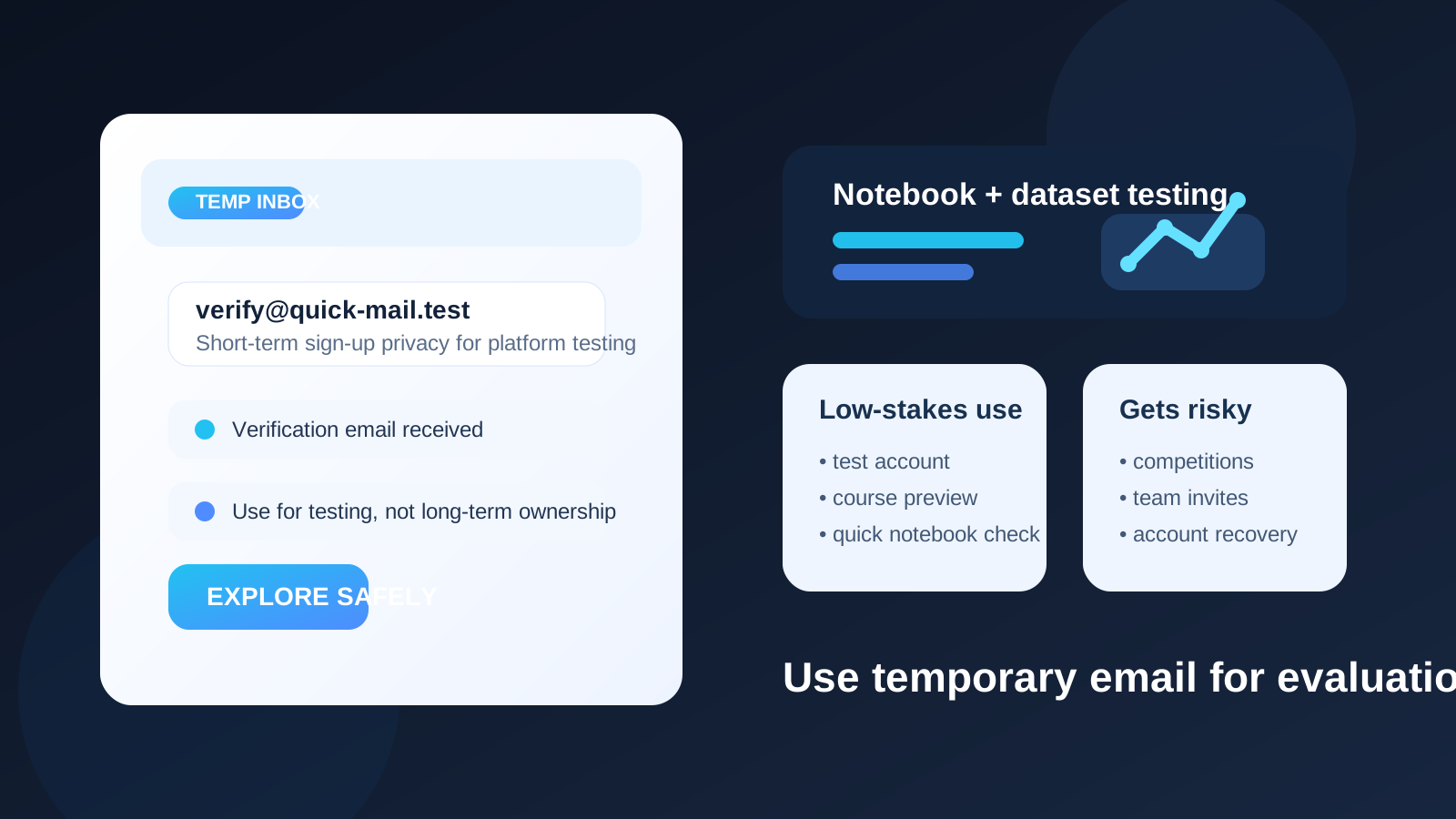
Kaggle sits in an awkward middle ground for temporary email. On one side, it is easy to treat it like a casual sign-up: you want to test a notebook, preview a course, explore public datasets, or poke around a competition without immediately giving another platform your main inbox. On the other side, Kaggle accounts can turn into real assets. They can hold notebooks, saved work, competition submissions, medals, discussion history, course progress, and collaboration invites. That means the privacy logic changes fast once the account becomes useful.
Short answer: fine for testing, weak for anything you may want to keep
If your goal is quick evaluation, a temporary inbox can make sense. You can create the account, handle the first verification step, and decide whether Kaggle is relevant to your workflow before handing over a permanent address.
If you expect to join competitions, publish notebooks, collaborate with teammates, receive deadline reminders, or use the profile as part of your portfolio, a stable email address is the better choice. A disposable inbox solves short-term exposure, but it creates long-term fragility.
Why people look for a temp email for Kaggle
The motivation is usually practical rather than suspicious. Kaggle can open the door to a lot of email over time, especially if you explore multiple parts of the platform.
- Inbox control: some people do not want another platform sending updates, challenge notices, or learning prompts into a primary mailbox right away.
- Low-stakes testing: you may only want to check whether Kaggle courses, datasets, notebooks, or discussions are worth your time.
- Privacy by default: if you are just experimenting, it is reasonable to avoid giving every site your everyday address on day one.
- Better separation: developers, analysts, and job seekers often already juggle job boards, docs platforms, coding tools, communities, and newsletters. A temporary inbox helps keep one more account from spilling into everything else.
That is why temp email for Kaggle is a sensible query. The problem is not the sign-up itself. The problem is that Kaggle can quietly shift from “just a test account” to “something I actually rely on.”
When a temp email for Kaggle makes sense
1. You only want to evaluate the platform
If you are curious about Kaggle but not yet committed, a temporary inbox is reasonable. You can create the account, explore the interface, sample a course, open a notebook, and decide whether the platform belongs in your real workflow.
2. You are doing one-off notebook or dataset exploration
Sometimes you only need a short burst of access: maybe you want to inspect a public dataset, test an environment, or see how notebooks run before deciding whether to invest more time. That is a good low-stakes use case.
3. You want to keep your main inbox out of early experimentation
Data and developer users often sign up for many services in the same month: learning platforms, benchmark tools, ML sandboxes, code repositories, newsletters, and AI products. If Kaggle is just one experiment in that pile, a temporary address can keep the clutter contained.
4. You are not attached to the account surviving
This is the real test. If losing access later would not matter, temp email can be fine. If it would annoy you, cost you work, or wipe out progress you care about, the account is not truly temporary anymore.
Where a throwaway inbox becomes a bad idea
Competitions and deadlines
Kaggle is not only a reading platform. Competitions can involve deadlines, submission updates, rules, announcements, and team coordination. If your inbox disappears or you stop checking it, you can miss information that actually matters.
Notebook ownership and published work
If you publish notebooks, save useful experiments, or build a visible project history, the account gains lasting value. A disposable email address is a weak foundation for anything that may become part of your portfolio or technical track record.
Team invites and collaboration
Even if you start alone, a project can become collaborative. Team invitations, shared work, or competition coordination work better when the account is tied to an inbox you control long term.
Course progress and certificates
If you use Kaggle Learn or any structured learning path seriously, you may eventually care about progress, completion history, or easy re-entry across devices. A throwaway address makes that continuity less reliable.
Account recovery and security friction
This is the classic failure mode. Temporary inboxes are convenient during sign-up and annoying during recovery. If you later need to confirm a login, reset access, or prove account ownership, the privacy benefit you got at the start may not feel worth the hassle.
What many people underestimate about Kaggle
People often assume the account will stay casual. That is not always true. A quick sign-up can turn into:
- a place where you save reference notebooks and datasets,
- a profile with public technical activity,
- a learning account you revisit over months,
- a competition identity connected to rankings or teammates,
- a portfolio signal you may later mention in applications or discussions.
Once any of that happens, the account stops being disposable even if the email was disposable at the beginning.
Temp inbox vs separate long-term inbox
For most people, the better comparison is not “main email or temp email forever.” It is this:
- Main inbox: easiest, but it exposes your everyday email to another platform and its notifications.
- Separate long-term inbox or alias: the strongest balance of privacy, organization, and recoverability.
- True temp email: best only for short tests, low-stakes exploration, and accounts you genuinely do not mind losing.
If you think there is any real chance you will keep using Kaggle, the separate long-term inbox is usually the smarter answer. It gives you privacy without turning future access into guesswork.
That is where a tool like Anonibox fits naturally. It works well for first-pass evaluation and short-term signup privacy. But once the account starts holding valuable work, a durable address or alias is usually the safer move.
How to use temp email for Kaggle without creating future pain
Decide whether this is a test account or a keeper account
Be honest before you sign up. Are you only exploring? Or do you realistically expect to keep notebooks, enter competitions, or use the account again later?
Use temp email only for the first exploratory phase
If the account is truly low stakes, a temporary inbox is fine for verification and early browsing. Just do not confuse “good for evaluation” with “good for long-term ownership.”
Switch to a stable address early if the account becomes useful
If you start saving work, joining discussions, taking courses seriously, or entering competitions, move the account to an inbox you can keep. The earlier you do it, the less messy it is.
Keep track of sign-in details
If you use a temporary inbox at all, save the basics while they are fresh: the exact address, sign-in method, and whether the account was tied to direct email login or another identity provider. Temporary access becomes much riskier when you do not document the setup.
Who should avoid a throwaway address on Kaggle?
- Competition participants: deadlines, rules, standings, and submission updates can matter too much for a disposable inbox.
- People building portfolio notebooks: if the work may become public proof of skill, the account deserves a stable foundation.
- Collaborators: team communication and account continuity matter more than a small privacy win at sign-up.
- Job seekers using Kaggle professionally: if you might ever share the profile in applications, reliability matters.
- Anyone who hates recovery headaches: if rework annoys you, skip the disposable route unless the account is truly throwaway.
Practical examples
Good use case
You want to preview Kaggle courses, inspect some datasets, and test a notebook environment before deciding whether you will actually spend time there. A temporary inbox is a fair privacy-first approach.
Borderline use case
You signed up casually, but now you are returning every week, saving notebooks, and thinking about entering competitions. That is usually the point where a temp inbox stops being smart and a separate durable inbox becomes the better choice.
Bad use case
You are already planning to publish notebooks, collect medals, collaborate with teammates, or link the profile publicly. That account should not depend on an inbox you may lose.
Quick checklist before you sign up
- Am I just testing Kaggle, or do I expect to keep using it?
- Would I care if I lost access a few months from now?
- Do I want privacy from the platform, or do I actually need a separate long-term inbox?
- Will I only browse and test, or will I publish, compete, and collaborate?
- Does this account have a real chance of becoming part of my learning or portfolio history?
Those questions usually make the right answer obvious. If the account is temporary, a temp inbox is fine. If the value may grow, stable separation is better than disposable access.
Final takeaway
A temp email for Kaggle is useful when you want short-term sign-up privacy while testing courses, notebooks, or datasets without pushing more platform email into your main inbox.
It becomes a weak choice once the account starts holding anything you would actually miss: competition participation, saved work, collaboration invites, public notebooks, or account recovery access. For that stage, a separate long-term inbox or controlled alias is usually the smarter privacy move.
The practical middle ground is simple: use temporary email for evaluation, not for ownership. That lets you protect your main inbox early without making a real Kaggle account fragile later.