Yes, a temp email for MeetRecord can be a smart move if you only want to verify signup, explore the product, and decide whether it deserves a place on your shortlist without sending another vendor into your main inbox.
No, it becomes a bad long-term setup once shared recordings, team access, review workflows, or account recovery depend on that inbox still existing.
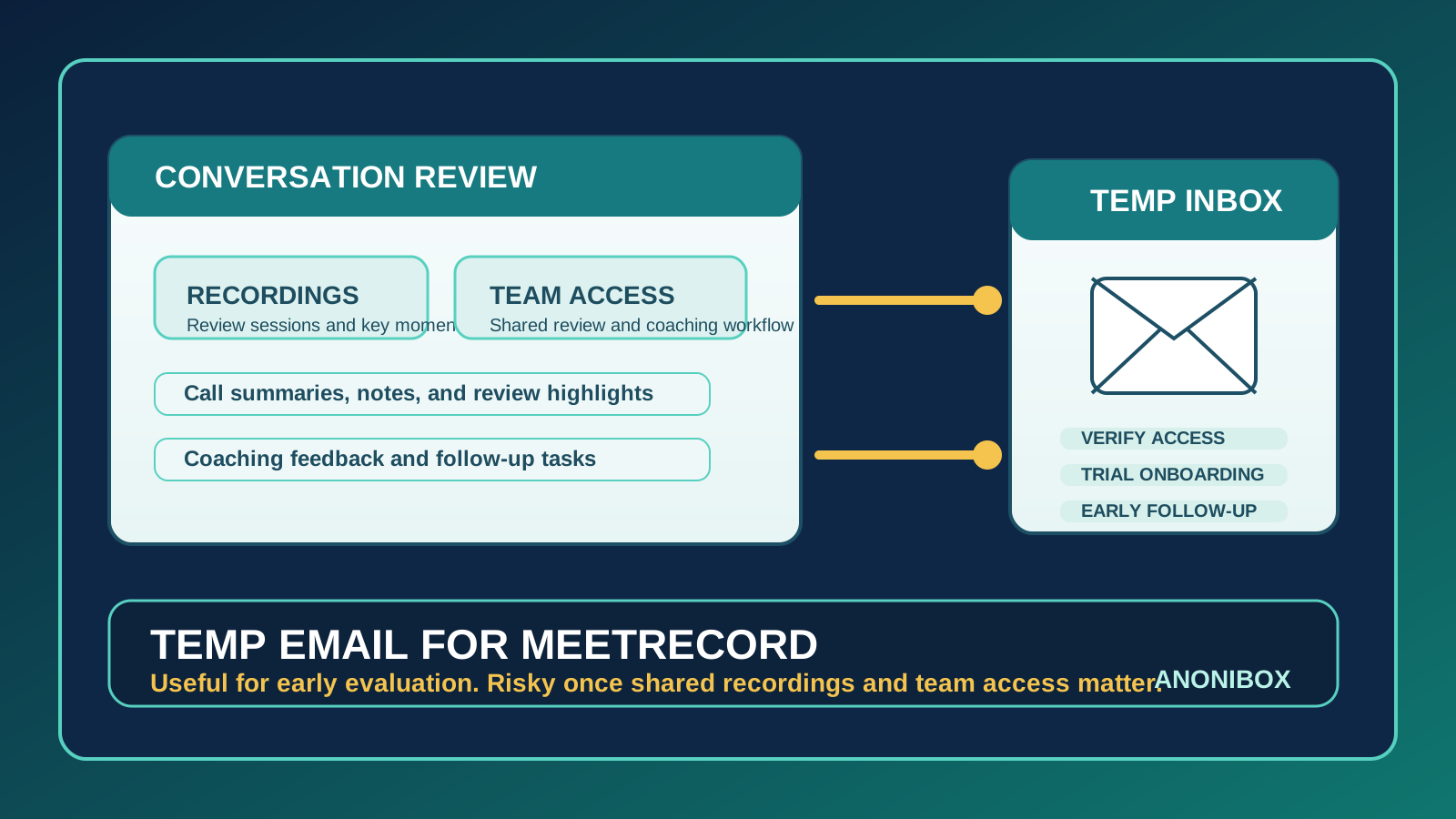
That is the real answer behind the query temp email for MeetRecord. A disposable inbox can be useful in the earliest stage of evaluation, especially if you are comparing conversation intelligence, sales coaching, or call-review tools and want to avoid weeks of follow-up landing in your everyday work email before you even know whether the product is a fit.
The key is knowing where the line is. In the first hour or two, a temp inbox can protect your privacy, keep the trial separate, and reduce inbox clutter. But as soon as the account starts collecting anything meaningful, the email address attached to it stops being a minor signup detail. It becomes part of who controls the account, who can recover it, and how safely the evaluation can continue.
MeetRecord sits in the same practical category as several related tools already covered on Anonibox, including Gong, Chorus, Jiminny, and ExecVision. The same pattern holds across all of them: temporary email is fine for a first look, but risky once the account starts becoming part of a real workflow.
When a temp email for MeetRecord makes sense
A burner address is most useful when your goal is narrow, low-stakes, and short-lived.
1. You are doing a first-pass vendor comparison
If you are screening multiple products in the same category, a temporary inbox can help you separate one trial from another. That way, you can verify access, read the first onboarding email, and check the interface without automatically turning your primary inbox into a list of demo reminders, nurture emails, and “just bumping this up” sales follow-ups.
2. One person is evaluating before involving the team
Sometimes a sales leader, enablement owner, or revops person just wants to answer a simple question: is this worth a deeper evaluation? In that situation, the goal is not to build a permanent workspace yet. The goal is to check whether the product feels promising enough to keep moving. A temporary inbox is reasonable for that kind of solo first pass.
3. You want privacy during early product research
Not every software trial deserves permanent access to your work identity from the first minute. If you are only trying to understand the product, not commit to it, a temp inbox through Anonibox can create a useful boundary between curiosity and commitment.
4. You mainly want to inspect onboarding and usability
Early evaluation is often less about deep rollout questions and more about the basics: how fast can you get into the account, how clear is the first-run experience, how helpful are the initial prompts, and how intuitive does the interface feel? If that is all you need at first, a disposable address can be enough.
Why people search for this in the first place
Most people are not looking for a temp email for MeetRecord because they want to hide something dramatic. Usually they want one of three normal things:
- less inbox clutter while exploring multiple vendors,
- more privacy before committing a real work address, or
- better separation between light research and real operational tools.
Those are fair goals. Software evaluation creates more email noise than people expect. One signup can turn into onboarding drips, webinar invites, rep follow-ups, feature tours, calendar nudges, and sales check-ins for weeks. If you are still deciding whether the platform matters at all, using a throwaway address can be a sane way to contain that noise.
The mistake is assuming that what works for the first hour will still work once the account becomes useful.
Where temporary email starts becoming a liability
Shared recordings and call libraries are not throwaway assets
The moment useful conversations, meeting reviews, or searchable call context start piling up, the account matters. It may still be “just a trial” on paper, but in reality people are already forming opinions, storing notes, or relying on the workspace to compare vendors and workflows. That is too much value to leave tied to an inbox you may not control later.
Team access changes the stakes immediately
If another person needs access, the account is no longer a private experiment. Now you have questions of ownership, permissions, continuity, and accountability. Even if the team is small, a disposable inbox becomes a weak foundation for shared access.
Review workflows tend to become sticky fast
This is one of the most common failure modes. Someone signs up “just to look around,” then uploads or reviews a few conversations, then someone else asks to compare features, then a manager wants to see how coaching notes or summaries work. Suddenly the account is part of a live internal discussion, but the login still depends on an address that was never meant to last.
Password resets and account recovery expose the weakness
A temp inbox feels harmless right up until you need it again. If a password reset, verification message, ownership change, or security notice lands in an inbox you no longer monitor, recovery becomes harder than it should be. That is not a theoretical downside. It is exactly how temporary shortcuts create avoidable friction later.
Support and admin handoffs get messier
When you need help from support or want to move toward a more serious pilot, stable account ownership helps. Disposable ownership creates ambiguity. Even if the issue is small, you are starting from a weaker operational position.
A safer way to use a temp email for MeetRecord
If you want the privacy benefit without creating a cleanup problem later, use a staged approach instead of an all-or-nothing one.
Use the temp inbox only for the first pass
Use it for signup, verification, and very early exploration. This is the cleanest and safest use case. You get the first look without giving every product immediate long-term access to your primary inbox.
Save the messages that matter
If the trial sends useful setup information, confirmation details, or onboarding instructions you may need again, save them early. Temporary inboxes are helpful specifically because they are disposable, which is also why you should not casually depend on them later.
Make a fast go-or-no-go decision
Do not let a temporary setup drift into accidental permanence. After the first look, decide whether the platform is clearly not a fit or whether it is strong enough to continue testing. If it is a real contender, move it to an address you actually control.
Switch before you invite other people
This is the clearest cutoff point. The moment another teammate may need access, change the ownership email first. That avoids a surprising amount of administrative mess later.
Use a durable team-controlled inbox for serious pilots
If the evaluation moves beyond curiosity and into real team review, use a business-owned inbox, shared evaluation alias, or another stable address with clear ownership. That preserves the early privacy benefit without turning the trial into an account-recovery headache.
What to evaluate during the early trial
The value of a temp inbox is not that it makes the evaluation shallower. It should make the evaluation cleaner. Once you are inside the product, focus on the questions that actually matter.
- Recording and review usability: can you find what matters quickly, or does the interface feel heavy?
- Insight quality: do the summaries, coaching cues, or call-review features seem practically useful, or mostly cosmetic?
- Sharing and permissions: if more people join, does the access model feel simple and manageable?
- Workflow fit: does the product support the way your team actually reviews conversations, or only the way a demo suggests it should?
- Onboarding clarity: did the first-run experience help you understand the product, or mostly create more vendor process around it?
- Ownership risk: if the trial becomes valuable, how easy will it be to move from solo testing to stable team use?
Those questions matter more than whether the vendor sends three emails or seven. The point of temporary email is to give yourself room to judge the product itself rather than the persistence of the follow-up machine around it.
A realistic example
Imagine a revenue leader comparing several conversation-intelligence products over two weeks. They do not want the whole team involved yet. They just want to see which options feel promising enough to advance to a more serious evaluation. If every trial starts with the same main inbox, that person can end up buried under overlapping follow-up before anyone has even agreed on a shortlist.
Using a temp inbox for the first phase keeps things cleaner. They can verify access, inspect the product, judge the workflow, and decide whether MeetRecord deserves a second look. If the answer is yes, the next move should be switching ownership to a real address before recordings, reviewers, or internal testing habits accumulate around the account.
A better long-term alternative
For most teams, the best answer is not “use a burner forever” and not “always use your main inbox from the first click.” The better middle ground is a separate but durable work-managed inbox. That can be a team alias, an evaluation mailbox, or another monitored address created for vendor trials.
This approach gives you most of the privacy and inbox-hygiene benefits people want from temporary email while preserving recoverable ownership if the account becomes important. For products that touch recordings, collaboration, admin control, or team workflows, that compromise is usually the smartest one.
Common mistakes to avoid
- Keeping the temp inbox too long: once the account matters, switch it.
- Inviting teammates before changing ownership: that turns a neat shortcut into an avoidable admin problem.
- Assuming trial data is disposable just because the inbox is: useful review context can become valuable faster than expected.
- Forgetting to save important setup messages: temporary inboxes are not where you want your only recovery path living.
- Confusing follow-up intensity with product quality: judge the workflow, not the email cadence.
Final verdict
A temp email for MeetRecord is useful when you want a low-commitment first look, cleaner inbox separation, and a little more privacy during software evaluation. It becomes a poor choice once the account starts holding shared recordings, review context, team access, or anything you may need to recover later.
The practical rule is simple: use temporary email for the earliest screening phase, then move to a stable address before the trial becomes operationally meaningful. That lets you stay organized and protect your inbox without creating unnecessary ownership problems later.