Yes, a temp email for Pipedream can make sense when you are testing workflows, comparing automation tools, or verifying a one-off account without inviting another long SaaS email sequence into your main inbox.
No, it is not a smart long-term address for a real Pipedream workspace that will hold production API keys, billing notices, recovery access, or failure alerts.
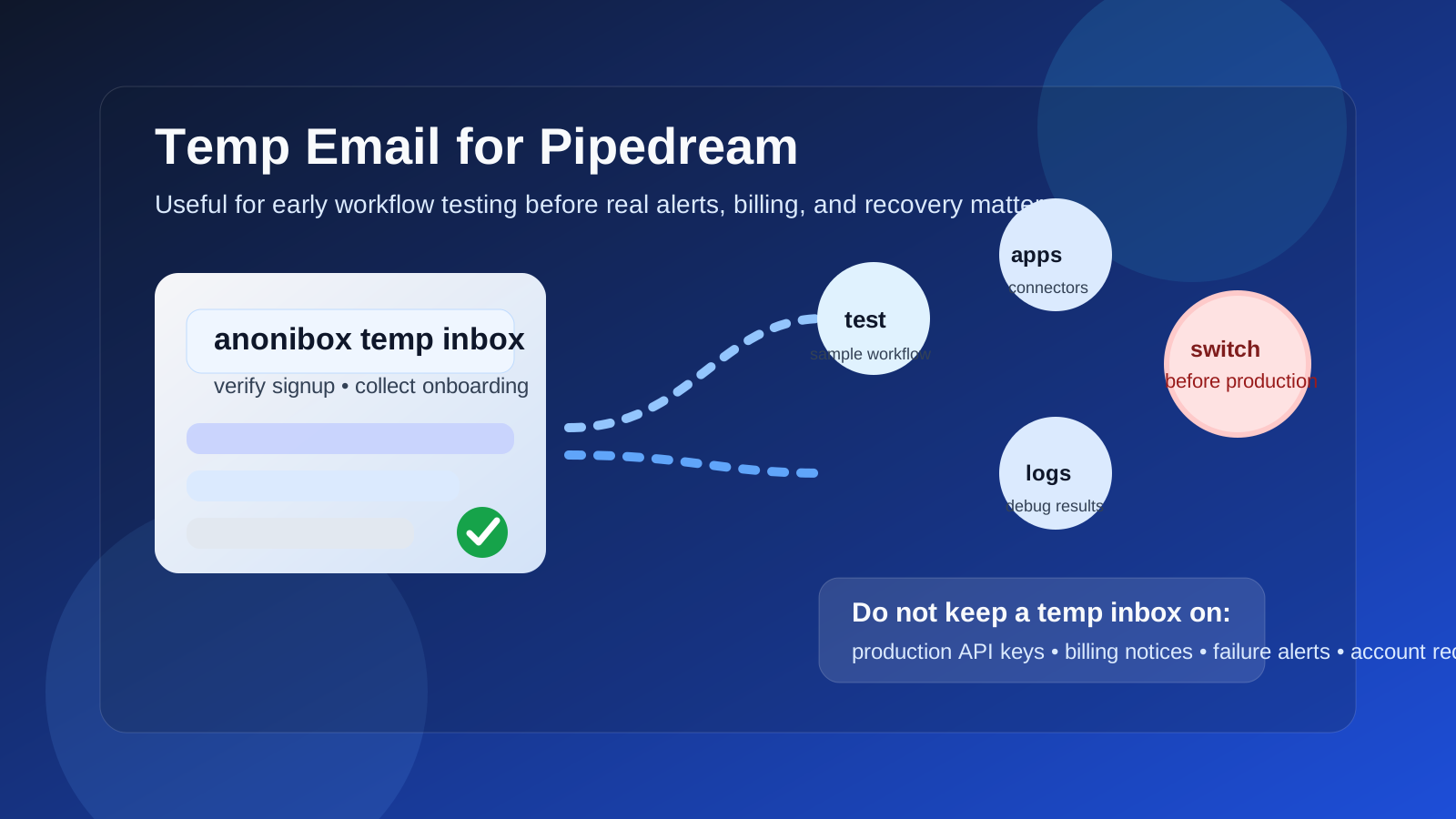
If you are exploring workflow automation, it is normal to create a few accounts, connect sample apps, test an event trigger, and decide whether the product actually fits your use case. That early evaluation stage is where a temporary inbox is most useful. You get the verification email, the welcome sequence, and the initial setup steps you need, without handing your main inbox over to another stream of release notes, webinar invites, and upgrade nudges before you have even decided to keep the tool.
Pipedream is a particularly good example because it often starts as a harmless experiment and then becomes important very quickly. You might begin with one webhook test, one API call, or one internal alert. A few days later, that same workspace may be handling lead routing, sync jobs, support notifications, or developer workflows that actually matter. That is why the right answer is not simply “always use a temp email” or “never use one.” The better answer depends on whether you are still evaluating or already relying on the account.
This guide explains when a temp email for Pipedream is practical, where it becomes risky, how to test safely, and when to move the account to a permanent inbox you control.
Why people use a temp email for Pipedream in the first place
Workflow platforms attract curious testing. You often sign up because you want quick answers to a few practical questions:
- Can Pipedream connect to the apps, APIs, or webhooks I actually use?
- Is the workflow builder faster for me than Zapier, n8n, or another automation tool?
- Can I test a proof of concept before I involve teammates or clients?
- Will the product be useful enough to justify a permanent account?
- Do I really want more product-marketing mail in my main inbox before I know the answer?
A temporary inbox helps because it separates evaluation from commitment. You can verify the signup, read the onboarding emails, and explore the product without treating a short experiment like a permanent operational decision.
When a temporary inbox makes sense for Pipedream
1. You are comparing automation tools
If you are testing Pipedream against other workflow platforms, a disposable address is a clean way to keep each trial isolated. That matters when multiple tools are sending you setup tips, new-feature announcements, pricing reminders, and “finish your workflow” prompts at the same time.
2. You only need a short proof of concept
Maybe you want to confirm that a webhook can receive data, that a scheduled task can call an API correctly, or that an internal alert can be routed the way you expect. If the account exists mainly to answer those questions, a temp inbox is reasonable.
3. You want to protect your main inbox during early research
Product trials often create more email than people expect. Even useful platforms send welcome sequences, templates, community invites, release notes, and promotional nudges. A temporary address keeps that noise out of your daily inbox while you figure out whether the platform deserves a real place in your stack.
4. You are doing a private first pass
Sometimes you want to test a tool quietly before connecting it to a company email or shared admin address. In that situation, using a throwaway inbox first can be more sensible than attaching the very first experiment to a long-term team identity. A service like Anonibox can help you keep that first-pass testing separate from the inboxes that matter long term.
Where a temp email becomes risky
This is the part that matters most. Workflow tools are not just ordinary newsletter signups. Once the account starts controlling useful automations, the email tied to it starts to matter too.
Production workflow ownership
If a Pipedream workspace owns automations your business actually depends on, the account should sit behind a stable inbox. A disappearing address is a bad foundation for something that may route leads, process transactions, update records, or trigger internal actions.
API keys, connected services, and environment changes
As soon as you start wiring real services into the workspace, the account becomes more sensitive. Admin notices about integrations, environment settings, or connected resources should not vanish into a mailbox you only meant to use for a quick test.
Billing and subscription notices
If the account moves beyond a casual test, emails about plan limits, invoices, payment failures, or account changes matter. Those are not messages you want attached to a disposable inbox.
Error alerts and operational messages
Some of the most important workflow emails are not onboarding messages at all. They are failure notices, warning emails, and other operational updates that tell you something broke or needs attention. Missing those because the original signup used a temp inbox is not a great trade.
Password resets and account recovery
Even well-managed teams eventually need a recovery path. If the workspace is still tied to an inbox that no longer exists, recovery becomes harder than it needs to be.
A practical way to use a temp email for Pipedream safely
Step 1: Generate the temporary inbox before signup
Start with the inbox first. That keeps the full evaluation separate from your everyday mail from the very beginning and makes it easier to track which messages belong to which trial.
Step 2: Use it only for signup, verification, and early onboarding
The sweet spot for a temp email is the first stage: account verification, welcome emails, setup prompts, and a few onboarding resources. That is enough to let you test the product without pretending the account is already permanent.
Step 3: Build one realistic but low-stakes workflow
Do not judge the tool by reading feature pages alone. Build something small that mirrors your actual use case without creating operational risk. Good examples include:
- Sending a sample webhook payload into a spreadsheet or test database
- Triggering a notification from a mock form submission
- Calling a non-sensitive API endpoint with test data
- Running a scheduled workflow that writes to a sandbox destination
This tells you much more than just clicking around the dashboard. It also makes it obvious whether Pipedream is truly a fit for how you work.
Step 4: Save anything important before the inbox expires
If the verification email, onboarding guide, or setup links contain anything you may need later, save them somewhere permanent. Temporary inboxes are useful for access, not for long-term record keeping.
Step 5: Switch to a permanent email if the account has a future
If the workflow is clearly useful, move the account to a permanent inbox before real ownership, billing, or production risk builds around it. Do that early, not after the workspace has become business-critical.
What to test before you commit
If you are using a temp email for Pipedream during evaluation, focus on practical questions instead of getting distracted by the signup itself:
- Does the platform support the integrations or APIs you actually need?
- Can you debug failures without a painful learning curve?
- Is the workflow logic understandable enough that you would trust yourself or your team to maintain it later?
- Can you test safely with sample data before connecting real systems?
- Does the product feel like a temporary experiment, or something that could genuinely become infrastructure?
The answer to that last question matters most. If the account feels like future infrastructure, the email behind it should not stay temporary for long.
Common mistakes to avoid
Leaving the account in temporary mode for too long
What starts as “I am just testing this” can quietly turn into “this workflow now handles real work.” That transition happens fast. If the account is becoming important, the inbox behind it needs to become stable too.
Connecting too many real systems during a throwaway test
Keep the first experiment small. Use sample data, sandbox environments, or non-sensitive endpoints where possible. The goal is to evaluate the platform, not to create a cleanup problem.
Forgetting that email is part of operational resilience
People often think about account email only as a marketing issue. For workflow tools, it is also part of recovery, visibility, and ownership. That is why a temporary inbox is useful early and risky later.
Assuming a temp email solves every privacy problem
A disposable inbox reduces inbox exposure and long-term email clutter. It does not replace good credential hygiene, careful permission scoping, or sensible team access practices.
Quick checklist: should you use a temp email for Pipedream?
- Yes if you are comparing workflow tools or running a short proof of concept.
- Yes if you want to verify the account and collect onboarding mail without using your main inbox yet.
- No if the workspace will own production automations, important API keys, or billing notices.
- No if teammates will depend on the account or you expect to keep it long term.
- Switch soon if the test is going well and the account is starting to matter operationally.
Final takeaway
A temp email for Pipedream is a practical choice for the evaluation stage. It helps you verify the account, test workflows, and compare automation tools without turning a short experiment into months of inbox clutter.
Just do not let a testing setup quietly become a permanent ownership setup. If the account begins to matter for real integrations, billing, recovery, or failure alerts, move it to a stable inbox you control. Used that way, a disposable inbox is not a gimmick. It is a simple boundary between early experimentation and real operational responsibility.