A temp email for Podium can be fine for a short, low-stakes product trial. It is usually a bad idea once the account starts touching real customer messages, review workflows, listings, billing notices, or long-term team access.
If you only want to verify signup, look around the dashboard, and decide whether Podium belongs on your shortlist, a disposable inbox works. If the account is becoming operational, switch to an address you actually control before the trial turns into real business infrastructure.
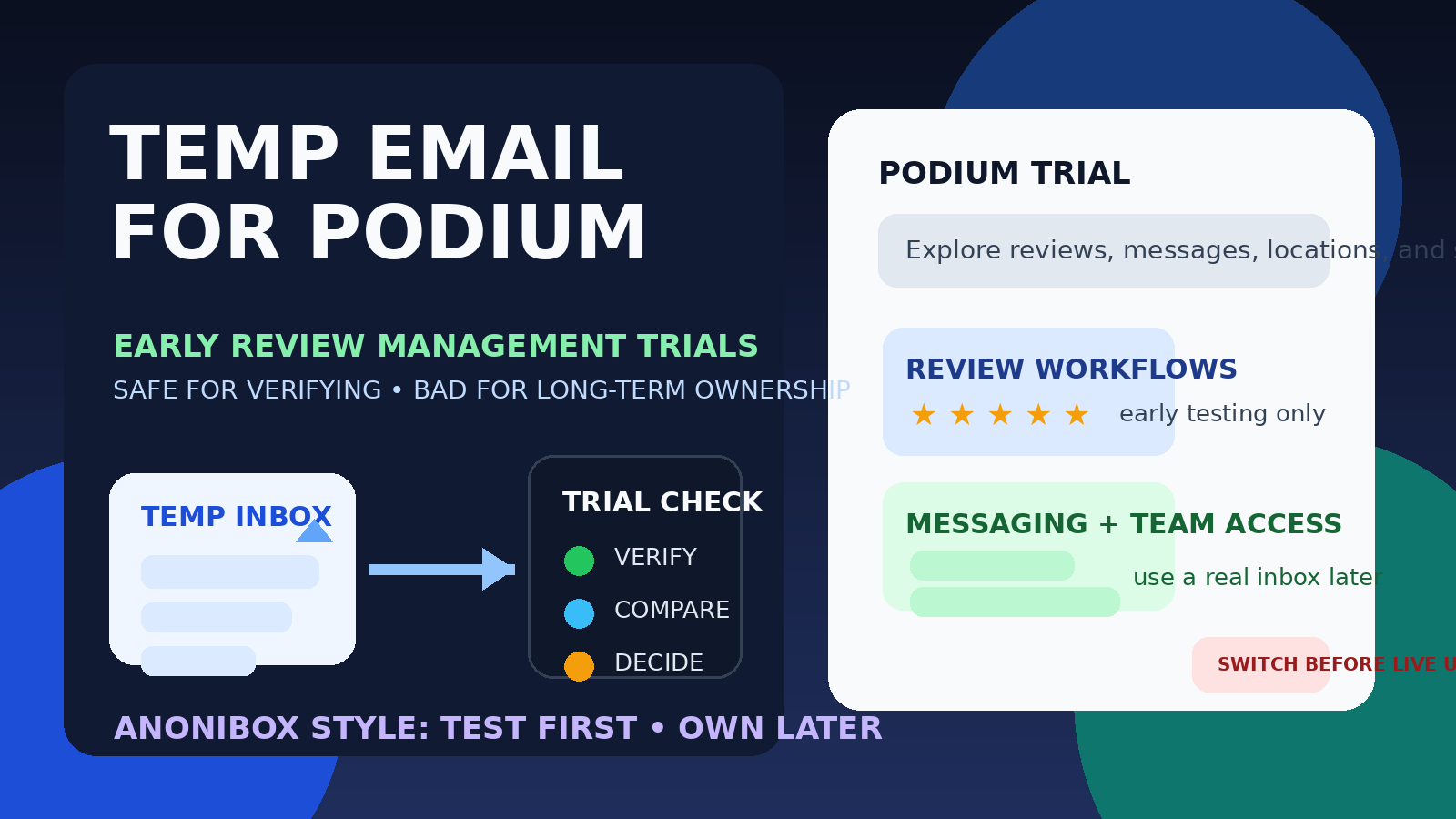
Why people look for a temp email for Podium
The reason is usually simple: they want to evaluate the platform without feeding a permanent business inbox into another long sales and onboarding sequence too early. That is a reasonable instinct. Local marketing, review management, and customer-communication tools often ask for an email before they unlock product tours, trial environments, follow-up calls, and setup instructions. You may want access to the product without committing your everyday inbox to months of follow-up before you even know whether the software fits your workflow.
A temporary inbox from a service like Anonibox can help during that first stage. You can receive the verification email, complete the first login, and inspect the product while keeping your main address out of early nurture campaigns. That is often enough for an honest first-pass evaluation.
When a temporary inbox makes sense
A disposable address is most useful when your goal is narrow and temporary. In other words, when you are testing the platform rather than relying on it.
- You only want to confirm that the signup works and see the interface.
- You are comparing Podium with tools like Birdeye, Yext, or other local-marketing platforms side by side.
- You want to judge the setup flow before giving a permanent business email to another vendor.
- You expect the trial to last one or two short evaluation sessions, not weeks of operational use.
- You want onboarding emails and sales follow-up kept separate from your real work inbox until you have a shortlist.
That use case is practical. You are not trying to hide from a legitimate vendor. You are simply separating light research from long-term account ownership.
When a temp email starts becoming risky
The trouble usually does not appear in the first few minutes. It appears later, when the account begins to matter. Podium-style accounts can stop being “just a trial” faster than people expect. One moment you are exploring settings. Next thing you know, the account is tied to customer messages, review requests, staff permissions, location details, reporting, and account recovery.
Once that shift happens, a disposable inbox becomes a weak foundation.
1. Account recovery becomes fragile
Password resets, login alerts, verification links, and ownership confirmations only help if you can still access the inbox. If the address was disposable and is no longer available when you need it, a minor issue can become an annoying support problem.
2. Messaging workflows can become exposed
If the platform starts handling real message routing, customer replies, or notification alerts, the email attached to the account matters much more. A throwaway address is fine for a quick login. It is not a good long-term endpoint for something tied to real customer interaction.
3. Listings and business-location work should live under a durable inbox
Anything connected to location data, business profiles, or ongoing visibility work is better managed through an address the business actually owns. Even if the email itself is not customer-facing, it still sits in the chain of control.
4. Team access gets messy
Once colleagues are invited, roles are assigned, or approvals start happening, you want a stable admin contact. Temporary email makes ownership murkier exactly when clarity becomes important.
5. Billing and renewal notices can be missed
If the trial rolls toward a paid plan, invoices, plan notices, or renewal reminders should not land in a disposable inbox you may not be watching anymore.
A simple rule that works
Ask one question: am I only testing Podium, or am I beginning to depend on it?
If you are only testing it, a temp email is often fine. If the account is starting to hold anything operational, move to a permanent inbox immediately. That one rule handles most edge cases without overcomplicating the decision.
What to test during an early Podium trial
If you do use a temporary inbox, use that limited access window well. The goal is not just to create an account. The goal is to decide whether the platform deserves deeper evaluation.
Check the core workflow first
- Is the signup and initial setup straightforward?
- Can you quickly understand where reviews, messaging, and business-location settings live?
- Does the dashboard feel usable for a real team, or only for a vendor demo?
Judge how much real work the product expects
Some tools are easy to test casually. Others become account-dependent very quickly. If the trial immediately pushes you toward connecting live channels, inviting teammates, or setting up business-critical workflows, that is a sign you should not stay on a disposable inbox for long.
Notice how much value you get before a sales call
A good trial should let you understand enough to decide whether a deeper conversation is worth your time. If the account only exists to funnel you into aggressive follow-up, a temp inbox probably did its job: it protected your main address while you found that out.
How to use a temp email for Podium safely
- Create the temporary inbox first. Do not improvise halfway through signup. Starting clean makes the trial easier to track.
- Use it only for early access and verification. Let it receive the first login link, welcome email, and setup prompts.
- Take notes outside the inbox. If a useful setup detail or contact name matters, copy it into your own notes immediately.
- Avoid connecting anything real too soon. Do not treat a disposable-address account like a safe home for long-term operational work.
- Promote finalists to a permanent inbox. If the product makes your shortlist, update the account before deeper setup, team rollout, or billing begins.
That workflow gives you the best of both worlds: early privacy and later stability.
Signs you should switch to a permanent email right away
- You want to keep the account beyond a quick trial session.
- You are saving meaningful setup work you do not want to repeat.
- You are connecting real business information or live communication channels.
- You are inviting coworkers, managers, or agency partners.
- You may need dependable password recovery, security alerts, or billing notices.
- The vendor has become a serious finalist rather than a casual experiment.
If even two or three of those are true, the disposable stage is probably over.
What if Podium blocks disposable email addresses?
That can happen. Some platforms reject known temporary email domains to reduce spam, fake trials, abuse, or duplicate signups. If the address is blocked, do not force it. The better move is to decide whether the platform is worth using a more durable trial address for.
In that situation, a dedicated evaluation inbox you control can be a smarter middle ground than either extreme. It gives you separation from your main day-to-day inbox without creating the recovery problems that come with a truly disposable address.
Common mistakes to avoid
- Using one throwaway address for every vendor: that makes comparison harder and increases confusion later.
- Forgetting to save important information: if the inbox is temporary, act like it is temporary.
- Leaving a real account on a disposable address too long: this is where most avoidable problems start.
- Evaluating the vendor based only on email cadence: the real question is whether the product helps your workflow.
- Ignoring ownership issues: if the account will matter later, the email identity behind it matters too.
Best practical answer
For most people, the best answer is not “always use a temp email” or “never use a temp email.” It is stage-based:
- Early exploration: disposable inbox is fine.
- Serious evaluation: consider moving to a stable trial or team inbox.
- Real deployment: use a permanent business-controlled address.
That keeps the privacy benefit where it helps and removes the risk before it becomes expensive or annoying.
Final verdict on temp email for Podium
A temp email for Podium is useful when you are doing a quick, cautious first look and want to avoid filling your main inbox with early sales and onboarding messages. It is the wrong long-term choice once the account starts touching review activity, messaging, listings, permissions, billing, or anything your business may actually depend on.
Use a temporary inbox to verify, compare, and decide. Then, if Podium earns a real place in your workflow, move the account to an email you control for the long haul. That is the cleanest way to protect your inbox without creating preventable account problems later.