A temp email for Tray.io can be useful when you only want to test connectors, open a trial workspace, or compare automation tools without feeding another vendor follow-up sequence into your main inbox.
It becomes risky once that Tray.io account starts holding real integrations, shared workspace access, billing notices, or password recovery paths you may need later.
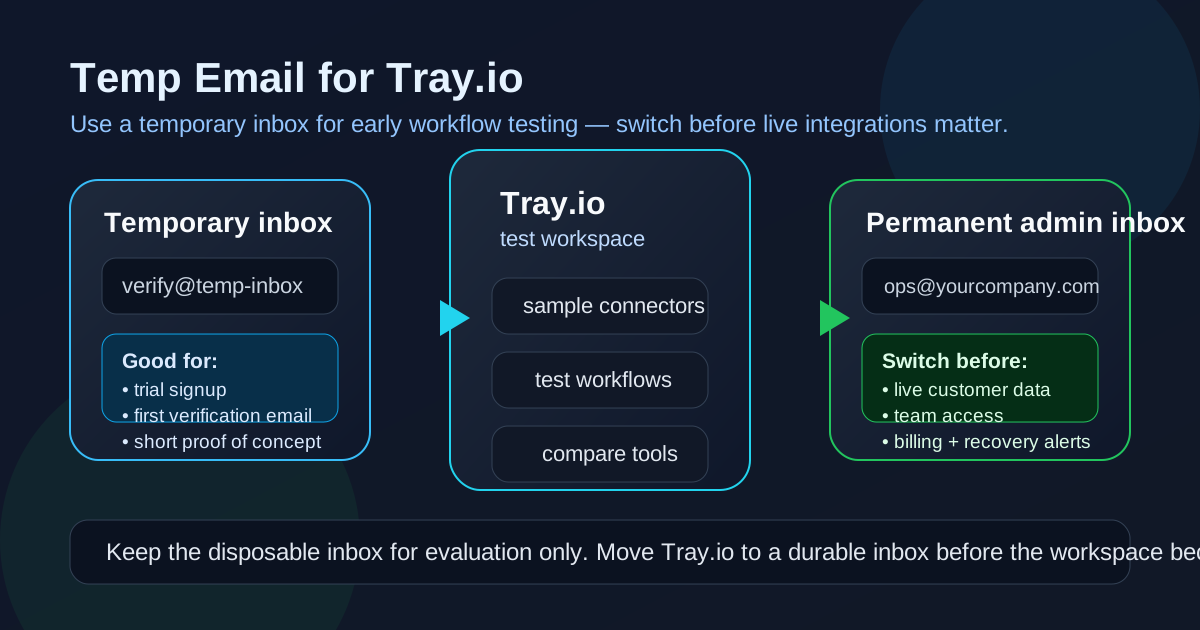
That is the practical answer behind the search for a temp email for Tray.io. Yes, a disposable inbox can make sense in the evaluation stage. No, it is usually a poor long-term home for an integration platform that might end up touching real customer data, internal workflows, error notices, or shared admin ownership.
Tray.io sits in the same broad category as tools people often test side by side, including Zapier, n8n, Pipedream, Make.com, and Workato. That makes a separate inbox appealing. You may only want to inspect connectors, build a proof of concept, test a few data flows, and decide whether the platform fits your stack. In that phase, keeping your main inbox out of another trial funnel is perfectly reasonable.
The mistake is letting a test identity quietly become the permanent admin identity. Integration tools have a habit of becoming important faster than expected. A simple experiment can turn into a lead-routing flow, support handoff, reporting sync, or internal notification chain that somebody starts relying on. Once that happens, the email on the account is not just a signup detail anymore. It becomes part of governance, continuity, and recovery.
Why people look for a temp email for Tray.io
Most people searching this are not trying to hide for dramatic reasons. Usually they just want separation. Integration-platform trials can produce verification emails, onboarding sequences, webinar invites, partner promos, feature announcements, and sales follow-ups for weeks. If you are comparing several tools at once, your main inbox can get noisy fast.
A temporary inbox from a service like Anonibox can help when you want to:
- verify a new Tray.io account without using your everyday work address right away;
- compare workflow builders before picking one for a serious project;
- keep a short-lived proof of concept separate from your normal operations inbox;
- test whether the connector coverage and builder logic are worth deeper evaluation;
- avoid long-term vendor email clutter for a tool you may never adopt.
Those are all legitimate reasons. The important distinction is whether the account is truly temporary, or whether the project behind it is likely to become real.
When a temp email for Tray.io actually makes sense
There are a few scenarios where a disposable inbox is a smart and low-risk choice.
1. You are comparing automation platforms
If you are testing Tray.io beside other integration tools, a temp inbox can keep the evaluation tidy. You can verify the account, inspect the workspace, try a few sample flows, and judge the product without committing your primary address before you know it deserves a place in your stack.
2. You only need short-term access
Sometimes the goal is narrow: get the verification email, open the dashboard, look through connectors, and see whether the builder feels intuitive enough to pursue. That is a clean disposable-email use case because the whole exercise is short-lived by design.
3. You are building a throwaway proof of concept
A proof of concept that uses sample data, fake records, or a totally disposable sandbox can live behind a temporary inbox for the first pass. If the experiment will be deleted after the demo, the risk stays fairly low.
4. You want privacy during vendor research
Not every product trial needs your main work identity from minute one. If you are still deciding whether Tray.io is relevant at all, a disposable inbox can give you breathing room before you turn the relationship into an ongoing one.
Why Tray.io becomes higher-stakes surprisingly quickly
Integration tools almost never stay purely theoretical for long. The whole point is to connect systems and automate actions. That means even a modest trial can start handling information or processes people care about.
You might begin with a harmless test that moves sample form data into a spreadsheet, creates a demo task, or pushes a mock ticket into a sandbox desk. Then someone notices the flow works. The sample becomes real data. The demo gets reused for a live campaign. The one-off experiment turns into the first version of an operational workflow. That is where a temporary inbox stops being convenient and starts becoming fragile.
Tray.io is especially vulnerable to this because it is often used in collaborative, ops-heavy, or client-facing environments. The person who signs up first is not always the person who will own the integration long term. Agencies, RevOps teams, customer-success teams, and internal operations groups all have a way of inheriting automations that started life as quick tests.
Main risks of keeping Tray.io tied to a disposable inbox
1. Real workflows can outgrow the test account
The most common problem is quiet drift. A workflow starts as an experiment, survives the pilot, and then nobody circles back to clean up the admin identity. Months later, the workspace is doing real work but still depends on a throwaway email that nobody treats as durable.
2. Shared ownership gets messy
Tray.io is not always a solo product. If teammates, contractors, clients, or future admins may need access, the account should sit behind an address that can outlast one person’s temporary testing setup. Shared operational tools deserve boring, stable ownership.
3. Important notices can go missing
Integration platforms generate notices that matter more than people expect: login warnings, billing messages, plan changes, recovery prompts, and sometimes alerts related to workflow health or admin actions. A temporary inbox is fine when nothing matters yet. It is a bad place for messages you may need three months from now.
4. Recovery becomes annoying at the worst time
Password resets and security confirmations only feel unimportant until you need them during an outage, staff change, or urgent handoff. If the original email has expired or gone unmonitored, getting back into the account can become a needless distraction right when reliability matters most.
5. The account may hold more trust than you planned
Even if the workflows themselves can be rebuilt, the workspace often becomes a reference point for connector settings, environment structure, internal logic, and tribal knowledge. Once people trust it, the underlying admin identity matters more than it did on day one.
A safer way to use a temp email with Tray.io
If you want the privacy benefit without creating a future mess, the best approach is staged rather than permanent.
Start with the temporary inbox for evaluation only
Use the disposable address for signup, verification, and the first exploration pass. That is the part temporary email handles well.
Keep early testing low-stakes
Use sample data, sandbox systems, and reversible workflows while the workspace is still attached to a burner inbox. Avoid quietly letting it become the place where live business logic starts to accumulate.
Document what is worth keeping
If you find a useful connector pattern, account structure, or workflow approach, write it down while the test is fresh. That makes migration easier and reduces the temptation to keep using the throwaway setup just because it already exists.
Switch to a durable inbox before the workspace becomes operational
The right time to move the account is before team access, live data, or billing matter, not after. If you already know the platform might become real, switching early is the cleanest move.
Prefer a dedicated admin mailbox over a personal address
If Tray.io is likely to become a team asset, a stable shared admin inbox or well-managed alias is usually better than either a burner inbox or one employee’s private mailbox. What you want is continuity, not cleverness.
What to use instead of a burner forever
Many people do not actually need total disposability. They need separation. In that case, better options exist:
- A dedicated trials inbox: good for vendor evaluations you may revisit later.
- An email alias: useful for filtering trial mail without losing long-term control.
- A shared operations mailbox: best when the workspace may become a team-owned integration asset.
- A temporary inbox only for first verification: then switch to a permanent address once Tray.io proves worth keeping.
That last option is often the best compromise. You get privacy during the research phase and stability before the account becomes important.
Realistic examples
Good use case
You want to compare Tray.io with other workflow tools this week, test a few sample connectors, and decide whether the builder is worth a deeper pilot. A temp email is sensible because the project is exploratory and low-stakes.
Borderline use case
You are building a proof of concept for a client or internal ops team and telling yourself it is “just a demo,” but you already suspect people may want to keep the working flow if it performs well. That is usually the point where a durable inbox becomes smarter than a burner one.
Bad use case
You are connecting real customer systems, syncing live records, inviting teammates, attaching billing, or using the workspace as shared infrastructure. At that point, the inbox on the account should be something you control long term.
Quick checklist before you sign up
- Am I only evaluating Tray.io, or do I expect to keep this workspace?
- Will the workflows stay in sample data, or could live records show up soon?
- Will anyone else depend on this account or its automations?
- Would missing a recovery email, billing notice, or admin alert hurt later?
- Do I really need a disposable inbox, or do I just need a separate stable inbox for trials?
If your answers lean toward short-term, private, and reversible, a temp inbox can be a practical choice. If they lean toward shared access, live data, or operational importance, move to a durable address before the test hardens into real infrastructure.
Final takeaway
A temp email for Tray.io is useful for early workflow testing, account verification, and vendor comparison. It helps when the workspace is still experimental and you want to keep your main inbox cleaner during evaluation.
It becomes risky once real integrations, shared ownership, billing, or recovery depend on that address. Use disposable email for the trial stage if you want the privacy buffer, then switch to a permanent admin inbox before Tray.io becomes something your team actually relies on.