Yes — a custom domain email is usually a good choice for salary negotiations if you personally own the domain, the address is easy to read, and the mailbox is stable enough for offer letters, deadlines, and follow-up questions.
No — it is a bad choice if the domain is tied to your current employer, a side project you may shut down, or a forwarding setup you barely trust. During compensation talks, reliability matters more than novelty.
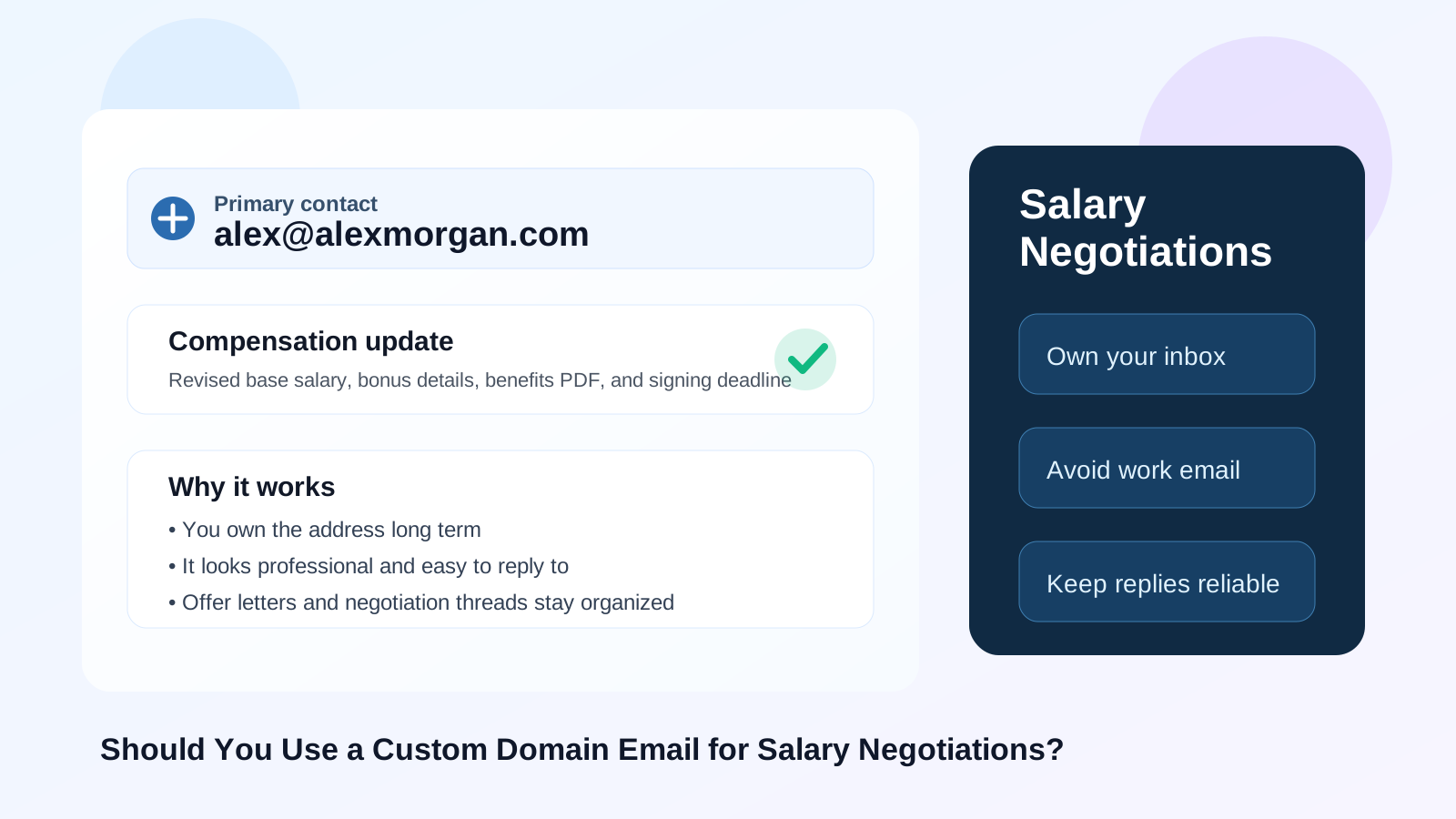
Why this question matters more at the negotiation stage
Salary negotiations are a different kind of communication than early job-board browsing. By this point, the conversation may include pay ranges, counteroffers, bonus details, benefits summaries, stock or equity explanations, start-date discussions, relocation support, and formal offer documents. The inbox you use is no longer just a place to catch a recruiter hello. It becomes the place where important written details live.
That is why a custom domain email can be either a smart upgrade or an unnecessary risk. If the address feels clear, durable, and fully under your control, it can help you look organized while keeping sensitive career messages separate from the rest of your digital life. If it feels experimental, over-branded, or temporary, it can create doubt at exactly the wrong moment.
Short answer: use it only if it behaves like a normal professional inbox
Most recruiters and HR teams do not care that your address is on a custom domain by itself. They care about simpler things: whether they can read it quickly, whether replies reach you without friction, and whether the inbox is likely to stay available through the entire process.
A custom domain email works well for salary negotiations when it feels boring in the best possible way. The address should look professional, the mailbox should receive messages reliably, and you should be confident that it will still exist when someone sends a revised offer letter or asks for a final confirmation.
Why a custom domain email can be a good fit
1. You control the address long term
If you truly own the domain, you are not depending on an employer, a school, or a platform you may abandon. That can be useful during negotiations because compensation conversations do not always end in one message. A company might send a first offer, revise the package, answer questions about benefits, and then follow up again after you respond. A domain you control gives you continuity across that whole sequence.
2. It can look polished without looking corporate
A clean custom-domain address based on your name can look professional and calm. Something like alex@alexmorgan.com or sam@samlee.net is easy to understand and easy to trust. It does not signal “temporary inbox,” and it does not tie you to a free provider brand either.
That said, the polish only helps if the address is simple. If the domain is hard to spell, too clever, or looks like a company unrelated to you, the effect flips fast. Negotiation-stage communication should reduce friction, not make people wonder whether they are writing to the right person.
3. It keeps sensitive job-search messages separate
Many people use one main personal inbox for everything: receipts, newsletters, travel confirmations, friends, family, financial alerts, and job-search activity. A custom-domain inbox can give you cleaner separation without resorting to a disposable address. That is useful when you want one place for offer threads, compensation notes, and recruiter attachments without exposing those conversations to a noisier everyday inbox.
4. It avoids the problem of using a work-owned account
If you are still employed while negotiating with a new employer, your current work email is usually the wrong answer. Even if nobody is actively monitoring it, a work account is not really yours. A custom domain email can give you a professional alternative that stays under your control and does not rely on your current employer’s systems.
When a custom domain email is a strong choice
It is usually a strong choice when:
- the domain is personally owned by you and not by your current employer
- the address uses your real name or a clean professional variation
- you plan to keep the domain active well beyond the hiring process
- the mailbox already works reliably for sending, receiving, and replying
- you actually monitor the inbox closely
If those basics are true, a custom domain email can be a better option than a crowded personal inbox and a much safer option than a temporary address.
When it is a bad idea
1. The domain belongs to your current employer or freelance client
This should be the easiest no. If the domain is tied to your current company, agency, or a client relationship, do not use it for salary negotiations with another employer. It creates privacy risk and awkward optics at the same time.
2. The domain is attached to a side hustle you might close
A side-business domain can seem convenient, but ask yourself what happens if you stop renewing it, rebrand it, or stop using that project. Negotiation emails should land in an address that feels stable beyond the next few months.
3. The domain looks gimmicky or confusing
If the address feels like a joke, a slogan, or a personal branding experiment, it may distract from the conversation. Salary negotiations are not the place to force personality through your contact details. Clear beats clever.
4. The mailbox depends on a forwarding chain you have not tested
Some custom-domain setups are really just forwarding layers into another mailbox. That can be fine, but only if you trust the setup completely. Before using it for negotiations, make sure replies arrive properly, attachments come through, and messages do not get lost in spam filtering. A domain you control is only helpful if the mailbox behavior is dependable.
What recruiters and HR teams actually care about
Hiring teams are usually not scoring you on whether you use Gmail, Outlook, Fastmail, or your own domain. They care about whether your contact information works. In practice, that means:
- the address is readable and believable
- your replies are prompt and consistent
- the inbox can receive documents and links without issues
- the thread stays in one place instead of bouncing across multiple addresses
If your custom domain helps on those points, it is doing its job. If it adds uncertainty, it is not helping just because it looks more advanced.
How it compares with other options
Custom domain vs. your main personal email
Your main personal email may be perfectly fine if it is professional and well managed. A custom domain becomes useful when you want more separation, better long-term control, or a cleaner negotiation-specific workflow. It is not automatically better; it is better only when it solves a real problem.
Custom domain vs. a separate provider inbox
A separate Gmail, Outlook, Fastmail, or similar account is often simpler. A custom domain can offer more identity control, but it also adds one more layer of setup. If you are not confident in that setup, a normal separate inbox may be the safer answer.
Custom domain vs. an email alias
An alias can work if replies and forwarding are rock-solid, but aliases sometimes create confusion if you forget where messages ultimately land or whether reply behavior stays consistent. A full custom-domain mailbox is usually easier to reason about than a chain of aliases and forwards.
Custom domain vs. temporary email
This is the easy comparison. Temporary email can be useful for low-trust signups, lead magnets, or early research where you mainly want a verification link and spam protection. Salary negotiations are not low stakes. They require stability, written records, and a contact method that feels credible. If you used Anonibox or another privacy-first workflow earlier in the funnel, this is usually the stage where you switch to a more permanent inbox you fully trust.
Best practices if you use a custom domain email for salary negotiations
- Keep the address simple. Your real name or a clean variation is usually best.
- Test the mailbox before you need it. Send messages to and from major providers, open attachments, and confirm replies arrive where you expect.
- Turn on strong account security. Use a strong password and two-factor authentication if available.
- Check the inbox often. Negotiations can move quickly once an employer is trying to close.
- Save important documents locally. Offer letters, compensation summaries, and benefit PDFs should not live only in one mailbox.
- Use one clear primary address. Do not make recruiters guess between two equal inboxes during the same negotiation thread.
A practical example
Imagine you own jamiecarter.com and use jamie@jamiecarter.com as a long-term personal professional inbox. You control the domain, you plan to keep it, and you already know the mailbox works well. That can be a solid address for salary negotiations.
Now imagine the alternative: offers@jamiesidehustlelab.io forwards into an inbox you rarely check, and you are not even sure whether you will keep renewing the domain next year. That setup may look interesting, but it is a poor fit for compensation conversations. One version signals continuity. The other creates unnecessary risk.
Red flags that matter more than the domain itself
Even a perfect custom-domain email does not make a sketchy opportunity safe. Be careful if:
- the company refuses to write from an official domain
- you are pushed to move the conversation entirely to text or chat
- the offer appears before any real interview process
- you are asked for sensitive identity or banking details too early
- links, attachments, or instructions feel inconsistent or rushed
In those cases, the issue is not whether your inbox is polished enough. The issue is whether the opportunity is trustworthy at all.
Final answer
Yes — a custom domain email can be a smart choice for salary negotiations when you personally own the domain, the address looks straightforward, and the mailbox is reliable enough for time-sensitive offer documents and follow-up questions.
Use it if it gives you control, continuity, and a cleaner record of the conversation. Skip it if the domain is employer-owned, side-project-dependent, confusing, or lightly tested. At negotiation time, the best email address is not the fanciest one. It is the one that feels professional, stable, and easy for everyone to trust.