Usually yes, but only if DuckDuckGo Email Protection forwards reliably to an inbox you check constantly and you are ready to switch to a more direct address if the process becomes fragile.
For reference checks, the biggest risk is not looking “too private.” It is missing time-sensitive messages, portal links, or follow-up requests because you treated a late-stage hiring step like a throwaway signup.
That balance matters because reference checks happen close to the finish line. At that stage, recruiters, hiring coordinators, third-party screening vendors, and sometimes your references themselves may be moving quickly. You may get consent forms, scheduling requests, portal invitations, reminder emails, and clarification questions in a short window. DuckDuckGo Email Protection can help you keep your real inbox less exposed, but it works best when you treat it as a forwarding layer, not as a magic privacy shield.
In other words, DuckDuckGo Email Protection for reference checks can be a sensible option when you want a privacy buffer and cleaner message tracking, but a stable dedicated inbox is often the safer long-term choice once the hiring process is clearly real and moving forward.
What DuckDuckGo Email Protection is actually doing
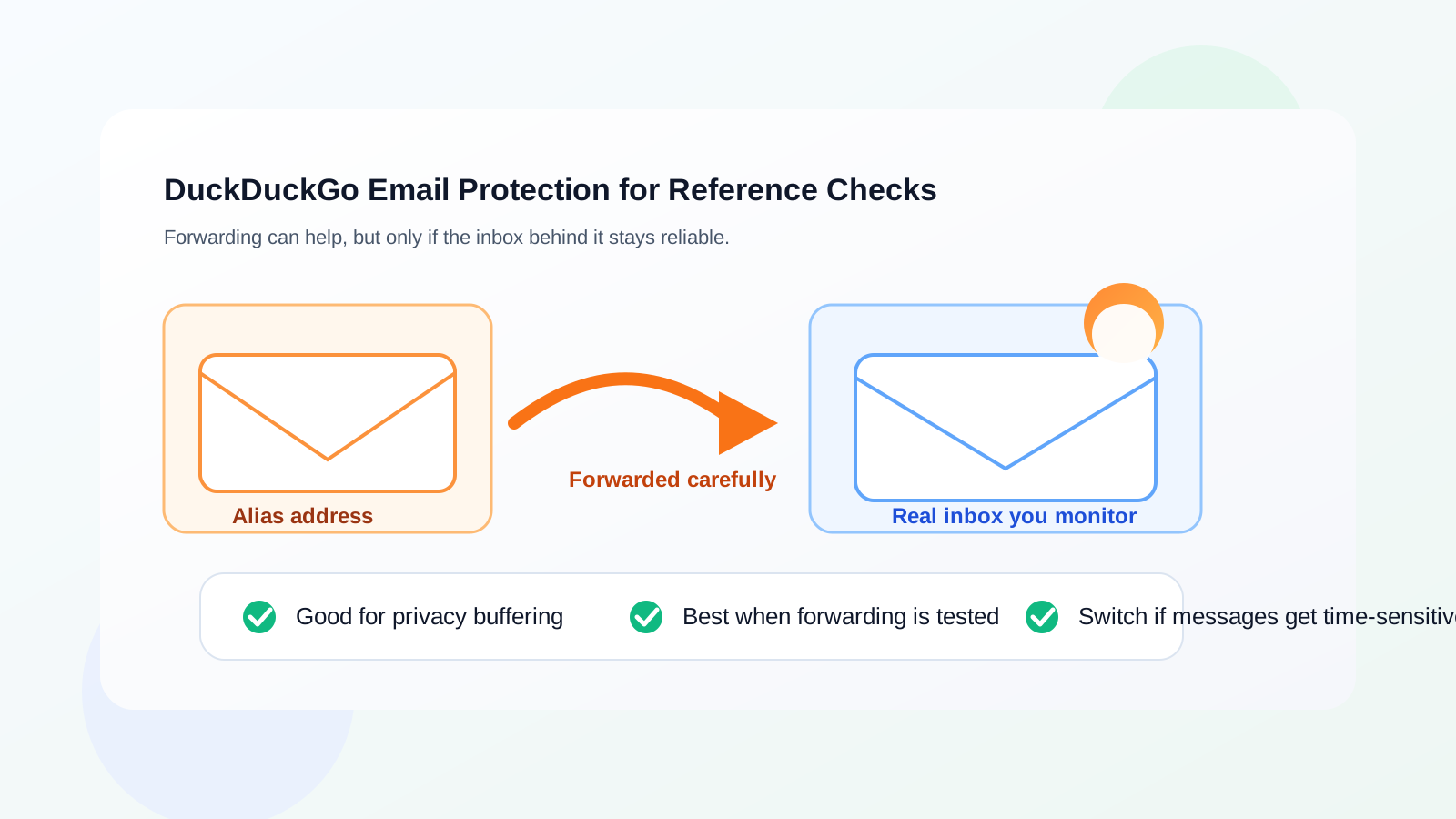
DuckDuckGo Email Protection is not the same as a traditional temporary inbox. It gives you a forwarding address that sits in front of your real mailbox. Messages sent to the alias are routed onward to the inbox you control.
That distinction matters for reference checks. A true disposable inbox can be useful when you only need a one-time verification message and do not expect an ongoing relationship. Reference checks are different. They often involve multiple messages over several days, plus attachments, portals, reminders, and occasional urgency. That makes a forwarding alias more practical than a disposable inbox, but only if the destination inbox is stable and closely monitored.
If you only need a low-trust intake point early in a job search, a temporary inbox like Anonibox can be useful. But once references are involved, continuity usually matters more than pure disposability. That is why DuckDuckGo Email Protection sits in the middle: more stable than a throwaway inbox, but still one extra layer between you and a critical hiring step.
Why reference checks are different from job applications
A lot of privacy advice that works for job applications becomes less reliable during reference checks.
- Timing is tighter: employers may want forms completed the same day.
- The messages matter more: one missed portal link can delay an offer.
- More parties may be involved: recruiter, hiring manager, third-party verifier, and sometimes your references.
- The process may include sensitive details: job titles, former employers, dates, contact names, and consent steps.
That means the right question is not just “Does an alias protect my privacy?” The right question is “Will this alias still let me handle a late-stage hiring workflow cleanly, quickly, and without confusion?” If the answer is yes, DuckDuckGo Email Protection can work. If the answer is maybe, a direct dedicated inbox is safer.
When it makes sense to use DuckDuckGo Email Protection for reference checks
1. You want a privacy buffer without using a disposable inbox
If you do not want every recruiter, staffing agency, or screening vendor to have your long-term personal address, a forwarding alias is a reasonable middle ground. You still receive the important emails in a real inbox you control, but you do not reveal that underlying address immediately.
2. You already have a clean destination inbox behind it
The best setup is simple: the DuckDuckGo alias forwards into an inbox you actually trust, check often, and plan to keep active through the hiring process. If the destination inbox is already overloaded, rarely checked, or shared across too many unrelated messages, the alias adds complexity without solving the real problem.
3. You want source-level separation
One underrated benefit of alias tools is message tracing. If you use a distinct alias for a specific employer, recruiter, or screening flow, it becomes easier to see where follow-up is coming from and when the traffic starts getting noisy. That can help you keep reference-related communication separate from broader job-search clutter.
4. You are still evaluating trust
Sometimes a reference-check request is legitimate, but you still do not know how carefully the vendor or recruiter handles communication. In that case, a forwarding alias can give you a bit of distance while still preserving continuity.
When DuckDuckGo Email Protection can be the wrong choice
Serious processes need the fewest moving parts possible
Once a real employer is actively checking references, fewer layers are usually better. Every extra dependency is another place where confusion can happen: forwarding delays, missed spam filtering, reply-thread oddities, or simply forgetting which alias you used for which employer.
Same-day action items can punish hesitation
If a recruiter says “Please complete this reference-check consent form by 5 PM,” that is not the moment to discover you were not watching the forwarding inbox closely enough. Reference checks do not always move slowly. In many companies, they happen fast because the employer is trying to finish a decision.
Some vendors and portals work best with a stable direct address
Many systems work fine with aliases, but not every workflow is equally forgiving. If you are dealing with repeated follow-up, resend links, login recovery, or document-heavy communication, the cleanest path is often one dedicated inbox used consistently from start to finish.
You may stay in “temporary mode” too long
This is the subtle risk. Alias tools are helpful, but they can keep you thinking like every contact is still low-stakes. Reference checks are not low-stakes. They are part of a near-offer workflow. If the process is real, it is worth acting like it is real.
Practical benefits if you decide to use it
- Less exposure for your main inbox: your underlying address is not handed out as widely.
- Cleaner job-search separation: reference-check messages are easier to isolate from personal email.
- Better source tracking: you can tell which employer or vendor used a given alias.
- Easier shutdown later: if a vendor becomes noisy after the process ends, the alias layer gives you more control.
Those are real advantages. They are just not more important than reliability. A privacy tool is only helping if it does not interfere with the hiring process you are trying to complete.
DuckDuckGo Email Protection vs a temporary inbox like Anonibox
This is where people often mix up two very different tools.
A temporary inbox is best when you want a quick, low-trust interaction: one verification email, one gated download, one lightweight signup, then you are done. That is why temporary inboxes are great for disposable signups, spam-heavy forms, and situations where you actively do not want a durable contact channel.
Reference checks usually need more than that. You may need to read instructions, confirm identity, respond to scheduling, monitor reminders, and keep the thread alive until the employer finishes reviewing everything.
DuckDuckGo Email Protection is better suited to that kind of continuity because the mail still lands in a real inbox you control. But if the process becomes clearly serious, a separate long-term job-search inbox is often even better than staying behind a forwarding alias forever.
DuckDuckGo Email Protection vs a dedicated reference-check or job-search inbox
If your only goal is privacy buffering, DuckDuckGo Email Protection can absolutely help. But if your goal is to run a smooth late-stage hiring workflow, a dedicated inbox usually wins on simplicity.
A dedicated inbox gives you:
- one address to use consistently across recruiter messages, forms, and vendor portals
- a full sent-mail history tied directly to the address you shared
- folders, labels, and rules built specifically for your job search
- less risk that you forget which alias belongs to which employer
- fewer forwarding dependencies when deadlines are tight
For many people, the most practical answer is a hybrid workflow. Use privacy tools to reduce exposure early. Then move important hiring stages onto a stable inbox you monitor aggressively.
Best practices if you want to use it safely
Monitor the real inbox behind the alias constantly
The alias is not the inbox. The real inbox is where success or failure happens. During active reference checks, check it often, keep notifications on, and do not assume everything can wait until later.
Save key details outside the email thread
Keep a simple note with the employer name, the recruiter, the alias used, any portal URLs, and deadlines. That way you are not relying on memory when messages start coming quickly.
Switch to a direct address if the workflow gets complicated
If the process expands into multiple reminders, document requests, or repeated vendor contact, do not be stubborn. It is fine to move the conversation to a dedicated address that you use only for your job search.
Do not confuse privacy with anonymity
Reference checks usually involve real identity details. The goal is not to look anonymous. The goal is to reduce unnecessary inbox exposure while remaining reachable, organized, and professional.
Check that replies behave the way you expect
Before trusting any forwarding setup for a time-sensitive process, test it. Make sure the messages arrive quickly, display cleanly, and are easy for you to reply to without confusion.
A quick decision checklist
- Is the employer or recruiter clearly legitimate?
- Is the process early enough that a privacy buffer still makes sense?
- Does the alias forward into an inbox you monitor daily?
- Would a direct dedicated inbox make this process simpler?
- Are there deadlines, portals, or documents that make missed messages costly?
If you answer yes to the forwarding and monitoring questions, DuckDuckGo Email Protection can work. If you hesitate on reliability, use a dedicated inbox instead.
Final answer
Yes, you can use DuckDuckGo Email Protection for reference checks, and it can be a smart privacy buffer when you want less exposure than giving out your primary long-term email everywhere.
But reference checks are late-stage, time-sensitive, and often more fragile than ordinary job applications. If the process is moving quickly, a stable dedicated inbox is usually the better choice. Use DuckDuckGo Email Protection when it improves control without adding confusion, and move to the simplest reliable contact method as soon as the opportunity becomes serious.