Yes, you can use a temp email for Quora if your goal is to protect your primary inbox while testing the platform, following a few topics, or reducing digest-email clutter.
It works best for low-stakes use, but if you expect to keep the account, publish answers, save posts, or rely on password recovery later, a separate long-term inbox is usually smarter than a throwaway address.
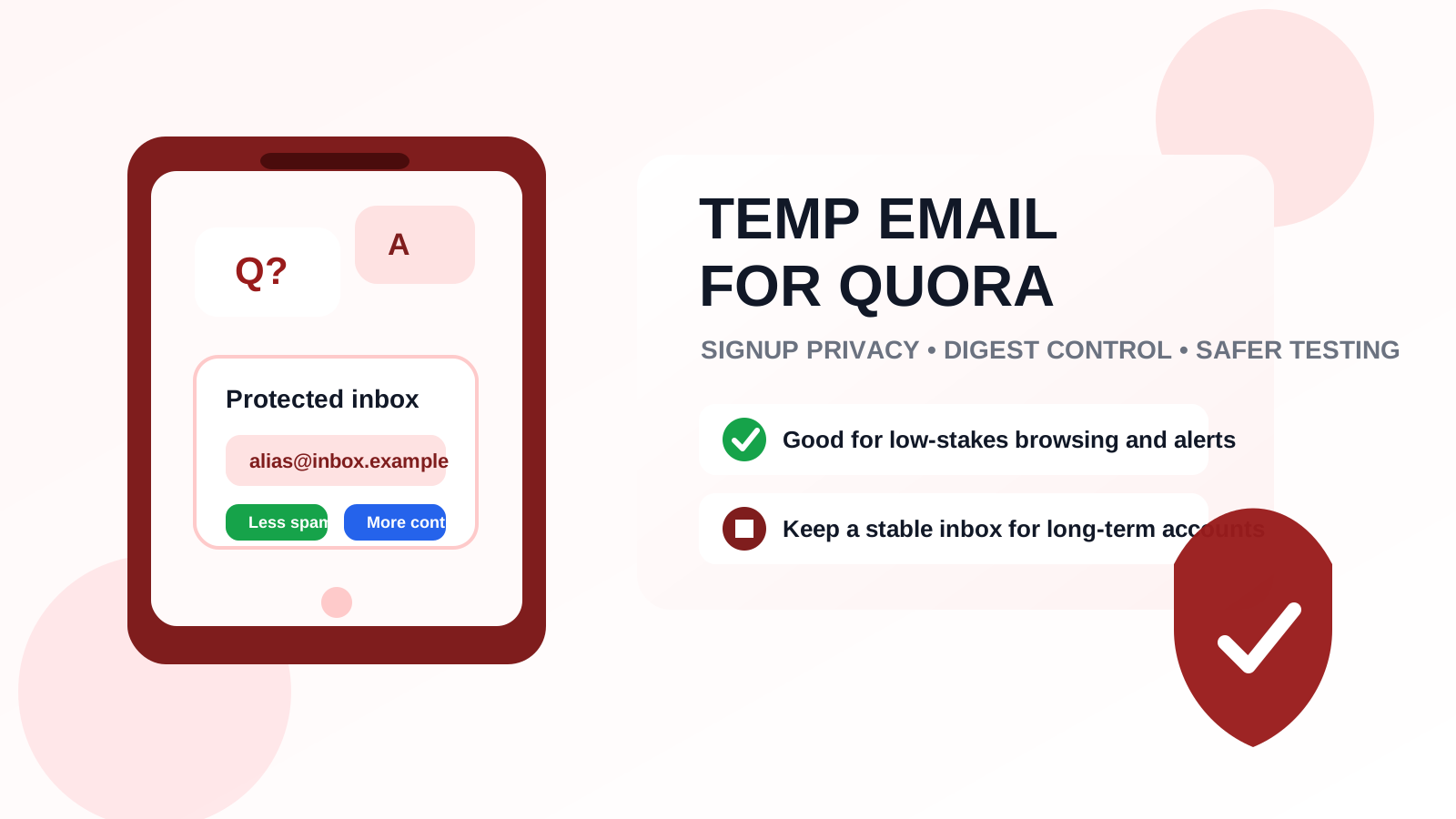
Quora can be useful, but it also has the kind of engagement loops that make people protective of their inboxes: account verification, question notifications, answer comments, topic digests, suggested content, follow-up emails, and periodic “come back and read this” nudges. That does not make the platform bad. It just means you should decide early whether Quora deserves access to your permanent personal email address.
A temp email can be a practical buffer. It lets you explore the platform without instantly plugging your main inbox into another stream of updates. But there is an important trade-off: the more seriously you use Quora, the more valuable reliable account access becomes. The right setup depends on whether you are casually browsing or building a profile you want to keep.
Why people consider a temp email for Quora
There are a few common reasons people reach for a disposable or temporary address before signing up.
- They want to test the platform first: maybe you just want to read a few gated answers, follow one topic, or see whether the experience is worth keeping.
- They do not want more email in their main inbox: recommendation and digest emails add up quickly across social and community platforms.
- They want a layer of privacy: using a separate address keeps one more service from being tied directly to the inbox they use for work, banking, family, and everything else.
- They are trying to control spam and clutter: even legitimate account emails become noise when too many platforms are sending them.
Those are all reasonable motivations. Many people do not need Quora tied to their primary address on day one, especially if they are only exploring.
When a temp email for Quora makes sense
1. You are only evaluating the platform
If you are not sure whether you will keep the account, a temp email can make sense. It gives you a way to sign up, verify access if needed, and look around without committing your permanent inbox immediately.
2. You want to separate low-priority accounts from your main email
Some accounts are useful but not important enough to live beside job offers, legal notices, school messages, or personal correspondence. If Quora falls into your “nice to have, not mission-critical” category, a temporary or at least non-primary address is a fair choice.
3. You mainly care about reading, not building a public profile
If your plan is occasional reading rather than a long-term identity on the platform, the risk of using a disposable address is lower. You are less likely to care about years of account continuity, old answer history, or a profile attached to your professional reputation.
4. You are deliberately reducing inbox exposure
Privacy-conscious users often avoid connecting every social, forum, and newsletter-style product to the same personal inbox. Quora fits that pattern. A temp email or masked address can be part of a broader “less surface area, less clutter” approach.
Where a temporary email can backfire
The problem is not signing up. The problem is what happens later if the account becomes useful.
You may lose account recovery access
If you use a truly throwaway address and later forget your password, want to confirm a login, or need to recover the account, you may be stuck. That matters more than many people expect because temporary addresses feel harmless right up until an account becomes valuable.
You may miss important notifications you actually wanted
Not every email from Quora is junk. Some messages may be genuinely useful: replies to your answers, comments on your posts, moderation notices, login alerts, or updates on topics you actively follow. If the inbox disappears or you stop checking it, you lose the ability to separate the useful from the annoying.
You may build a profile you did not expect to care about
People often join a platform casually and then end up using it more than planned. Maybe you start answering questions in your niche. Maybe you collect followers. Maybe a strong answer starts ranking in search. If that happens, the account stops being disposable even if the email address was.
You may create avoidable friction for yourself
The easiest privacy move is not always the most practical one. A temp inbox that works for one-time access can become a hassle when you want stable settings, consistent notifications, or reliable sign-in later.
Temp email vs separate long-term inbox: the better comparison
For Quora, the real choice is often not “main inbox or throwaway inbox.” A better comparison is:
- Main personal inbox for maximum convenience but more exposure
- Separate long-term inbox or alias for a balanced privacy setup
- True temp email for short-term testing only
If you think there is even a decent chance you will keep the account, a separate long-term inbox is usually the sweet spot. It protects your primary email without leaving you stranded later.
That is where a tool like Anonibox fits naturally. Instead of treating every sign-up as all-or-nothing, you can create a cleaner boundary: Quora gets its own address, your primary inbox stays less exposed, and you still keep reliable control if the account becomes worth maintaining.
What kind of Quora use should not rely on a throwaway address?
A true throwaway email is usually a bad fit if any of these apply:
- You want to publish answers under a profile you may build over time
- You plan to save posts, follow experts, or maintain a topic library
- You care about keeping access to drafts, comments, or answer history
- You expect to use the account across devices for months or years
- You would be annoyed if password recovery became impossible later
In short: if the account has any real continuity value, treat the email address as part of that continuity.
Best practices if you still want to use a temp email for Quora
Use it for testing, not for a serious identity
Think of a temp email as a trial-layer tool. It is best when you are still deciding whether the platform belongs in your routine at all.
Save the login details somewhere safe
If you are going to test Quora with a temporary address, do not make the mistake of also being careless with the password. A temporary inbox plus a forgotten password is an easy way to lock yourself out.
Watch the first few messages before abandoning the inbox
See what kind of email volume you actually get. Sometimes a platform sends fewer messages than expected once you adjust settings. Sometimes it sends more. That first wave tells you whether the account should move to a stable secondary inbox instead.
Adjust notification settings early
One of the easiest ways to reduce clutter is not just changing your sign-up email, but reducing unnecessary email at the platform level. If you decide to keep Quora, review digests, topic recommendations, and promotional notifications before the inbox becomes noisy.
Upgrade to a stable separate inbox if the account becomes useful
You do not have to decide everything forever at signup. Start cautiously if you want. But if Quora becomes a platform you return to, move it to an address you can actually keep.
When your primary inbox is probably fine
Sometimes the simplest answer is also the right one. If you already manage your inbox well, use filters comfortably, and are not especially worried about account separation, your primary email may be perfectly acceptable for Quora.
This is especially true if you actively want to stay on top of replies, comments, and recommendations and you know you will keep the account long term. Convenience matters too. Not every service needs a complicated privacy workflow.
A practical setup that works for most people
If you want a sensible middle ground, use a separate persistent inbox or alias for Quora rather than a fully disposable one. That gives you the main benefit most people actually want—less exposure for the primary inbox—without the long-term downside of losing access to the account.
A good rule is simple:
- Just testing Quora? A temp email can be fine.
- Keeping the account but do not want your main inbox tied to it? Use a separate stable address.
- Building a serious profile or posting regularly? Use an inbox you fully control and plan to keep.
Quick checklist before you choose
- Am I only browsing, or do I expect to keep this account?
- Would I care if I lost password recovery later?
- Do I want fewer emails, or do I want a long-term account with cleaner separation?
- Would a stable alias or secondary inbox solve the problem better than a throwaway address?
- Have I checked Quora’s notification settings so I am not solving a settings problem with an access problem?
Bottom line
A temp email for Quora can be a smart short-term move if you are mainly trying to protect your primary inbox while exploring the platform.
But if you expect to answer questions, build a profile, follow discussions, or keep the account for the long haul, a separate long-term inbox is usually the better privacy play. It gives you cleaner boundaries without sacrificing recovery, continuity, or control.
That is the useful distinction: temporary for testing, stable and separate for keeping. If you match the email setup to how seriously you plan to use Quora, you get the privacy benefit without creating a mess for future-you.