Yes, a temp email for Refiner can make sense when you only want to test signup, preview in-app surveys, or compare feedback tools without giving another trial your main inbox.
No, it is not a good long-term choice once live survey programs, workspace ownership, team access, or account recovery depend on that address still being available.
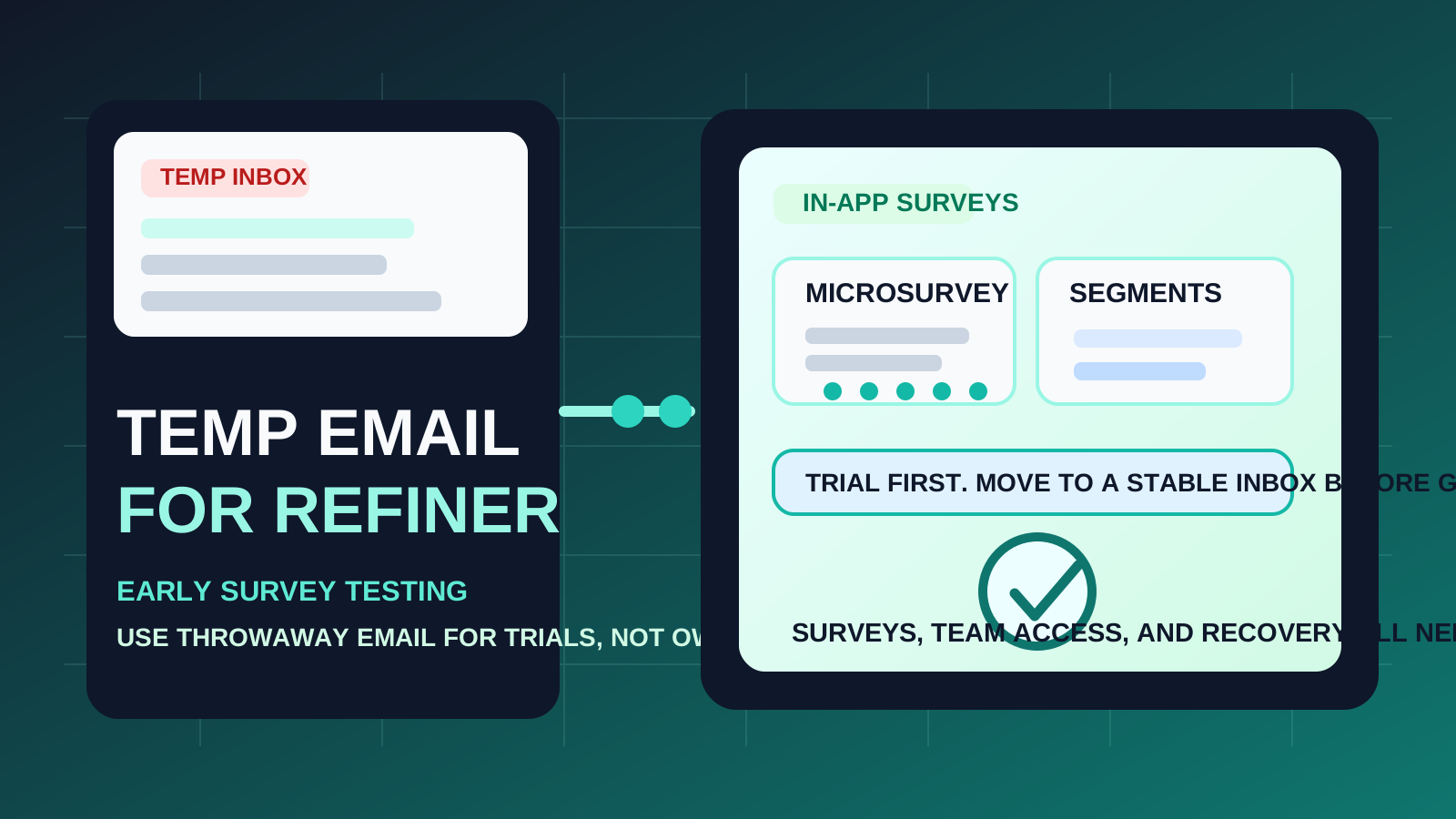
If you evaluate customer-feedback software regularly, you already know how quickly the email clutter starts. One trial becomes a verification message, then a welcome sequence, then product tips, webinar invites, case studies, feature launches, and sales follow-up that keeps arriving long after you decided the tool was not right for your stack. Using a temporary inbox can be a practical way to keep that noise out of the address you actually rely on every day.
That is especially relevant for Refiner. Teams usually look at Refiner while exploring in-app surveys, microsurveys, onboarding questions, NPS collection, user segmentation, and product-feedback workflows. In the early stage, you may only want to see how fast you can get inside the dashboard, whether the setup feels clean, and whether the product looks better for your use case than alternatives like AskNicely, SatisMeter, or Qualaroo. For that kind of first-pass evaluation, a throwaway inbox can be perfectly reasonable.
The problem starts when a short test turns into a real workspace. The more your account matters, the less clever disposable email becomes. A temporary inbox may help you get through signup, but it is a weak foundation for ongoing notifications, ownership, and recovery later.
Why people look for a temp email for Refiner
Most people are not trying to be sneaky. They simply want to reduce inbox risk while evaluating another software tool. A temp email is attractive here because it lets you:
- Verify the account quickly without tying another product trial to your everyday inbox.
- Compare several survey tools side by side while keeping each signup isolated.
- Avoid long promotional follow-up if the platform never makes it past the trial stage.
- Keep exploratory testing separate from the permanent email your product, support, or success team already depends on.
That is a sensible goal. It is the same reason people use Anonibox or another temporary inbox service during low-stakes software evaluation. The trick is knowing where the trial phase ends and where real operational dependency begins.
When a temp email for Refiner makes sense
1. You are only testing the signup and first-run experience
If your goal is to confirm that the account works, inspect the dashboard, and understand the basic workflow, a disposable inbox is fine. You are not committing to anything yet. You are simply lowering friction while you decide whether the tool deserves more attention.
2. You are comparing multiple feedback tools at once
Product, growth, and CX teams often evaluate several tools in one short window. You may want to compare survey builders, targeting rules, event triggers, dashboards, or notification options. Temporary inboxes help keep those trials organized instead of letting every vendor dump follow-up email into the same long-term account.
3. You want to protect your main work inbox from trial noise
Not every tool you explore becomes part of your stack. A temporary inbox lets you receive the verification email and onboarding prompts you need without turning your permanent mailbox into a graveyard of abandoned trials.
Where disposable email becomes risky fast
Live user feedback is not a throwaway workflow
Once your surveys are tied to real user experiences, the account matters more than it did during day-one testing. If the platform starts handling active feedback collection, response alerts, or stakeholder review, the email behind the account needs to be durable.
Workspace ownership can become messy
A lot of teams begin with “just a quick test” and accidentally create something valuable. Maybe the survey logic looks promising. Maybe someone adds targeting rules. Maybe the team starts discussing rollout. If that early workspace is attached to an inbox you do not control long term, ownership gets awkward later.
Team access and invites raise the stakes
As soon as another person is involved, your account stops being a private experiment. Invitation emails, access changes, password resets, and workspace administration are easier to manage when the account belongs to a monitored inbox that will still exist next month.
Account recovery is the obvious weakness
The biggest problem with disposable email often appears later, not during signup. You may not care today. Then a password reset, login challenge, security confirmation, or ownership question arrives weeks later and the original inbox is gone. What looked convenient at the start becomes a lockout risk.
A practical rule of thumb
Use a temp email for Refiner if you are evaluating the product. Do not keep using one if the account is becoming part of your real survey or product-feedback workflow.
That line is simple, but it prevents most of the avoidable pain. Disposable email is great for filtering, comparing, and reducing clutter. Stable email is better for control, continuity, and shared ownership. Problems happen when people want the benefits of both at the same time.
How to evaluate Refiner without creating a future headache
Start with a clear goal
Before signup, decide whether this is a short evaluation or the beginning of a real setup. If you only want to review the interface, inspect survey options, and compare capabilities, a temporary inbox is reasonable. If you already suspect the tool could become part of production, starting with a durable email is cleaner.
Save the messages that matter
Even during a short trial, a few emails are worth keeping:
- the verification email
- the welcome or onboarding message
- any setup links you may want to revisit
- details about workspace creation or next-step configuration
Do not assume you will remember everything or still have access later. Capture the useful information while the inbox is live.
Test the real questions quickly
Rather than drifting through the dashboard, use the trial to answer practical questions:
- Does the survey builder feel fast or fiddly?
- Can you understand how targeting and segmentation work?
- Does the reporting surface the signal you actually care about?
- Do the response workflows feel usable for your team?
- Is the product clearly better for your situation than the alternatives you are considering?
This is where temporary email helps most. It gives you a clean way to enter, evaluate, and leave if the tool is not a fit.
Switch early if the account starts becoming real
The safest time to move to a permanent inbox is before anything important depends on the workspace. Do it before live survey collection, before teammate invites become routine, and before the account turns into a source of production data you would hate to lose.
Examples of good and bad use
Good use: one-person product evaluation
A product manager wants to compare a few in-app survey tools in one afternoon. They only need to verify access, look at the setup flow, and judge whether Refiner belongs on the shortlist. That is a clean case for a temporary inbox.
Good use: quick exploratory test for an onboarding survey
You want to see how fast you can create a basic onboarding question and whether the workflow feels lightweight enough for your product team. Again, a disposable inbox is acceptable because nothing important depends on the account yet.
Bad use: keeping a real workspace on a throwaway inbox
The trial goes well, someone adds surveys, another teammate joins, and the workspace starts accumulating real settings and internal decisions. At that point, continuing to rely on the throwaway inbox is just building technical debt into your account access.
Bad use: tying notifications or ownership to an inbox you cannot recover
If survey responses, internal alerts, or billing-related messages might matter later, the email behind the account should be something your team actually monitors and controls. Convenience at signup is not worth future access confusion.
What to avoid
- Treating a temporary test like a permanent account: if the workspace matters, the inbox should too.
- Waiting too long to switch: the longer you delay, the more painful it becomes.
- Forgetting that recovery matters more than signup: the real risk often shows up later.
- Inviting teammates before fixing the inbox situation: shared work amplifies ownership problems.
- Confusing inbox hygiene with account strategy: keeping your mailbox clean is useful, but it should not override long-term control.
A safer long-term setup
If Refiner proves useful, move to an email address that matches the level of importance the workspace now has. For some teams, that means a shared functional inbox. For others, it means a dedicated work account with clear ownership and monitoring. The exact setup matters less than the principle: the account should live behind an email address your organization can still access when something important happens.
That way, you keep the upside of temporary email during evaluation while avoiding the predictable downside once the account becomes operational.
Final takeaway
A temp email for Refiner is helpful when you want to test signup, preview in-app surveys, and compare tools without filling your main inbox with another trial.
It is the wrong long-term choice once the account starts handling real feedback workflows, team access, notifications, or recovery. Use temporary email during the evaluation stage, then switch to a stable inbox before the workspace becomes something your team actually depends on.