Yes, a temp email for Tally can be useful if you only want to test the form builder, preview the signup flow, or keep one more software trial out of your main inbox.
No, it is not a smart long-term setup once real client intake, submission alerts, payment-related forms, or business-critical notifications depend on that address.
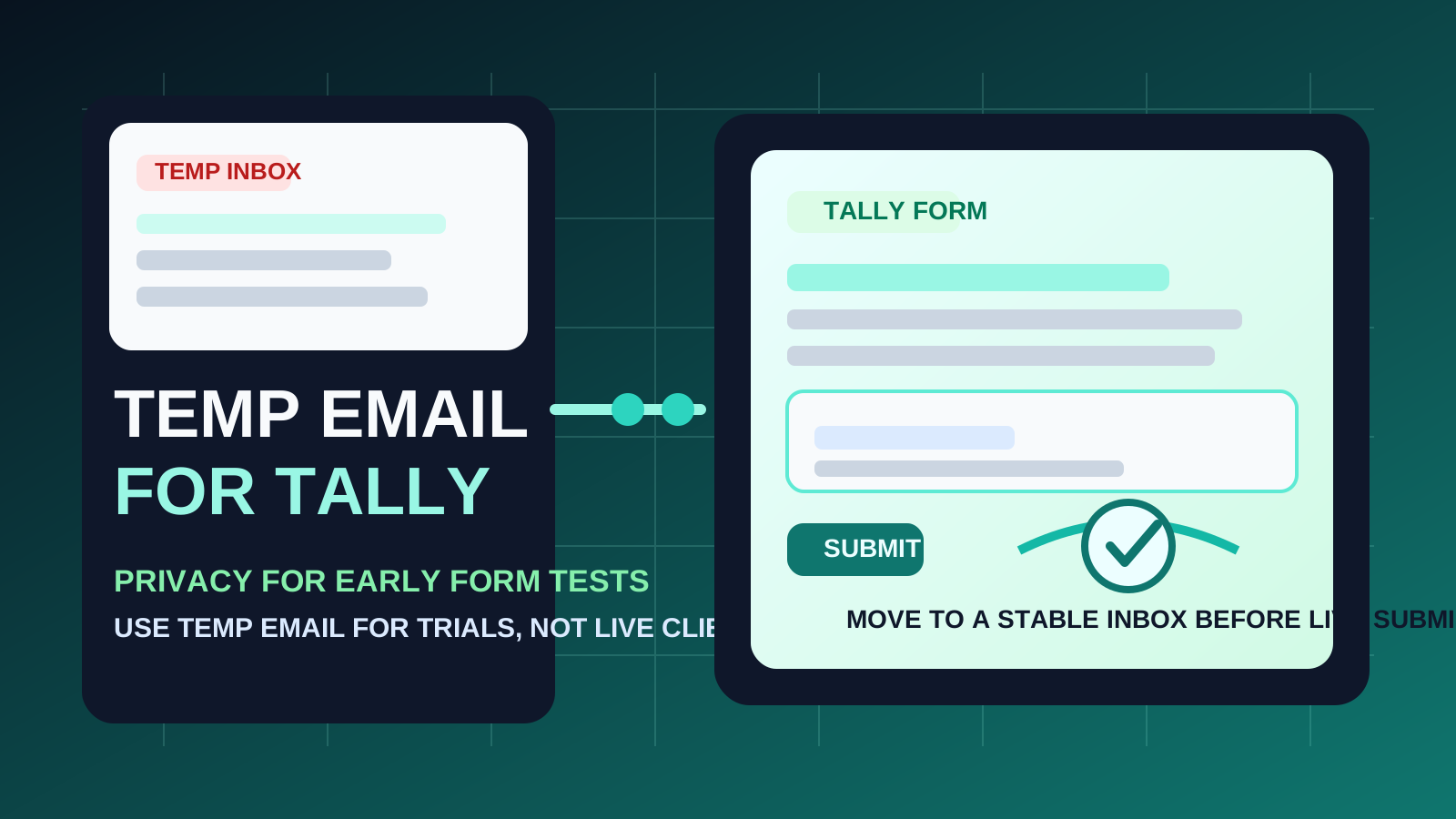
That is the practical answer, and for most people it is the one that matters. Tally is easy to treat like a lightweight experiment because the signup is simple and the product feels approachable. But forms have a habit of starting small and becoming real infrastructure very quickly. A quick mockup can turn into lead capture, client intake, registrations, approvals, file collection, or payment-adjacent workflow before you realize the inbox behind the account now matters.
If you are using a service like Anonibox to keep vendor trials, form-builder experiments, and one-off tests away from your everyday inbox, Tally is a reasonable candidate for that early-stage privacy strategy. The trick is knowing when the disposable address is still helping and when it has quietly become the weakest link in the workflow.
Why people consider a temp email for Tally in the first place
Most people do not sign up for Tally because they want another long-term inbox relationship. They sign up because they want to move fast. Maybe they want to compare form builders, test a template, build a waitlist, check the editor, or see whether Tally feels simpler than tools like Fillout, Paperform, or Formstack. That is a normal and reasonable reason to protect your main inbox.
Software evaluation usually creates more email than you expected. A single signup can trigger welcome emails, onboarding tips, feature announcements, webinar invites, upgrade prompts, product education sequences, and sales follow-ups. Even when the product is good, that noise can last longer than the trial itself. A temporary inbox lets you verify the account, collect the first messages you actually need, and keep the rest of the follow-up separate from your daily work.
That setup is especially appealing when you are only in research mode. If you are exploring whether Tally fits a future workflow, not launching anything real yet, disposable email can make the evaluation cleaner and less annoying.
When a temp email for Tally makes sense
There are several situations where using a temporary inbox is practical rather than reckless.
1. You are comparing form builders
If you are testing Tally against other tools and only want to judge the product experience, a temp inbox is fine. You can verify the account, see how the editor feels, review the first onboarding emails, and avoid turning your primary inbox into a long-term archive of product tours you may never revisit.
2. You want to test the editor and template workflow
Sometimes you are not choosing a tool yet. You just want to learn how quickly you can publish something simple, what the interface feels like, and whether the platform matches your style of working. A temporary inbox is well-suited to that short evaluation window.
3. You are running a low-stakes internal experiment
Maybe you want to sketch a sample request form, test an internal questionnaire, or mock up an intake flow before deciding whether the project deserves a permanent home. In that kind of sandboxed use, the email address is mostly there to get you through account creation and the first round of notifications.
4. You want cleaner inbox boundaries
If you are already dealing with recruiter emails, newsletters, demo requests, and other software trials, protecting your main inbox is not overthinking. It is basic organization. Keeping Tally test traffic in a separate inbox helps you see the product more clearly without adding more long-tail clutter to the email account you use every day.
Where a temporary inbox starts becoming a bad idea
The problem is not Tally itself. The problem is that forms often become real business workflow faster than people expect. Once that happens, a disposable inbox stops being a useful privacy filter and starts becoming operational debt.
Real client intake or lead capture
If the form is collecting actual inquiries, project requests, applications, registrations, or customer information, the inbox behind the account matters. Missing an alert because the account is tied to an inbox you no longer monitor is not a privacy win. It is just a lost message.
Submission alerts and business notifications
A lot of the important communication does not happen at signup. It happens later: confirmation messages, account notices, notifications about changes, and alerts related to live submissions. Temporary email works best for the first step of access. It is much weaker for anything you need to keep watching over time.
Payment-related or high-trust forms
If the form is anywhere near payments, invoices, consultations, bookings, or sensitive client intake, the account should be tied to an address you control long term. You do not want a critical form setup living behind an inbox you created for convenience during a trial week.
Automations and downstream workflow
The more your form connects to other systems, the less disposable the account should be. The problem is not only missing a message. It is losing track of the ownership, recovery path, and notifications attached to a workflow other people may depend on later.
Shared ownership
If a teammate may need access, the account should be managed through a durable inbox from the start or at least before launch. Temporary email is great for solo testing. It is a poor foundation for shared responsibility.
A better way to use Tally with a temp inbox
The strongest approach is not “never use a temp email” and it is not “keep the temp email forever.” It is phased use.
- Use the temporary inbox for first-pass evaluation. Sign up, verify the account, explore the editor, and review the early onboarding sequence.
- Decide whether this is still an experiment. If you are only researching, you are done. If the form is becoming real, stop treating the account like a throwaway test.
- Switch to a stable inbox before launch. Make the change before the form is published for real users, before alerts start mattering, and before any payment or customer-facing flow depends on that account.
- Document account ownership. If Tally becomes part of a recurring business process, the responsible inbox should be obvious and durable.
This gives you the privacy and inbox-control benefit at the beginning without building fragility into the final workflow.
How Anonibox fits into that workflow naturally
Anonibox makes sense during the phase where you want separation, not permanence. If you are testing Tally, comparing vendors, or looking at templates without deciding what will stick, a temporary inbox can keep that evaluation out of your long-term personal or work email. That is useful.
What Anonibox should not become is the hidden owner of a live form operation. Once the form is receiving real traffic, collecting real responses, or tying into a business process you care about, the temporary inbox has already done its job. At that point, moving to a stable email is not abandoning privacy. It is finishing the setup responsibly.
Practical signs it is time to stop using the temp email
- You have embedded the form on a real website.
- You are collecting actual client, customer, applicant, student, or event registration information.
- You care about every submission alert arriving reliably.
- You are using the form in a payment-adjacent, booking, or consultation workflow.
- You may need account recovery later.
- Someone besides you may need to manage the account.
- You would be genuinely frustrated if access to the inbox disappeared next week.
If two or three of those are already true, the disposable-email phase is probably over.
Common mistakes to avoid
Treating a real workflow like a temporary test
This is the most common problem. People start with a disposable inbox because the project is small, then forget to switch when the form becomes important.
Saving nothing from the early setup
If the account emails contain setup notes, links, or details you may want later, save them while you still have clean access. Convenience is the point of temp email, but that same convenience can turn into forgetfulness fast.
Letting notifications become critical before switching
The dangerous moment is not signup. It is when real users start submitting things and you still have the account tied to an inbox you no longer check regularly.
Using the same disposable inbox for every tool
That defeats a lot of the organizational benefit. If you are evaluating multiple tools, segmented test inboxes are easier to reason about than one chaotic catch-all.
Quick decision checklist
Before using a temp email for Tally, ask yourself:
- Am I only testing the product, or am I already building something real?
- Would I care if I lost access to this inbox next week?
- Will real people depend on this form?
- Will submission alerts, account notices, or recovery messages matter later?
- Is this account likely to become shared or business-critical?
If the answers point toward short-term testing, comparison, and exploration, a temp inbox is reasonable. If they point toward live intake, reliable notifications, and durable ownership, switch to a permanent address before the form goes any further.
Final verdict
A temp email for Tally is useful when you are doing early form-builder testing, checking the onboarding flow, or keeping another software trial out of your main inbox.
It is a bad long-term setup once real submissions, client intake, payment-related workflow, and important notifications depend on that account. Use temporary email during the evaluation phase, then move to a stable inbox before the form becomes something people actually rely on.